


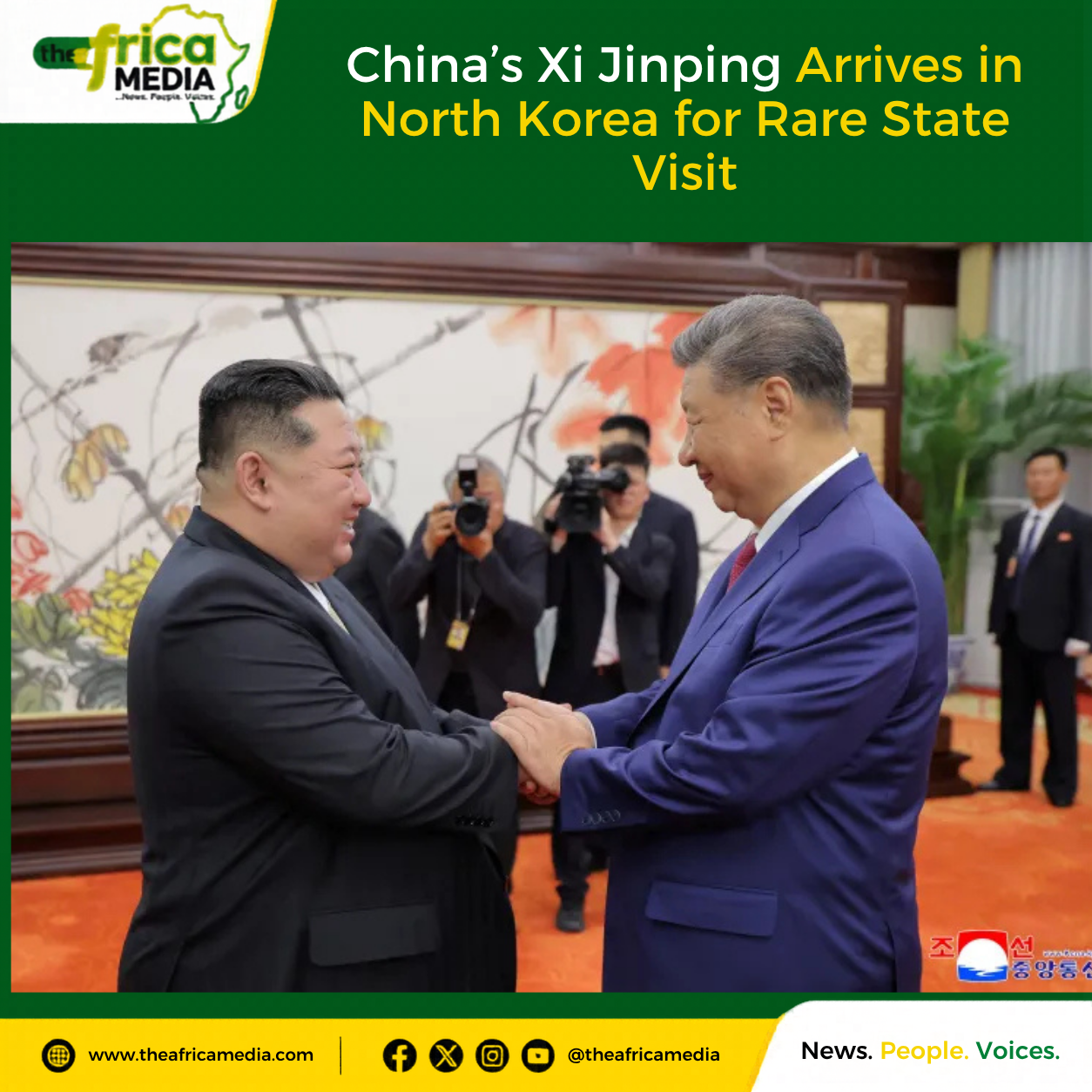
Chinese President Xi Jinping has arrived in North Korea for a rare state visit, marking his first trip to the country in seven years as Beijing and Pyongyang seek to reinforce diplomatic ties amid shifting global alliances.
Xi and his wife, Peng Liyuan, were received at Pyongyang International Airport by North Korean leader Kim Jong Un and his wife, Ri Sol Ju, according to Chinese state media. The arrival ceremony featured a 21-gun salute, military band performances, and large crowds gathered in festive displays of support.
Ceremonial welcome in Pyongyang
A large public reception was held in Pyongyang’s central square, where citizens, including children, waved flags, carried flowers, and held balloons. Government buildings were decorated with both Chinese and North Korean national flags as part of the state-organised celebration.
The visit, which will last two days, is expected to include a high-level summit between Xi Jinping and Kim Jong Un focused on strengthening bilateral relations.
Strengthening strategic ties
Ahead of the trip, Xi described China–North Korea relations as being at a “new historical starting point,” emphasizing that maintaining and developing ties between the two countries remains a long-standing policy of the Chinese Communist Party.
China has historically been North Korea’s closest economic and diplomatic partner, with Pyongyang previously relying on Beijing for the majority of its foreign trade.
However, analysts say regional dynamics have shifted in recent years, particularly following Russia’s invasion of Ukraine, which has deepened cooperation between Pyongyang and Moscow.
Geopolitical implications
Experts suggest China’s renewed engagement with North Korea may be aimed at maintaining its influence in the region as North Korea strengthens ties with Russia.
Beijing is also expected to use the visit to reinforce its leadership role in Northeast Asia amid growing strategic competition with the United States.
Analysts say potential discussions between Xi and Kim may include economic support measures such as food aid, agricultural inputs, tourism cooperation, and joint development projects.
Regional context
The visit highlights the evolving balance of power among China, North Korea, Russia, and the United States, with each seeking greater influence in a region marked by military and economic tensions.
Observers say the outcome of the talks could shape future cooperation between Beijing and Pyongyang, particularly in areas of trade, security, and diplomatic alignment.


