


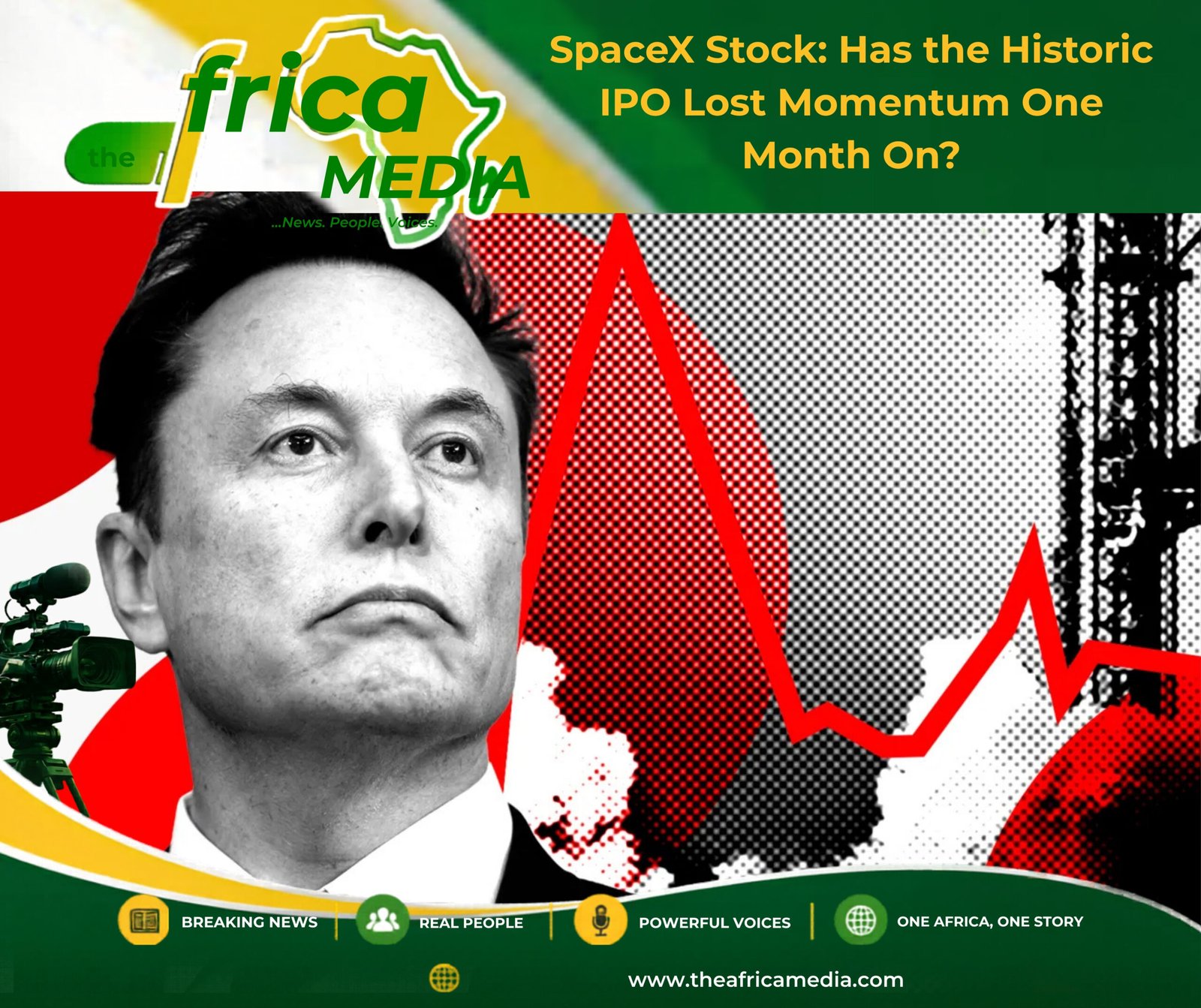
SpaceX stock has swung from celebration to concern in the company’s first month as a publicly traded firm.
When shares in the company, co-founded and led by Elon Musk, first became available to individual investors on 12 June, an investor frenzy followed. SpaceX had priced its shares at $135 each. The price shot up to $150 on the first day. It climbed as high as $176 and closed at $160.95. That performance made the offering the largest initial public offering (IPO) in history.
SpaceX Stock Soared, Then Started to Slide
The following week, shares climbed even higher. They hit an intraday high of $225. That level pushed SpaceX’s market value past both Amazon and Microsoft.
“With Elon Musk, any company he touches gets people excited,” said Keith Snyder, an analyst at investment research firm CFRA. He added that many investors saw the listing as their first chance to buy into a company marketed as an AI play.
Willy Lee, an investor at Neosteller, a platform that helps individuals invest in private companies, echoed that view. He said the excitement around the IPO centred heavily on artificial intelligence. SpaceX acquired Musk’s AI start up xAI earlier this year and rebranded it as SpaceXAI. The company has also begun leasing data centre capacity to other tech companies.
But rockets and Starlink satellites remain SpaceX’s core business. Starlink announced price cuts in the Memphis, Tennessee area amid local concerns over a major data centre project. SpaceX shares dropped 8 percent in a single day as a result.
Reality of the Business Starts to Bite SpaceX Stock
Investors have gained a clearer picture of how SpaceX actually generates revenue. As they have, its shares have continued to sink. Even amid a rocky stretch for tech stocks broadly, SpaceX has been hit especially hard. It joined the Nasdaq 100 index on 7 July. The index closed down 1.7 percent that day, but SpaceX shares fell 4.4 percent. An earlier addition to the FTSE Russell index had briefly lifted the stock.
By the end of its first trading month, SpaceX shares were trading around $145. That’s roughly 18 percent below their first day high and 35 percent below their peak. SpaceX did not respond to a request for comment.
Investors “Definitely Underwater”
That decline means retail investors who bought SpaceX stock during its first five days of trading are likely sitting on losses. “If you bought around the first tick you’re definitely underwater,” Snyder said. He compared the stock’s early trajectory to meme stocks like GameStop and Wendy’s, where online enthusiasm rather than fundamentals drove prices up.
Snyder expects the stock to fall further, to around $115 a share, based on the company’s underlying business performance. That level would value SpaceX at roughly $1.5 trillion.
Samuel Kerr, who leads equity capital markets analysis at Mergermarket, said the swings have affected investors differently depending on when they bought in. Those who invested at the IPO price or held pre-IPO equity are largely fine, he said. Those who bought in the first few days are “not very happy right now.”
Musk Remains Bullish, Uses Stock as Currency
Despite the volatility, Musk has shown little but optimism. The listing made him the world’s first trillionaire. Afterward, he projected SpaceX would generate $1 trillion in annual revenue by 2030.
Musk has also used SpaceX’s volatile shares strategically. The stock spiked on 16 June. That same day, SpaceX announced an all-stock acquisition of Cursor, an AI coding start-up, valued at $60 billion. The timing effectively let Musk acquire the company for free, given the stock’s inflated value at that moment. Kerr described the move as showing a level of market sophistication rarely seen among issuers. SpaceX shares have drifted downward since.
Attention Turns to First Earnings Report
Morgan Stanley, a lead banker on the SpaceX IPO, appears to view the dip as temporary. The bank initiated coverage last week with a $300 price target. That’s a 33 percent jump from the stock’s highest trading price to date.
SpaceX currently operates at a loss. It reported $18 billion in revenue last year, according to financial disclosures filed ahead of its public listing. That figure is roughly 55 times smaller than Musk’s projected $1 trillion target.
Anticipation is building around SpaceX’s first public earnings report, expected in early August, though a date has not been confirmed. The report will likely coincide with the end of a “lock up” period, when employees holding shares as part of their compensation become free to sell them on the open market. That could trigger further price swings.
“If SpaceX can do all the things it says it will do, yes, investors are sitting on the most valuable company ever,” Kerr said. “But it’s got a lot of work to do to get there.”


