


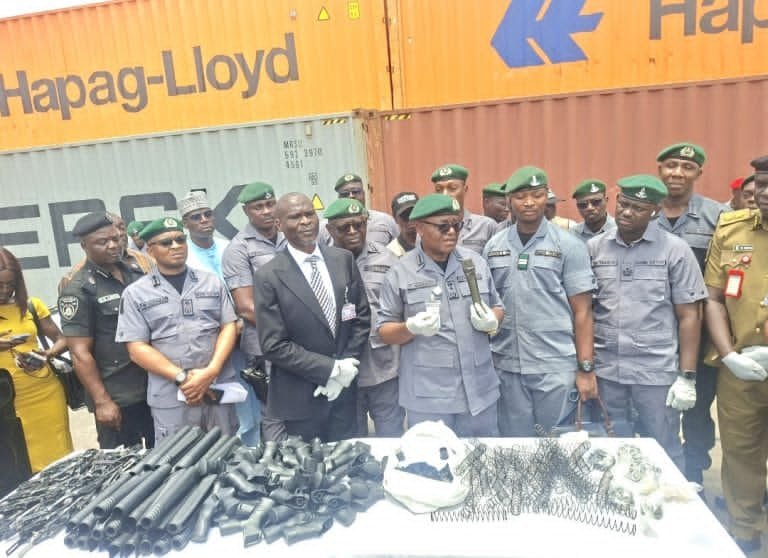
The Nigeria Customs Service (NCS), Tin Can Island Port Command, has intercepted another consignment containing 204 pump-action rifles smuggled from Turkey into Nigeria, bringing the number of firearms seized by the service to 603 in less than two weeks.
The latest seizure was announced on Monday by the Comptroller-General of Customs, Bashir Adewale Adeniyi, who was represented by the Deputy Comptroller-General, Enforcement, Investigation and Inspection, Timi Bomodi.
The development followed an earlier interception announced on August 18, 2026, involving knocked-down firearm components that were subsequently assembled into 399 pump-action rifles and handed over to the National Centre for the Control of Small Arms and Light Weapons.
Bomodi said the latest seizure demonstrated the effectiveness of the service’s intelligence-led operations and sustained surveillance at the nation’s ports.
According to him, credible intelligence prompted officers to flag a 20-foot container, numbered TEMU 184536/9, which arrived from Turkey aboard the vessel MV Algeciras Express on August 16.
The container was subjected to a 100 per cent physical examination on August 18, during which officers discovered concealed firearm components hidden among declared household and other goods, including furniture, refrigerators, solar panels and detergent.
Investigators also discovered discrepancies in the consignment documents, particularly concerning the identity of the consignee.
Bomodi said the Customs Service subsequently constituted a joint team comprising personnel from its Armament Unit and the National Centre for the Control of Small Arms and Light Weapons, under the Office of the National Security Adviser, to assemble the recovered components.
The exercise resulted in the recovery of 204 MAS 49 Alter Magnum pump-action rifles, alongside various leftover firearm components.
The recovered parts included 39 trigger pins, 58 locking lugs, 53 charging handles, 55 pistol-grip screws, 56 springs, 56 trigger groups, 38 forward grips or hand guards, 67 forward-grip latches, 56 pistol grips, 54 barrels and two U-plates.
Bomodi described the seizure as further evidence of the Customs Service’s commitment to preventing the illicit movement of firearms through Nigeria’s ports and borders.
He said the recovered arms had been secured and documented for formal handover to the National Centre for the Control of Small Arms and Light Weapons for appropriate statutory action.
The deputy comptroller-general also emphasised the importance of intelligence sharing and cooperation between the Customs Service, the Office of the National Security Adviser and other security agencies in tackling arms trafficking and other threats to national security.
He warned smugglers, arms traffickers and their collaborators that the service was strengthening its ability to detect attempts to conceal prohibited items in containers and consignments.
According to Bomodi, the Customs Service’s risk-management system combines intelligence gathering, profiling and technological tools with inter-agency collaboration to identify suspicious shipments.
He stressed that the agency’s objective went beyond merely intercepting prohibited items to identifying the networks responsible for moving firearms from their source to their intended destinations and beneficiaries.
“Our objective is to expose the entire chain involved in the illicit movement of firearms from the source and shipment to the intended destination and beneficiaries,” he said.
Bomodi subsequently handed over the seized arms to the South-West Zonal Director of the National Centre for the Control of Small Arms and Light Weapons, CP Abiodun Alamutu (retd.).
Also speaking, the Customs Area Controller of Tin Can Island Port Command, Comptroller Joe Anani, said the repeated seizures demonstrated that the port would not become a weak link in the enforcement of import prohibitions.
Anani warned those attempting to use the port to smuggle prohibited and dangerous items into the country that they would face strong resistance from the Customs Service.
“Those who see our port as an easy route to bring prohibited and dangerous items to Nigeria should understand that we will not find a winning partner in Nigerian Customs Service,” he said.


