


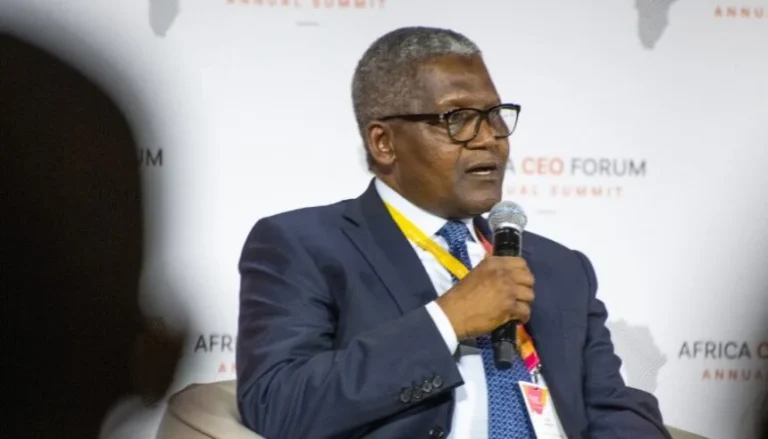
Africa’s richest man, Aliko Dangote, has announced plans to invest more than $10 billion in the power sector over the next few years as part of efforts to address the continent’s electricity deficit and support industrial growth.
Dangote disclosed this in an interview with Al Jazeera, where he identified unreliable electricity supply and inconsistent government policies as major challenges to investment and industrial development in Africa.
He said his conglomerate was considering redirecting funds from some planned ventures, including steel, into electricity generation and other power-related projects.
“In the next three to four years, there will be a major transformation in Africa, and that’s why we’re looking at power. We are going to invest in power,” Dangote said.
“We want to invest over $10bn alone in power.”
The industrialist expressed concern that more than 600 million Africans still lacked access to electricity, describing the situation as a major obstacle to economic development.
“We Africans should not really allow over 600 million of our people to remain in darkness,” he said.
Dangote described reliable electricity as a critical foundation for economic growth, industrialisation and job creation, arguing that Africa would struggle to achieve sustainable development without adequate power supply.
“Power is key; we will never create growth without power. That’s why they say power is growth. When I say power, I mean electricity is growth,” he said.
He also called for greater investment in local manufacturing and processing to reduce Africa’s dependence on imported goods.
According to him, the continent could eventually face difficulties financing its growing import bill unless it expands its productive capacity.
“One day we will not have money to import what we are consuming. So how can we remain an import continent? It has to change,” he said.
Dangote attributed some of the challenges facing investors in Africa to frequent changes in government policies, as well as inadequate electricity supply.
“The problem really is, it takes two to tango. I think in the past, there’s been a lot of flip-flops in government policies. Government policies were changing every day, and then, the lack of electricity is also there,” he said.
He maintained that private-sector investment would remain essential to creating jobs and driving industrialisation across the continent.
“For some of us that really mean business, we are here, and we know that yes, without our intervention, Africa will never be able to create jobs,” he said.
Dangote also defended the expansion of his businesses against allegations of monopoly, saying he would remain focused on his investment plans despite criticism.
Using football star Lionel Messi as an analogy, he said business leaders who focus on criticism rather than their objectives could lose sight of their goals.
“If I’m Messi, for example, I’m kicking the ball, and I’m looking at the audience, do you think I won’t miss the ball? I will miss the ball,” he said.
Dangote argued that his companies had not been granted exclusive rights by governments and that other investors had opportunities to participate in the sectors where his businesses operate.
“There’s nothing that the government gave us and say, ‘this is only for Dangote,’” he said.
He added that investors who chose not to take advantage of available opportunities should not blame businesses that had committed capital to those sectors.
Using a 100-metre race as another analogy, Dangote said: “Some people were on the bench while I’m on the track, and I agreed to run that race, and I won that race alone, are you going to blame me or are you going to blame people who just sat on the bench?”
He said his broader investment strategy was also aimed at widening participation in businesses and strengthening corporate governance.
“We want to make sure it’s about spreading the wealth. It’s about getting more people in the business. It’s also about corporate governance,” he said.
Dangote further called for increased processing of Africa’s raw materials within the continent, arguing that local value addition would create more jobs and economic opportunities.
He said African countries needed to develop industries capable of processing commodities before export instead of continuing to ship raw materials abroad.
“Eventually they (foreigners) will stop taking our raw materials. They must produce on our own continent,” he said.
Dangote said he remained committed to his industrialisation plans despite criticism, describing the development of Africa’s productive capacity as a responsibility he was prepared to pursue at considerable personal cost.
“We have a target, and we’re getting to our target,” he said.


