



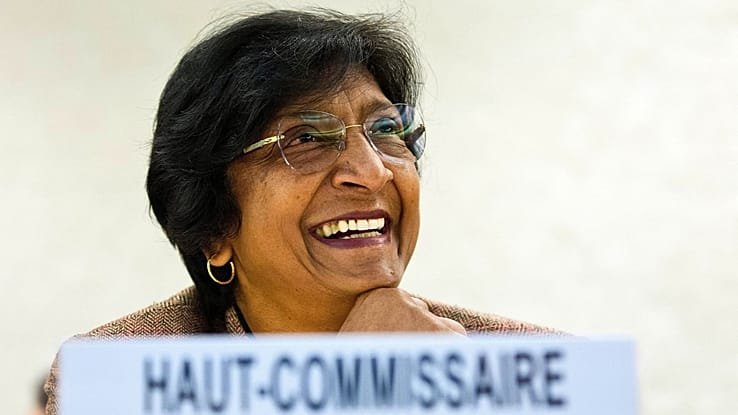
Nobel Peace Prize laureate Navi Pillay has condemned US President Donald Trump’s sanctions against the International Criminal Court (ICC), describing them as unlawful interference with an independent judicial institution.
Pillay, in an interview with AFP on Wednesday, urged Trump to seek proper legal advice on international law, arguing that the sanctions undermine the principles of international justice.
Asked what message she had for the US president, the 85-year-old former judge said: “Call in your legal advisors to explain to you what international law is.”
She added that Trump should understand why interfering with an independent international court was unlawful.
Pillay also suggested that the timing of the sanctions announcement, which came hours after news of her Nobel Peace Prize award, was significant, arguing that it reflected disappointment that Trump had not received the honour.
The United States announced the sanctions on Friday in a move intended to cripple the ICC’s day-to-day operations. The court prosecutes individuals accused of war crimes, crimes against humanity and genocide.
Trump’s administration has vowed to dismantle the court, following its decision to issue an arrest warrant for Israeli Prime Minister Benjamin Netanyahu over alleged crimes committed in Gaza.
Pillay criticised what she described as double standards in Washington’s approach to the ICC, noting that previous US administrations had welcomed the court’s arrest warrant for Russian President Vladimir Putin.
“That’s selective, that’s double standards, and that’s wrong,” she said.
The sanctions are expected to affect the court’s technology and banking operations, with implementation scheduled to take effect in six months. Dutch Prime Minister Rob Jetten has called for discussions with Washington during that period to explore possible reforms to the court, which is based in The Hague.
However, Pillay questioned whether reform was the real objective of the US administration, describing the proposal as “euphemistic”.
She argued that Washington’s actual demand was an assurance that the ICC would not investigate US citizens.
“You can’t do that, because you can’t have double standards. You can’t selectively pursue one lot of people and not the other,” she told AFP, warning that such an arrangement would establish a dangerous precedent.
Pillay also responded to criticism from Israeli officials following her Nobel Peace Prize award. She previously headed the UN Independent International Commission of Inquiry, which concluded last year that genocide was occurring in Gaza.
Netanyahu described her as a “bigot”, while Israel’s foreign ministry invoked Nazi propagandist Joseph Goebbels in its criticism of the award.
Pillay described the remarks as hurtful and insulting, arguing that the comparison disregarded the historical record of Goebbels and the atrocities associated with his role in Nazi Germany.
She also acknowledged the political difficulties involved in securing Netanyahu’s arrest and appearance before the ICC over the allegations, which he strongly denies.
Despite the obstacles, Pillay expressed confidence that international justice could eventually prevail.
“All my life I’ve seen people get around difficulties, so I’m confident that it will happen,” she said when asked whether Netanyahu might eventually appear before the court.
Pillay said she was still coming to terms with winning the Nobel Peace Prize, noting that relatively few women had received the award and describing the situation as reflecting longstanding gender inequality.
At 85, she expressed concern that her age could limit her ability to travel extensively to promote international justice, recalling that she visited 79 countries while serving as the UN High Commissioner for Human Rights.
She is also considering how best to use the 12 million Swedish kronor prize, valued at approximately $1.2 million, and indicated that some of the funds could support initiatives in her native South Africa.
“Africa is suffering. South Africa is suffering. It’s very difficult to raise funds there,” she said.
Pillay disclosed that the University of KwaZulu-Natal had established a unit in her name, adding that she planned to discuss potential support with the institution.
She said education, particularly for children and young people, remained one of her priorities.


