



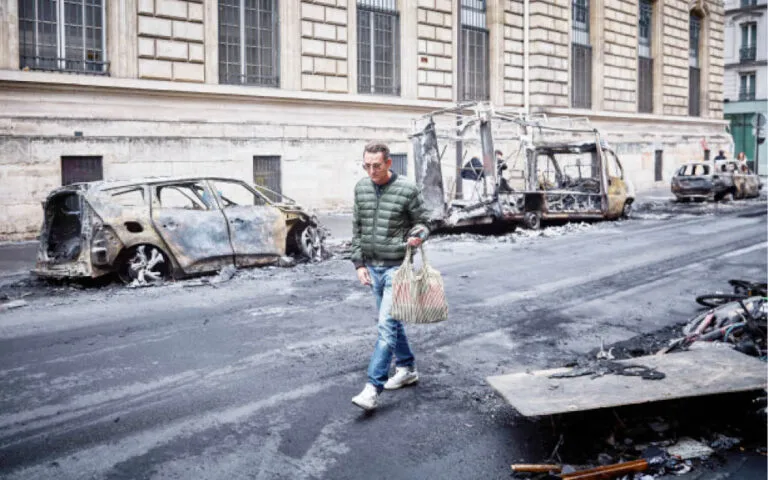
French Prime Minister Sébastien Lecornu has promised a massive police deployment ahead of fresh demonstrations this weekend, as the government faces mounting criticism over its handling of violent unrest that has shaken the country.
Lecornu made the pledge on Tuesday while addressing lawmakers, acknowledging shortcomings in the security response to Saturday’s riots, which erupted alongside nationwide protests against the rising cost of living.
“The deployment for next Saturday will be massive,” he said, accusing ultra-left radical groups of pursuing what he described as an “insurrectionary plan” behind the violence.
The unrest has prompted authorities to impose partial curfews in Paris and several other cities, including Bordeaux and Nice, as the government moves to prevent further attacks on public infrastructure and businesses.
Lecornu said additional curfews would be introduced where necessary, while Paris police imposed a temporary ban on carrying cans or bottles of petrol and gas following reports that government buildings and shops had been set ablaze.
Security operations were intensified overnight, with a helicopter using searchlights to monitor Place de la République in Paris, one of the focal points of the unrest.
A targeted curfew for minors was also scheduled to take effect in several districts of Marseille from Tuesday evening through at least Friday, according to a source close to the matter cited by AFP.
The violence has raised concerns about public safety, with images of looted shops and burning buildings prompting the United States, China, Germany and other countries to issue travel advisories for their citizens in France.
Authorities have also arrested a man suspected of links to ultra-left groups in connection with the burning of a historic town hall in Limoges, an incident that has become a symbol of the unrest.
Justice Minister Gérald Darmanin said nearly 150 people had been jailed, while more than 800 had appeared before the courts.
He defended the government’s tough judicial response, arguing that swift and firm action was necessary to prevent citizens from resorting to taking the law into their own hands.
“The justice system is being extremely firm,” Darmanin said, adding that people without previous criminal records were being sent to prison.
The security response has also come under scrutiny following reports of serious injuries among demonstrators. One man reportedly lost a hand to a police grenade, while a 17-year-old girl lost an eye in the eastern city of Mulhouse.
Interior Minister Laurent Nunez offered to resign on Sunday, saying police had “lost control” during the unrest, but President Emmanuel Macron rejected his resignation.
Macron, who is currently on a Gulf tour where he secured additional diesel supplies in an effort to reduce prices, has acknowledged shortcomings in the handling of the protests.
The crisis comes at a difficult time for France, which is grappling with high public debt, rising living costs and growing political pressure ahead of the next presidential election.
Saturday’s unrest followed demonstrations involving about 500,000 people across the country, after four weeks of school protests.
Opposition politicians have seized on the crisis to challenge the government’s authority. Far-right presidential candidate Marine Le Pen described the violence as a “wake-up call” exposing what she called a profound crisis of authority.
Meanwhile, investors have sold French government debt in recent weeks amid growing concerns about the country’s public finances and the government’s ability to rein in spending.
In a bid to support businesses affected by the violence, the government announced that interest-free loans would be available from Friday to shops and other businesses that had suffered damage or looting.
The unrest has also fuelled debate beyond France. US President Donald Trump attributed the violence to immigration and urged Macron to tighten border controls, reinforcing his anti-immigration rhetoric.
However, several analysts disputed immigration as a principal cause of the demonstrations, pointing instead to economic grievances and the broader cost-of-living crisis.
Other European countries have also witnessed protests over rising prices, with smaller clashes reported in Milan, Italy’s financial centre, and Belgium over the weekend. Italy was preparing to deploy 500 troops to Milan as its government considered tougher security measures.


