



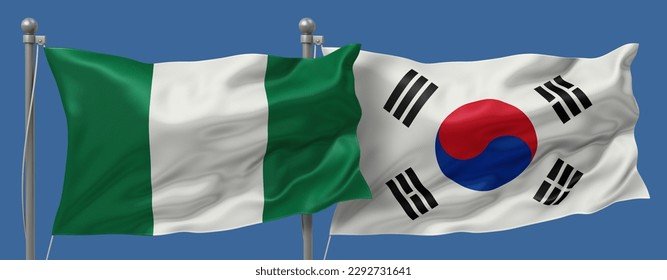
The Federal Government has called for increased South Korean investment in technology, agriculture, manufacturing and automobile assembly as part of efforts to diversify Nigeria’s economy, create jobs and strengthen local industries.
The government said expanding economic cooperation with South Korea would help Nigeria benefit from the Asian country’s industrialisation experience, technical expertise and advanced manufacturing capabilities.
The Chief of Protocol, Ministry of Foreign Affairs, Ambassador Babagana Wakil, made the call on Friday at the 2026 South Korean National Day reception in Abuja, where he delivered a goodwill message on behalf of the Minister of Foreign Affairs, Ambassador Bianca Ojukwu.
Wakil said Nigeria was interested in expanding bilateral trade beyond crude oil and liquefied natural gas, urging South Korean businesses to explore opportunities in non-oil exports, agricultural processing, shipbuilding and other productive sectors.
He said stronger economic relations should translate into technology transfer, employment generation and improved productivity, particularly among Nigeria’s growing youth population.
“However, there remain considerable potential to expand trade volume beyond crude oil and liquefied natural gas. We need to promote non-oil exports, including agricultural produce,” he said.
The government also identified agriculture as a priority area for collaboration, expressing interest in South Korea’s expertise in mechanised farming, rice production and agro-processing to improve food security.
Wakil said Nigeria was looking forward to exploring opportunities under South Korea’s K-Ricebelt initiative, which could support efforts to strengthen domestic rice production.
He also called for expanded cooperation in education, digital technology, research, scholarships and technical training, noting that such partnerships would equip Nigerians with skills needed to participate in a modern economy.
The envoy, who disclosed that he had benefited from a capacity-building programme facilitated by the Korea International Cooperation Agency (KOICA), said the agency had also trained many Nigerians.
He urged both countries to sustain and expand the programmes to strengthen human capital development.
On maritime security, Wakil said Nigeria and South Korea shared interests in safe shipping routes, secure waterways and maritime infrastructure, adding that collaboration in shipbuilding, fisheries and technical training could support trade and investment.
He described the Nigeria-South Korea Joint Commission as an important platform for advancing bilateral cooperation, noting that the sixth session was held in 2021.
Nigeria, he said, was ready to host the seventh session in Abuja and welcomed stronger participation by South Korean government officials and investors.
Earlier, South Korea’s Ambassador to Nigeria, Jeong Yeon, reaffirmed his country’s commitment to deepening relations with Nigeria through investment, entrepreneurship, education and cultural exchanges.
He disclosed that the Abuja Centre for Entrepreneurship, established through a partnership involving KOICA, the Small and Medium Enterprises Development Agency of Nigeria and the United Nations Development Programme, was expected to support hundreds of young entrepreneurs and start-ups.
The ambassador also said South Korea’s Smart School project, implemented in partnership with the Universal Basic Education Commission, had reached 8,000 children and trained more than 300 teachers and school leaders.
According to him, KOICA and the Food and Agriculture Organisation are collaborating to create green jobs for young Nigerians in agriculture, while about 2,000 Nigerian officials have received training in South Korea through KOICA programmes.
“Our shared goal is simple: more opportunities for young people, stronger local businesses, and better lives for our people,” Jeong said.
He identified Korean companies, including Daewoo E&C, LG, Samsung, Hyundai and Solpia, as participants in Nigeria’s energy, manufacturing, clean water and digital technology sectors.
Jeong added that the South Korean Embassy, working with the Korea Trade-Investment Promotion Agency, would continue to promote investment, technology sharing and local employment.
He also highlighted cultural exchanges between both countries, citing Nigeria’s growing interest in K-pop, Korean films and dramas, alongside South Korea’s appreciation of Afrobeats and Nollywood.
Nigeria and South Korea established diplomatic relations in 1980 and have maintained cooperation in trade, education, technology and other areas of mutual interest.


