



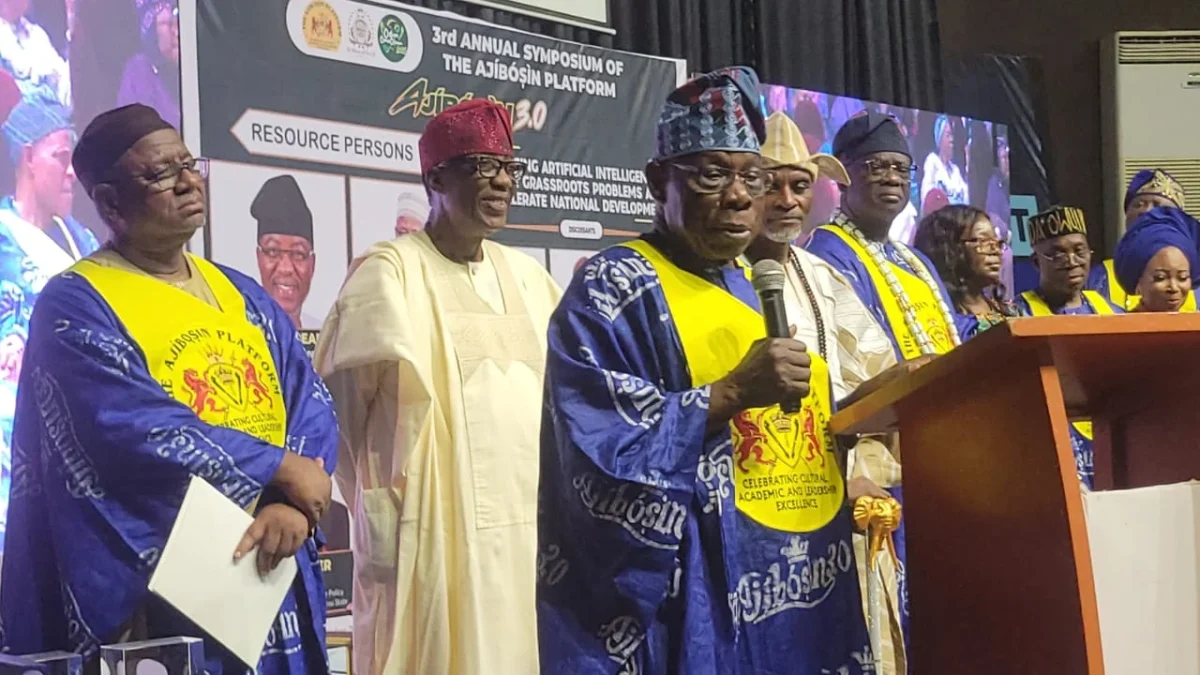
Former President Olusegun Obasanjo has warned that Nigeria’s rising debt burden poses a greater danger to the country than leprosy, faulting President Bola Tinubu’s recent defence of government borrowing.
Obasanjo argued that excessive borrowing could mortgage the future of generations yet unborn, insisting that its consequences extended far beyond the immediate economic challenges facing the country.
He spoke on Friday at the third Ajibosin Annual Symposium, themed, “Leveraging Artificial Intelligence to Solve Grassroots Problems and Accelerate National Development,” held at the amphitheatre of the Olusegun Obasanjo Presidential Library in Abeokuta, Ogun State.
Reacting to Tinubu’s recent assertion that borrowing was not leprosy and that the government only needed to work hard to repay its debts, the former president dismissed the argument as “absolute nonsense”.
Obasanjo, who secured about $30 billion in Paris Club debt relief for Nigeria during his administration between 1999 and 2007, questioned the country’s growing debt profile and the capacity of its leaders to manage the economy.
He said, “What have our leaders done? What do our leaders know, and what do they not know? From what they know, what can they do for us? For anybody to say debt is no leprosy is absolute nonsense. Debt is worse than leprosy, because leprosy destroys only one person. Debt destroys generations.”
The former president also criticised the influence of the World Bank and International Monetary Fund (IMF) on Nigeria’s economic policies, arguing that their recommendations were not necessarily designed to promote the country’s development interests.
He questioned why Nigeria should blindly adopt economic prescriptions from international financial institutions without considering the country’s peculiar circumstances.
Citing an encounter with former British Prime Minister Jimmy Callaghan, Obasanjo recalled how the British government supported agricultural production through subsidies while discouraging developing countries from adopting similar measures.
He said international financial institutions often presented their recommendations as sound economic policies, but warned that Nigerian leaders should scrutinise such advice rather than implement it without questioning its suitability.
Obasanjo also expressed concern over the continued depreciation of the naira, comparing its value against the dollar when he established his farm 47 years ago with its current exchange rate.
“When I started my farm 47 years ago, one naira to the dollar was one naira to one dollar 85 cents. What has Nigeria done in 47 years that we now have N1,500 naira to the dollar? What have we done?” he asked.
Beyond the country’s economic challenges, Obasanjo warned against embracing artificial intelligence (AI) and other emerging technologies without adequate understanding, ownership and control.
He argued that technologies developed by powerful foreign countries could be deployed against African interests if the continent failed to establish the capacity to manage them.
Although he acknowledged his limited technical knowledge of artificial intelligence, he stressed the need for Nigeria to determine how the technology would serve its development priorities.
“I don’t know too much technically about AI. But I know that anything that is not in your control can be abused against you,” he said.
In his lecture, historian and political commentator, Dr Umar Ardo, similarly warned that Africa could become vulnerable to a new form of economic exploitation through artificial intelligence if it failed to control its data, technological infrastructure and intellectual property.
Ardo said AI offered significant opportunities for economic transformation but warned that adopting the technology without local ownership, technical capacity and adequate safeguards could reproduce the exploitative economic relationships associated with slavery, colonialism and post-independence dependency.
He traced Africa’s historical experience of economic exploitation from the transatlantic slave trade through colonialism to the continued exportation of raw materials and dependence on foreign industrial technology.
According to him, during the slave trade, advanced technologies of the period, including sailing ships, navigational instruments and firearms, were controlled by foreign interests that exploited African labour.
He said colonialism subsequently shifted the pattern of extraction towards land and natural resources, with railways, explosives and other technologies deployed largely to facilitate the movement of commodities from African territories to foreign markets.
Ardo argued that the pattern had continued after independence, with African countries exporting unprocessed commodities while importing finished products and depending on foreign economies for technology and industrial expertise.
He cited Nigeria’s continued dependence on imported refined petroleum products despite being a major crude oil producer, as well as the dependence of cocoa-producing countries on foreign manufacturers for finished chocolate products.
“Stand back and see the arc: human beings, raw materials, unprocessed commodities and skilled labour. In every age, Africa has been the quarry and not the miner, the farm and not the factory, the source and not the beneficiary,” he said.
Ardo warned that data could become the next major commodity extracted from Africa without corresponding economic benefits to the continent.
He noted that data generated from African populations, farms, hospitals, languages, businesses and public institutions was increasingly valuable, while computing infrastructure, artificial intelligence models, intellectual property and much of the resulting profits remained concentrated outside the continent.
He therefore urged African countries to establish greater control over their digital resources and technological infrastructure to ensure that the adoption of artificial intelligence translated into local economic benefits rather than another cycle of external dependence.


