



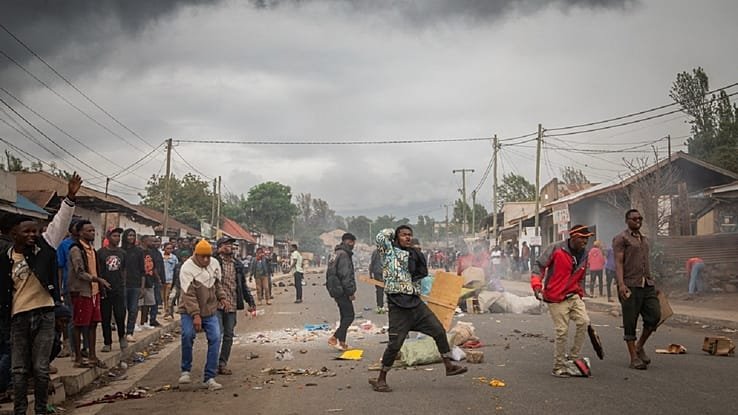
One year after deadly election violence rocked Tanzania, survivors, opposition figures and human rights activists say the country remains trapped in fear, with unresolved killings, alleged abductions and arrests continuing to fuel tensions.
The anniversary of the October 29, 2025 election has reopened painful memories for victims and families of those killed during protests that erupted after President Samia Suluhu Hassan was declared winner with 98 per cent of the vote in an election that largely excluded opposition participation.
Security forces violently suppressed the demonstrations, leaving thousands dead according to opposition groups and rights organisations. However, a government-appointed commission put the death toll at 518.
For survivors such as 61-year-old Twaha Bomeza, the violence continues to shape everyday life.
Bomeza was injured by shrapnel in his eye during a security operation to disperse protesters in the economic capital, Dar es Salaam. He also lost four front teeth and says he still suffers from headaches, breathing difficulties and internal eye injuries.
“I tried to save myself, but I was shot. I fell down here and lost four front teeth,” he told AFP, displaying his dentures.
He said he needed surgery but could not afford the treatment.
“My blood was spilled here, but a year has passed, and there is no more blood here,” he added.
The anniversary was marked by Catholic Church services in honour of victims, while the main opposition party, Chadema, declared seven days of mourning.
In a statement, Chadema accused the government of turning Tanzania into an authoritarian state that failed to uphold the rule of law and protect human rights.
Dar es Salaam remained largely quiet under a heavy police presence as residents gathered for religious services.
One churchgoer, Noela Kigosi, said the country needed to learn from the tragedy and embrace dialogue rather than excessive force.
“I feel sad today… As a nation, we need to learn that dialogue and negotiations are better than using massive force,” she told AFP.
Another resident, 22-year-old Asma, recalled witnessing a protester being shot in the neck while attempting to escape security forces.
“I was telling him to run, but as he tried to flee, he was shot in the neck and died,” she said, describing the incident as horrifying.
The anniversary has also renewed international scrutiny of Tanzania’s human rights record. Western partners have criticised the killings, while the United States ambassador warned on Thursday that the deaths would not be forgotten.
President Hassan, meanwhile, has sought to strengthen Tanzania’s diplomatic relationship with Russia, following her government’s representation at the Russia-Africa summit in Moscow by the Prime Minister.
Political tensions remain high, with analysts describing the country as increasingly unsettled amid allegations of arbitrary arrests and intimidation of government critics.
Attention has particularly focused on the treason trial of opposition leader Tundu Lissu, whose verdict is scheduled for November 6.
Lissu was arrested before the election after campaigning under the slogan “No reform, no election”. He began a hunger strike this week to demand access to his lawyer.
Another opposition figure, John Pambalu, was charged with treason in the past week, while Tanzanian dissident Twaha Mwaipaya was reportedly abducted in neighbouring Kenya and remains missing.
Human rights activist Tito Magoti said the country was experiencing both grief and widespread anxiety.
“The country is not only in a mourning mood but also in a state of terror. We live in paranoia,” he said.
Anna Bwana, director of civil society organisation Twaweza East Africa, warned that the government’s response to political criticism and commemorations was deepening the crisis.
She said the authorities appeared increasingly prepared to use force against dissenting voices.
“If you commemorate, then you’re acknowledging what happened and you’re acknowledging the numbers of those who lost their lives. And how can you commemorate when you’re still kidnapping others?” she asked.
Fulgence Massawe of the Legal and Human Rights Centre said his organisation was representing about 56 people facing terrorism-related charges, alleging that the legal actions were being used to silence critics.
The government had established a presidential commission to investigate the election violence, but critics questioned its independence and accused the authorities of seeking to protect the country’s international image.
Magoti alleged that the authorities were attempting to erase evidence of their involvement in the violence.
Amnesty International has also criticised the government’s handling of the aftermath, accusing it of failing to ensure accountability and using counterterrorism laws to intimidate critics.
For many survivors, however, the consequences of the violence remain painfully visible.
Joseph Zakayo, 37, who was shot in the thigh during the unrest, said his injuries had left him unable to continue operating his motorcycle taxi business.
“My life has taken a major step backwards,” he said.
A year after the election, the unresolved deaths, continuing legal battles and allegations of repression have left Tanzania facing renewed questions about political freedoms, accountability and the prospects for national reconciliation.


