


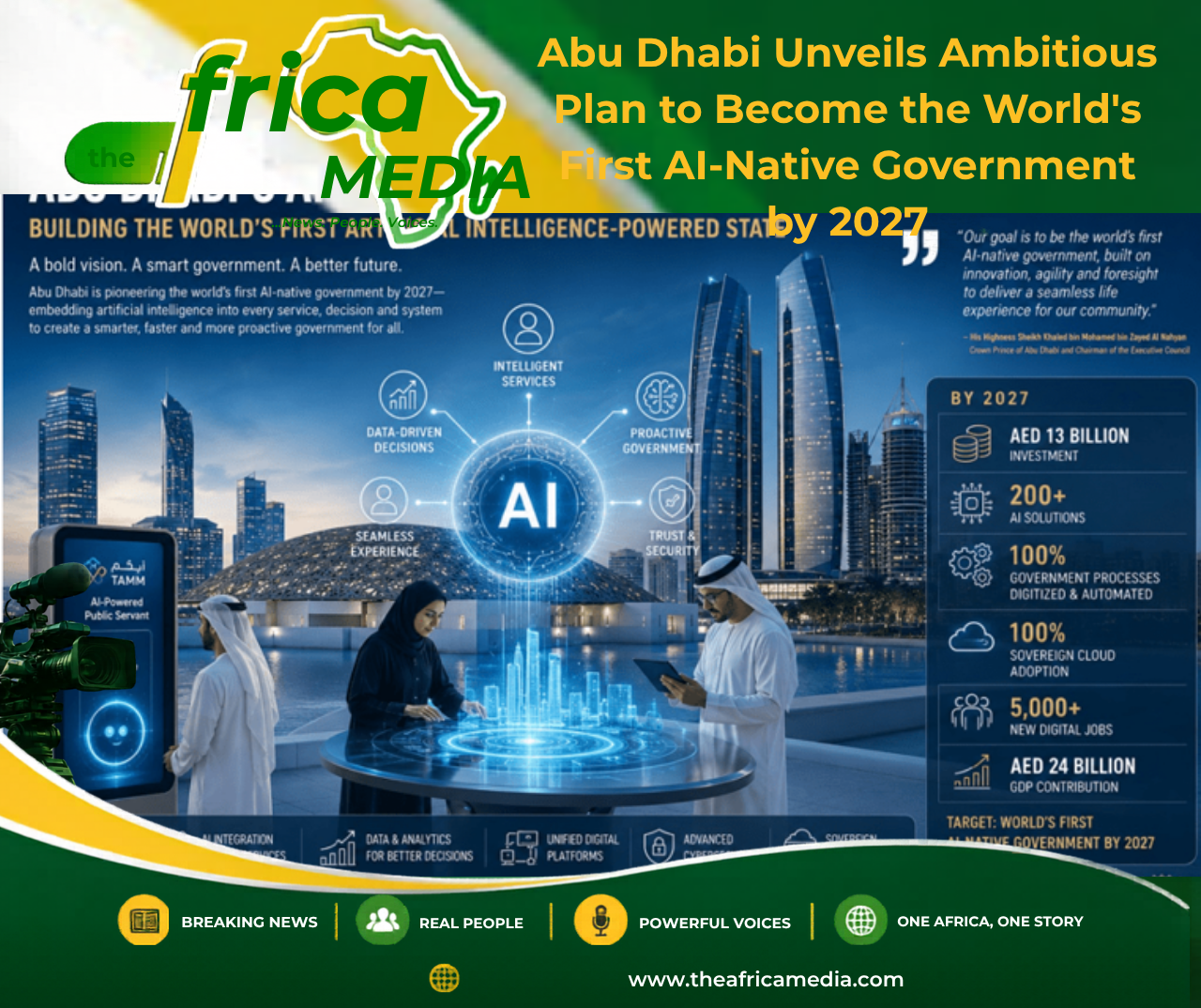
Abu Dhabi has announced an ambitious strategy to become the world’s first fully AI-native government by 2027, investing approximately AED 13 billion (US$3.5 billion) to integrate artificial intelligence into every aspect of public administration.
Unlike traditional digital transformation efforts that focus on moving services online, Abu Dhabi’s Government Digital Strategy 2025–2027 aims to redesign how government operates. The initiative seeks to make artificial intelligence the foundation of governance, enabling smarter decision-making, proactive public services, and more efficient management of government resources.
The strategy is designed to transform government operations by embedding AI into policy development, service delivery, economic planning, and administrative processes, with the goal of creating a faster, more responsive, and citizen-centered government.
Massive Investment to Drive AI Transformation
The government plans to roll out more than 200 AI-powered solutions over the next three years while fully digitizing and automating government processes.
Key targets of the strategy include:
- AED 13 billion investment between 2025 and 2027
- Deployment of over 200 AI solutions
- 100% digitization and automation of government services
- Full adoption of sovereign cloud infrastructure
- Creation of more than 5,000 digital jobs
- An estimated AED 24 billion contribution to Abu Dhabi’s GDP by 2027
Officials say the initiative will not only modernize government operations but also strengthen the emirate’s position as a global leader in artificial intelligence.
Five Pillars of the AI-Native Government
The strategy is built around five key priorities:
- AI-powered public services: Government systems will proactively identify citizens’ needs, automatically initiating services such as license renewals, permits, healthcare support, and social benefits.
- Data-driven decision-making: Real-time analytics and predictive AI will help policymakers anticipate challenges, improve planning, and allocate resources more effectively.
- Sovereign cloud infrastructure: Government data will be securely stored within national infrastructure, enhancing cybersecurity and digital sovereignty.
- Unified government platforms: Agencies will operate through a single connected ecosystem, reducing bureaucracy and providing seamless services.
- Cybersecurity and responsible AI: Strong security measures and ethical AI principles will ensure transparency, accountability, and public trust.
TAMM AutoGov: AI-Powered Public Services
One of the flagship initiatives is TAMM AutoGov, unveiled during GITEX Global 2025.
Unlike conventional government portals that require citizens to submit applications, TAMM AutoGov is designed to anticipate users’ needs and deliver services automatically. The platform can handle tasks such as license renewals, payment reminders, notifications, and other routine administrative services with minimal human intervention.
Officials describe it as a major shift from reactive government services to proactive governance.
Building AI Infrastructure
To support the strategy, Abu Dhabi is investing heavily in advanced computing infrastructure.
A key project is Stargate UAE, a large-scale AI data center being developed through a partnership involving G42, OpenAI, Oracle, Nvidia, Cisco, and SoftBank. The facility is expected to become one of the world’s largest AI computing hubs outside the United States, providing the computing power required for large-scale AI deployment across government and industry.
Economic Benefits
Beyond improving public services, the strategy is expected to deliver significant economic gains.
The government projects that AI adoption will:
- Increase productivity by automating repetitive tasks.
- Improve efficiency across both public and private sectors.
- Create thousands of high-skilled jobs in AI, cybersecurity, cloud computing, software engineering, and data science.
- Contribute approximately AED 24 billion to Abu Dhabi’s economy by 2027.
- Attract global investment while supporting the emirate’s economic diversification beyond oil and gas.
Global Significance
Abu Dhabi’s AI-native government initiative is being closely watched around the world and could establish a new benchmark for government modernization, similar to how Estonia became a global model for digital government.
The project also strengthens the UAE’s broader ambition to become a global AI leader, complementing initiatives such as the UAE AI Strategy 2031 and continued investments in AI research, infrastructure, and innovation.
For developing economies, particularly in Africa, Abu Dhabi’s model offers valuable lessons on using strategic leadership, digital infrastructure, and artificial intelligence to modernize government services, improve efficiency, and accelerate economic development.


