


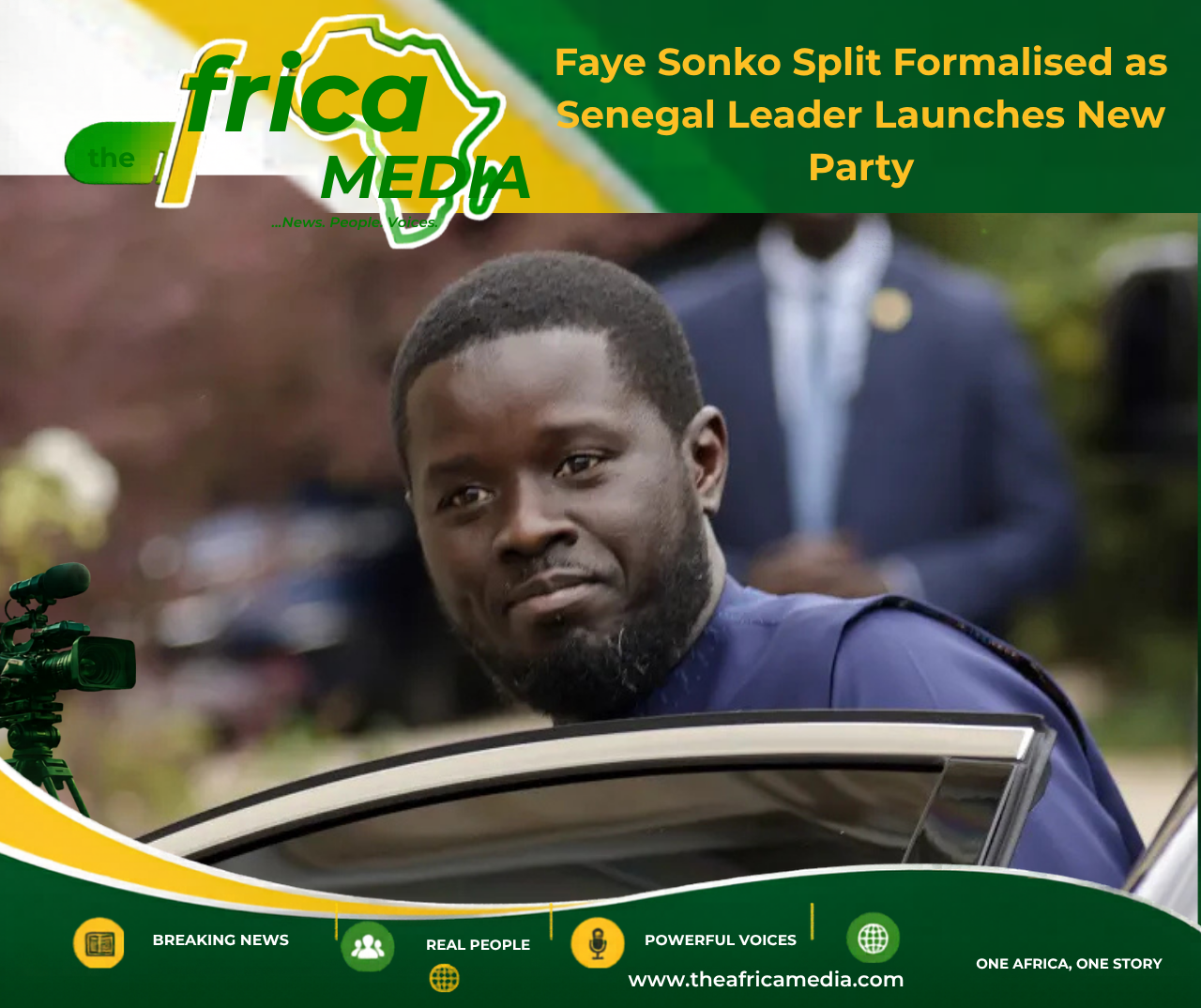
Senegalese President Bassirou Diomaye Faye has launched a new political party, formalising his split with former ally Ousmane Sonko and setting up a struggle for control of the reform movement that swept them to power in 2024. The Faye Sonko split follows months of tension over the direction of the government and Senegal’s mounting economic challenges.
The creation of Kiiraay-The Republican Patriots on Saturday formalised the collapse of the alliance between the two men. The new party grew out of the Diomaye President coalition, which backed Faye’s successful 2024 presidential campaign.
Faye Frames the New Party Around Institutions, Not Personalities
Speaking before supporters in Dakar, Faye portrayed Kiiraay as a movement centred on institutions rather than personalities. “Kiiraay-The Republican Patriots is an open house,” Faye said, adding that the party would be guided by ethics and transparency.
He said the movement would welcome young people, women, farmers, fishermen, teachers, health workers, the diaspora, and all citizens committed to serving the republic. In a message aimed at his supporters, Faye said political office should not be treated as a reward. “Responsibilities will be duties and not rewards,” he said, describing transparency as one of the party’s guiding principles.
From Allies to Rivals
Faye and Sonko rose together through the African Patriots of Senegal for Work, Ethics and Fraternity (PASTEF). Sonko, a former tax inspector, emerged as one of Senegal’s most influential opposition figures by campaigning against corruption, promising economic sovereignty, and attracting strong support from young voters frustrated by unemployment and the rising cost of living.
When Sonko was unable to stand in the 2024 presidential election, PASTEF nominated Faye as its candidate. Campaigning under the slogan “Diomaye is Sonko,” Faye won the presidency and later appointed Sonko as prime minister.
Tensions gradually emerged over how the government was run, its economic policy, and the direction of the governing coalition. The relationship deteriorated further as Senegal grappled with the fallout from previously undisclosed public debt, forcing the government into difficult economic decisions and renewed engagement with international lenders.
The rupture deepened at the end of May, when Faye dismissed Sonko as prime minister and dissolved the government. Days later, Sonko announced PASTEF would not participate in the new cabinet, cementing the split between the former allies.
A Test of Political Strength
For Faye, Kiiraay represents an attempt to build an organisation anchored in the presidency rather than in PASTEF’s political machinery. Whether he can do so remains uncertain, since much of his rise to power was closely tied to Sonko’s popularity and PASTEF’s nationwide grassroots network. The new party will be judged on whether it can build support beyond voters who backed Faye simply as Sonko’s chosen successor.
The split has also raised broader questions about the government’s ability to govern effectively while navigating economic pressures and maintaining its regional influence. Kabir Adamu, founder of Beacon Consulting Ltd and a Nigeria-based security analyst specialising in the Sahel, told Al Jazeera that the consequences could extend well beyond party politics. He said the dismissal of Sonko had torn the ruling coalition apart, creating a seismic political crisis, and warned that Senegal faces a dangerous period of legislative paralysis and economic instability. Adamu added that the domestic crisis could also prevent Faye from fulfilling the responsibilities expected of him by ECOWAS, the regional bloc.
For Sonko, the challenge is different. Although no longer part of the government, he remains one of Senegal’s most influential politicians and continues to command loyalty within PASTEF, leaving two competing camps both claiming to represent the reform agenda that brought them to power.
High Expectations Amid Economic Pressure
The split has occurred as Senegal faces mounting economic pressures. The government is working to restore confidence in public finances after an audit revealed previously undisclosed liabilities under the former administration, while also facing pressure to tackle corruption, create jobs, and ensure Senegal benefits more from its oil, gas and mineral wealth.
Mubarak Aliyu, a Nigeria-based political and security risk analyst specialising in West Africa and the Sahel, told Al Jazeera that the timing of the rupture could prove especially consequential given Senegal’s ongoing debt crisis. He warned that policy paralysis stemming from the rift between Sonko’s push for economic sovereignty and Faye’s pragmatic austerity and debt restructuring approach could spill into fiscal decision-making at the worst possible moment, adding that a debt crisis punishes hesitation and mixed signals, both of which this rupture supplies.
For many Senegalese, however, the ultimate measure of either camp will not be the split itself but whether it delivers on promises of reform and improved living standards. Benjamin Dwomoh-Doyen, executive director of the African Chamber of Content Producers (ACCP), told Al Jazeera he hoped Senegal’s leaders would place the country’s interests above political rivalry, describing the country as a longstanding beacon of democratic stability in West Africa and expressing hope that leadership would prioritise national cohesion over political differences.


