


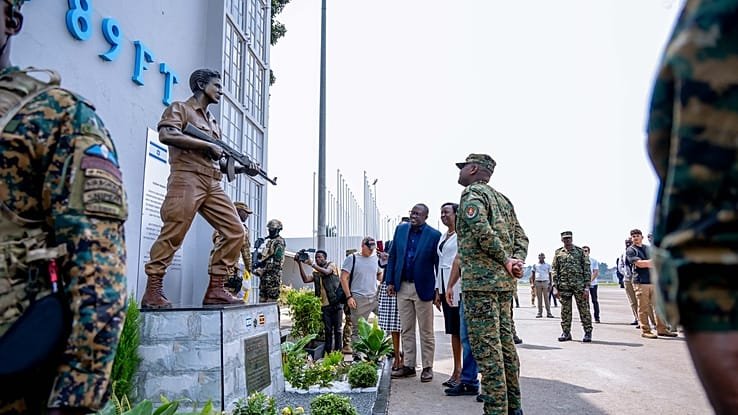
Uganda has pledged about 1,200 troops to a proposed international security force for Gaza, while Burundi is considering whether to join the mission as efforts intensify to assemble a 20,000-strong force.
Military officials from Uganda and Burundi visited Israel last week for talks on possible contributions to the proposed International Stabilization Force, according to officials familiar with the discussions.
The force is being developed under the U.S.-backed Gaza peace plan and is expected to operate in areas of the territory administered by an incoming technocratic committee following the withdrawal of Israeli troops.
A Board of Peace official said Ugandan officials participated in the discussions alongside a Burundian military delegation. Uganda is now finalising arrangements for its contribution after its parliament approved the deployment earlier this month.
A Ugandan military officer familiar with the preparations said about 1,200 personnel had been earmarked for the mission, with troops already being selected for a potential deployment.
Burundi has yet to make a formal commitment, although a senior Burundian military official indicated that the country was prepared to advance discussions on its possible participation.
The Burundian delegation included several senior military officers, underscoring growing interest in the proposed mission. However, the size of any potential Burundian deployment and the terms of its participation remain unclear.
The proposed international force is expected to comprise about 20,000 troops and will be led by U.S. Maj. Gen. Jasper Jeffers.
So far, commitments remain significantly below the target. Morocco has pledged up to 500 personnel, while Kosovo, Kazakhstan and Albania have together committed about 80 troops.
Indonesia had earlier indicated that it was preparing to deploy about 8,000 personnel but suspended those plans after the United States and Israel launched attacks on Iran.
Under the proposed arrangement, the international force would help monitor a ceasefire, train Palestinian police, support security operations and facilitate humanitarian assistance.
The plan also calls for Hamas to disarm as part of a broader framework aimed at ending the Gaza conflict.
However, implementation of the ceasefire that began last October has stalled over disagreements regarding an Israeli military withdrawal and the disarmament of Hamas.
Hamas has accepted the latest U.S. proposal, while Israeli Prime Minister Benjamin Netanyahu has rejected an immediate withdrawal from the roughly 60 per cent of Gaza currently under Israeli control, insisting that Hamas must first be fully disarmed.
U.S. officials have continued diplomatic efforts to bridge the differences, but Israel has yet to make a concrete commitment to the proposed withdrawal.
Somalia Experience Could Shape Gaza Role
Uganda and Burundi could bring considerable peacekeeping experience to the proposed Gaza mission, having deployed troops for years as part of African Union operations in Somalia against al-Shabab.
Security analyst Paul D. Williams of George Washington University said both countries had demonstrated a willingness to sustain difficult overseas deployments despite the risks and casualties involved.
He added that the drawdown of the Somalia mission could encourage the two governments to explore new opportunities for military support and financing.
“Deploying to Gaza with U.S. support is one way to do that,” Williams said.
The possible participation of Uganda and Burundi would strengthen the African presence in the proposed international force, but significant political, security and logistical challenges remain before the mission can become operational.


