



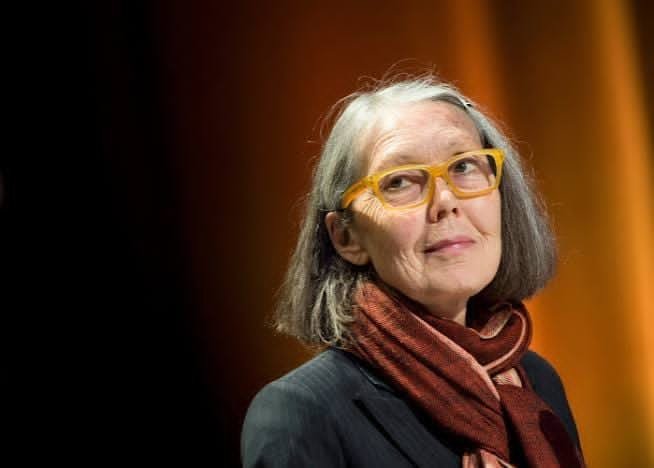
Canadian poet, essayist and translator Anne Carson has won the 2026 Nobel Prize in Literature in recognition of her innovative body of work, which blends poetry, fiction, classical scholarship and other art forms.
The Nobel committee selected the 76-year-old writer for her “bold and inventive oeuvre that, in playful dialogue with the classical tradition, has created new forms for contemporary literature”.
The Nobel Prize in Literature recognises an author’s lifetime achievement and is regarded as one of the world’s most prestigious literary honours. The award carries a prize of 12 million Swedish kronor, equivalent to about £900,000 or $1.2 million.
Ingrid Carlberg, permanent secretary of the Swedish Academy, said she informed Carson of the award by telephone shortly before the public announcement.
“She had time to tell me was that she is, for the moment, in Iceland, where she is listening to the wind,” Carlberg said.
She added that Carson was surprised by the news but was delighted, noting that she could hear the happiness in the writer’s voice.
Born in Toronto in 1950, Carson lives in Michigan and has held Icelandic citizenship since 2022.
Anders Olsson, chairman of the Swedish Academy’s Nobel Committee for Literature, praised Carson for moving beyond lyrical poetry centred on personal narratives and developing new forms of contemporary writing.
According to Olsson, her work moves between classical and modern poetry, as well as different literary genres and art forms, producing writing marked by playfulness and irony.
Canadian Prime Minister Mark Carney also congratulated Carson, describing her achievement as “an extraordinary achievement and a proud moment for Canada”.
In a social media post, Carney praised the writer’s distinctive style, highlighting her wit and imagination and her ability to introduce ancient stories to new audiences while reshaping perceptions of literature.
Carson’s notable works include The Glass Essay, Autobiography of Red: A Novel in Verse, Nox, Float and The Beauty of the Husband: A Fictional Essay in 29 Tangos.
Her work frequently draws on Greek literature and classical mythology, reinterpreting ancient narratives through contemporary perspectives.
In 2019, her performance piece Norma Jeane Baker of Troy drew parallels between Helen of Troy, the legendary figure from Greek mythology, and Marilyn Monroe, the Hollywood icon.
In 2021, she released The Trojan Women: A Comic, a graphic retelling of Euripides’ ancient tragedy. Her translation of Sophocles’ Elektra was also staged in London last year, featuring actress Brie Larson.
Carson has taught classics for more than three decades, and her academic background has played a significant role in shaping her literary work. Her translations often bring a contemporary sensibility to ancient texts while retaining their classical foundations.
Olsson also highlighted Carson’s collaborations with visual artists, choreographers, and opera and theatre directors, saying they demonstrate her freedom in challenging established literary conventions.
He said her approach had made her work particularly influential in international art and literature since the 1990s.
The 2026 award recognises Carson’s contribution to contemporary literature through a body of work that challenges conventional boundaries between poetry, scholarship, performance and other creative forms.


