


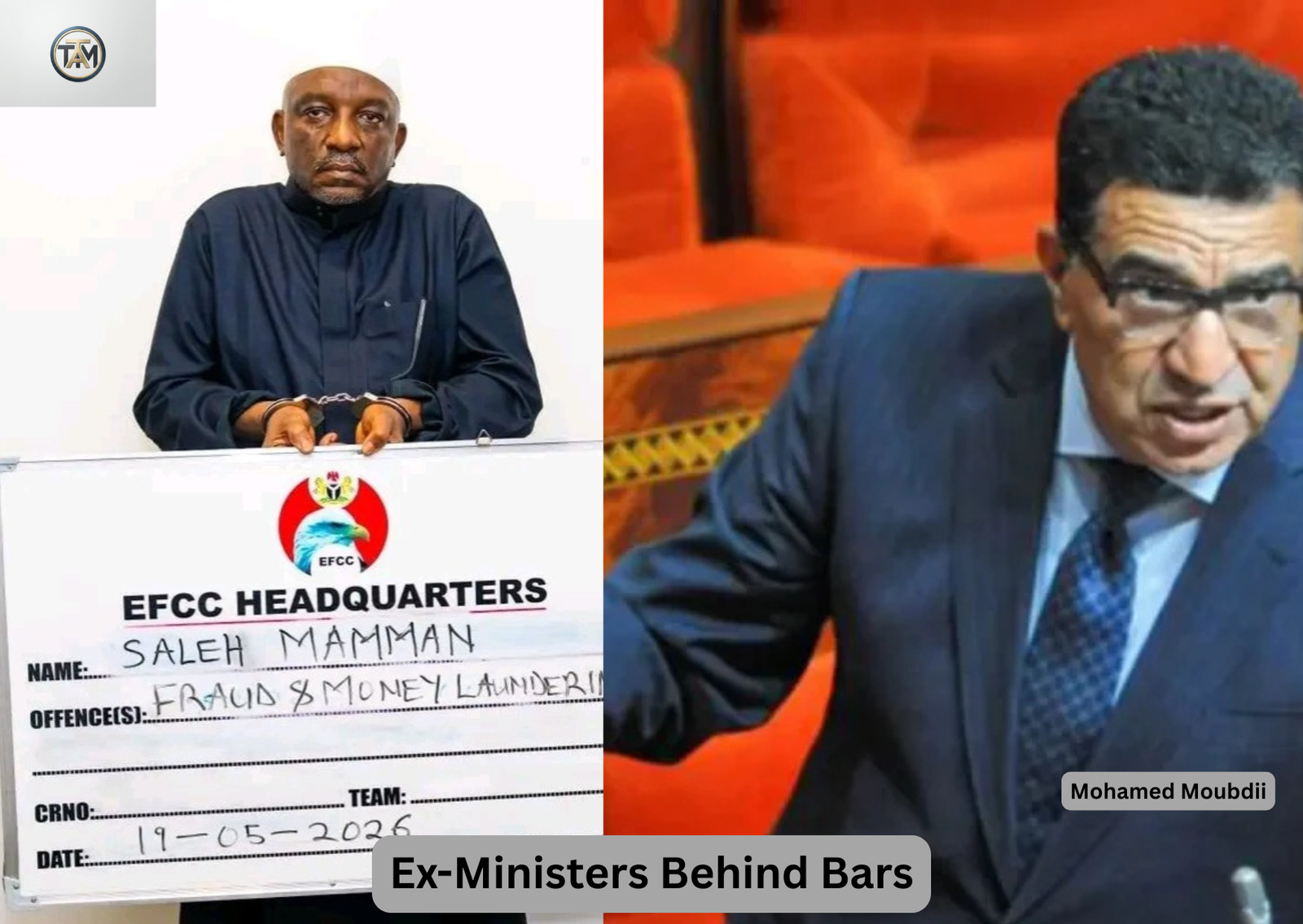
The ongoing battle against political corruption across the African continent has reached a dramatic crescendo with two high profile former government ministers handed lengthy prison sentences in Nigeria and Morocco.
In two entirely separate legal proceedings, judges in Abuja and Casablanca have made examples of former cabinet members, demonstrating a willingness to punish the abuse of public office with maximum severity.
In Nigeria, a Federal High Court in Abuja delivered an astonishing 75-year prison sentence to a former Minister of Power, Saleh Mamman, following his conviction on a twelve-count indictment detailing the industrial scale theft of state infrastructure funds.
Meanwhile, in Casablanca, the Moroccan Court of Appeal shattered domestic precedent by sentencing Mohamed Moubdii, the former Minister of Civil Service and a fixture of the kingdom’s political establishment, to thirteen years in the state penitentiary.
While the two cases are separated by thousands of miles of desert and vastly differing legal traditions, their simultaneous climax represents something entirely new. It is a synchronized, judicial assault on the grand corruption that has historically choked the economic potential of Africa’s two largest regional powerhouses.
The scale of the financial misconduct laid bare in the respective courtrooms reveals how hundreds of millions of pounds intended for infrastructure projects and municipal development were systematically siphoned into private hands.
Saleh Mamman’s grace to grass story
The downfall of Mamman, who directed Nigeria’s Ministry of Power between 2019 and 2021, is perhaps the most spectacular collapse from grace seen in the West African nation since its return to democracy.
The Federal High Court in Abuja, presided over by Justice James Omotosho, found Mamman guilty of massive conspiracy, financial misconduct, and money laundering linked directly to two of the country’s most critical strategic assets: the Zungeru and Mambilla hydroelectric power projects.
The scale of the theft detailed by the Economic and Financial Crimes Commission was breathtaking. Prosecutors successfully argued that Mamman masterminded the diversion of N33bn, a sum intended to build the infrastructure required to lift millions of ordinary Nigerians out of endemic electricity poverty. Instead, the court heard how state funds were systematically skimmed, laundered through complex corporate proxies, and converted into luxury properties and private assets.
What made the judgment particularly striking to the packed Abuja courtroom was Mamman’s decision to abscond before the final hearing. In an act of defiance that ultimately sealed his fate, the former minister chose not to face the bench.
Justice Omotosho, visibly unimpressed by the defendant’s flight, proceeded to deliver the sentence in absentia, ruling that the politician’s disappearance was a cynical attempt to frustrate the course of public justice.
The judge ordered that the sentences for each of the twelve counts run consecutively, culminating in the seventy-five year total. Furthermore, the court directed the final forfeiture of all properties traced to the fraud and issued an international arrest warrant via Interpol. The ruling sends a clear message to the Abuja political class: the era of the comfortable retirement funded by the public purse is coming to a close.
However, the Nigeria’s anti-corruption agency later arrested the former Power Minister a week after he was sentencedin the northern Kaduna state after “weeks of surveillance and intelligence gathering’’
Mamman served as Nigeria’s power minister between 2019 and 2021 under former President Muhammadu Buhari.
His conviction has sparked outrage over Nigeria’s lingering electricity problems, especially as he had promised to improve power supply while in office.
Despite being one of Africa’s biggest energy producers, Nigeria still faces frequent blackouts and power cuts which affect homes and businesses.
The Casablanca Reckoning: Marshalling The State Coffers
If Mamman’s sentence was a thumping display of judicial anger, the verdict handed down in Morocco was a deeper, more systemic shock to a political apparatus unaccustomed to such transparency.
The Casablanca Court of Appeal found Mohamed Moubdii guilty of the embezzlement of public funds, abuse of power, document forgery, and systemic corruption during his long tenure in public office.
Moubdii, a powerful figure within the center right Popular Movement party and a former minister between 2013 and 2016, had long seemed bulletproof. For over two decades, he had also maintained an iron grip on the municipal council of Fquih Ben Salah, serving as its president since 1997. It was from this provincial fiefdom that his empire began to unravel.
The Casablanca Court of Appeal sentenced Mohamed Moubdii to 13 years in prison. The prosecution proved that Moubdii had abused his long-standing position as the head of the municipal council of Fquih Ben Salah, a post he had occupied for over two decades.
The court found him guilty of the embezzlement of public funds, abuse of power, and the extensive forgery of official documents used to illicitly award lucrative public contracts to favoured commercial entities.
The legal action against the Moroccan politician began following a formal complaint launched by the Moroccan Association for the Protection of Public Property, a civil society watchdog group.
Alongside his thirteen-year prison term, the Casablanca court ordered Moubdii to pay a massive fine of 30 million Dirhams, which amounts to roughly $3.2m. Legal experts within the region have noted that while allegations of administrative misconduct are not uncommon, the actual arrest, prosecution, and severe penalisation of a cabinet level politician represents a rare and significant shift in Morocco’s judicial approach to state corruption.
Whether these convictions represent a permanent turning point or merely an isolated pair of high-profile examples remain to be seen. What is indisputable, however, is that the legal precedents have now been set.


