



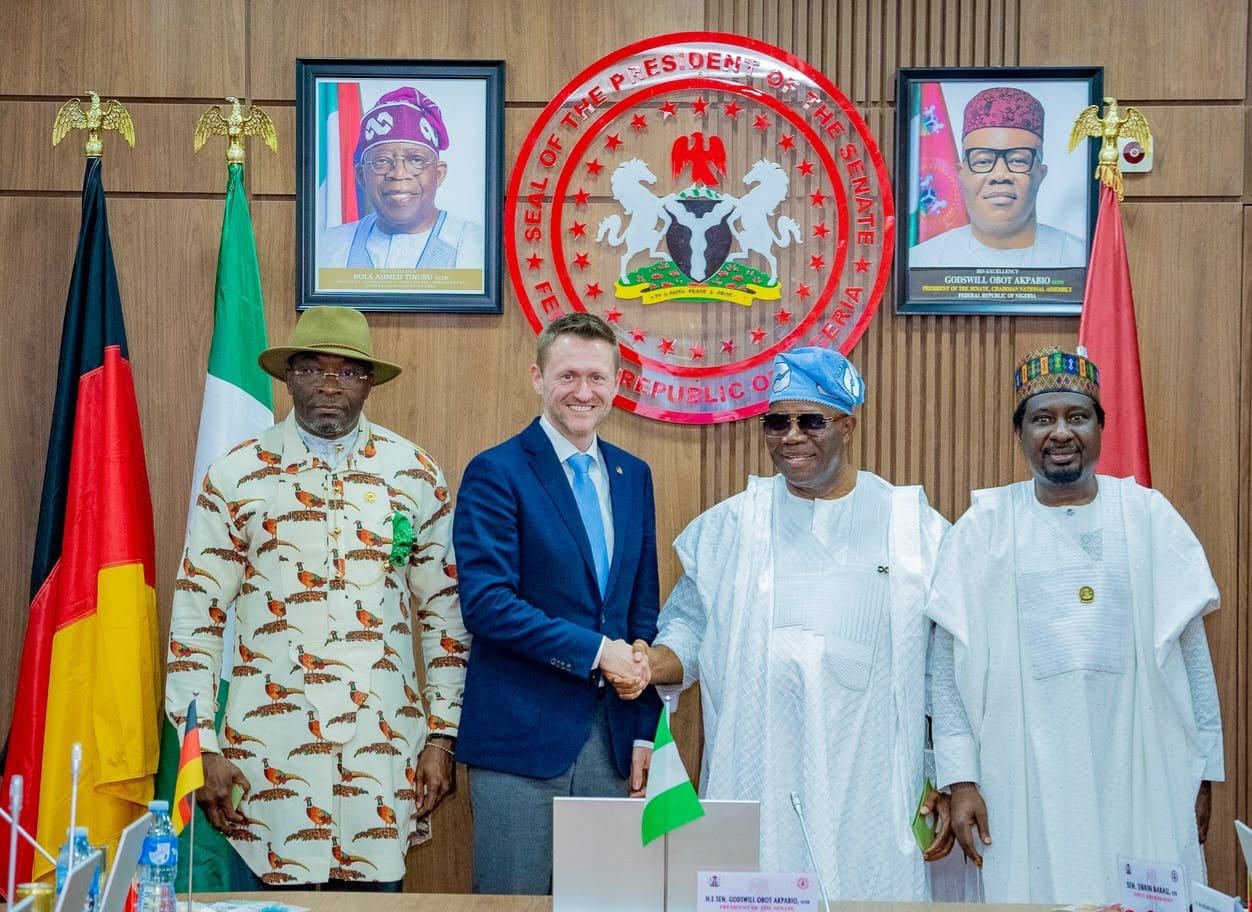
President of the Senate, Godswill Akpabio, has urged Germany to deepen investment in Nigeria’s manufacturing, electricity, technology and infrastructure sectors, saying the longstanding relationship between both countries should translate into factories, jobs and economic growth.
Akpabio made the call on Thursday in Abuja while receiving a delegation of the Committee on Economic Cooperation and Development of the German Bundestag, led by Prof. Wolfgang Stefinger.
In an address titled “Let Friendship Become Factories,” the Senate President said Nigeria and Germany had built more than six decades of friendship and mutual trust but needed to convert the relationship into tangible economic benefits for their citizens.
“Today, our responsibility is to translate that foundation into greater opportunities, stronger institutions and shared prosperity for our peoples,” he said.
Akpabio urged both countries to prioritise cooperation in electricity generation and distribution, technical skills development and job creation, noting that reliable power supply and a skilled workforce were essential to Nigeria’s industrial ambitions.
He said Nigeria was seeking partnerships that would go beyond trade to include local production, technology transfer and the development of domestic capacity.
According to him, German investment opportunities exist in manufacturing, agro-processing, pharmaceuticals, technology and infrastructure, particularly in partnerships that could connect Nigerian businesses to international markets.
The Senate President also called for measures to address barriers discouraging investors, including high financing costs, export-credit premiums and regulatory challenges, especially for German small and medium-sized enterprises seeking to partner with Nigerian businesses.
On electricity, Akpabio stressed that industrialisation would remain difficult without a reliable power supply. He called for accelerated implementation of the Presidential Power Initiative in partnership with Siemens, alongside investments in renewable energy, natural gas and sustainable infrastructure.
He said improved electricity supply would help businesses operate for longer hours, reduce production costs and strengthen investor confidence.
Akpabio also advocated stronger collaboration in technical education and vocational training, proposing partnerships between Nigerian institutions, German technical colleges and industries to develop skills in engineering, digital technology, artificial intelligence and entrepreneurship.
On security, he acknowledged Germany’s support for Nigeria and called for expanded cooperation in intelligence sharing, training, surveillance, counter-terrorism, border management and maritime security.
He added that such cooperation should respect human rights, noting that improved security in Nigeria would contribute to stability across West Africa and the Sahel.
The Senate President further called for expanded safe and lawful migration pathways, mutual recognition of professional qualifications and joint efforts to combat human trafficking.
He said migration-related arrangements, including returns and reintegration, should be handled in accordance with due process and respect for human dignity.
To ensure continuity beyond the visit, Akpabio proposed a structured Nigeria-Germany Parliamentary Dialogue, supported by committee exchanges and designated contacts to monitor the implementation of agreements.
He outlined five priority areas for follow-up: sustained parliamentary engagement, accelerated electricity and renewable-energy cooperation, a skills and innovation partnership, improved access to investment and development finance, and designated parliamentary contacts to track agreed actions.
Akpabio said stronger parliamentary cooperation would provide continuity, accountability and legislative support for economic partnerships, adding that Nigeria wanted a relationship with Germany that would strengthen local industries and create productive employment.
The visit provides an opportunity for both countries to explore ways of expanding economic cooperation, with particular emphasis on industrial development, skills transfer, energy security and investment.


