



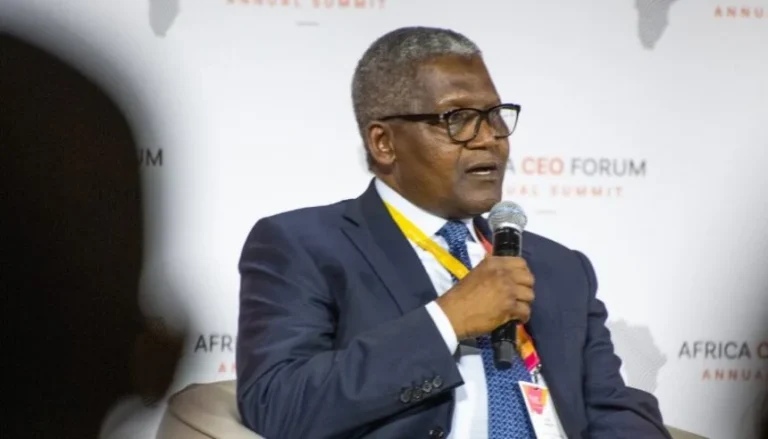
For decades, Nigeria has been battling to improve electricity supply across the country, but with no tangible results. The country’s electricity generation has remained around 4,000 to 5,000 megawatts, while the distribution network is constrained by its ability to receive and deliver power to consumers.
But there seems to be a possible intervention in sight, with the President and Chief Executive of Dangote Industries Limited, Aliko Dangote, saying the group is considering a 10,000-megawatt power programme across Africa, potentially including Nigeria.
According to Africa’s richest man, the group is also considering an expansion of the generating capacity dedicated to its own operations, as it seeks to increase investment in the continent under its Vision 2030 programme.
He disclosed plans to raise the group’s investment programme in Africa from $50 billion to about $70 billion, with a major intervention in electricity generation to support industrial growth.
Addressing creative industry stakeholders from Northern Nigeria, including content creators, journalists, bloggers, entertainers and Kannywood stars, Dangote said expanding production, creating jobs and providing reliable electricity were essential to unlocking Nigeria’s economic potential. He identified inadequate power supply as a major obstacle to the survival of small and medium-sized enterprises, warning that businesses dependent on petrol and diesel generators would struggle to remain profitable.
Dangote said the group was considering a 10,000-megawatt power programme across Africa, potentially including Nigeria, alongside an expansion of the generating capacity dedicated to its own operations.
“We initially planned to invest $50 billion. We are now looking at increasing that to about $70 billion in Africa,” he said.
Explaining the ambition behind Vision 2030, Dangote said African businesses must take greater responsibility for investing in the continent and addressing the infrastructure constraints that discourage other investors. According to him, inconsistent government policies and unreliable electricity remain significant barriers to investment. He said the group had largely addressed the power challenge within its operations by generating its own electricity.
“Across the group, we currently have almost 1,500 megawatts. By the time we complete Vision 2030, that could rise to between 4,500 and 5,000 megawatts,” he said. “That is captive power—electricity for our own operations. Separately, part of the vision is to intervene in power generation with 10,000 megawatts across Africa, potentially including Nigeria.”
The distinction between the two figures is important. The 4,500MW to 5,000MW target relates to captive power for the group’s own industrial operations, while the proposed 10,000MW programme is a separate intervention intended to contribute to electricity generation across Africa. Dangote did not provide details of the proposed locations, financing arrangements or implementation timetable for the wider programme.
Responding to a question about the economic decision that would most improve the lives of ordinary Nigerians, Dangote placed electricity at the centre of the country’s development needs. He argued that individual households and companies installing alternative power systems would not, by themselves, resolve the wider economic problem.
“Installing solar power for yourself does not mean the wider problem has been solved. Other people may not have that option,” he said. “A vibrant economy is driven by small and medium-sized enterprises. Large companies such as ours help sustain those businesses, but SMEs are essential to economic activity. When you generate electricity using diesel or petrol, it becomes very difficult to make money.”
His comments speak to a problem that has continued to undermine the competitiveness of Nigerian businesses. For manufacturers, retailers, hospitality operators and other small businesses, the cost of running generators has become a significant part of operating expenses. Many have had to increase prices, reduce operating hours or invest in alternative energy systems to remain in business.
The scale of Nigeria’s electricity deficit is also reflected in regulatory data. NERC’s September 2026 operational performance factsheet showed that an average of 5,038MW was available for dispatch during the month, while average hourly generation was 4,089MW. Although the figures indicate that some available capacity was being utilised, they also demonstrate how far the country remains from meeting the electricity needs of its population and businesses.
More importantly, increasing generation alone may not resolve the crisis. Nigeria’s power sector has struggled with problems across the entire electricity value chain, from gas supply and generation plant maintenance to transmission limitations, distribution infrastructure and the financial difficulties confronting operators.
The World Bank has identified weak distribution performance, transmission bottlenecks and the underutilisation of available generation capacity among the structural challenges affecting the sector. It has also highlighted the financial pressures created by revenue shortfalls and the inability of operators to recover costs across the electricity market.
Gas supply is another major concern. A February 2026 report by Reuters, citing the Nigerian Independent System Operator, said gas deliveries to power plants had fallen to about 43 per cent of required volumes at the time, contributing to a reduction in national electricity generation. The development illustrated how difficulties in supplying fuel to thermal plants can quickly affect the amount of electricity available to the national grid.
Consequently, any large-scale investment in power generation would need to be supported by adequate gas infrastructure, reliable transmission facilities and a distribution network capable of delivering the additional electricity to homes and businesses. Without these supporting investments, more generating capacity may not translate into a corresponding improvement in supply.
Dangote expressed confidence in Nigeria’s entrepreneurial strength, saying the country had yet to realise the full benefits of its large and dynamic economy. He said businesses had a responsibility to invest and create opportunities, while government should concentrate on providing policies and conditions that allow enterprises to grow.
“Government’s principal responsibility is to create an enabling environment through good policies. With the right policies, businesses can invest and create jobs,” he said.
The industrialist identified agriculture and solid minerals as areas with substantial potential, particularly in Northern Nigeria, but stressed that the country must move beyond exporting unprocessed resources. He said investment in infrastructure, including ports, could open markets for other producers and make it easier for businesses to develop and export their products.
“It is not only about us; it is about Nigeria and the African continent,” he said. “We should not simply export raw materials and then buy back the processed products at many times the price. That is the pattern we want to change. Without production, we will continue to face economic difficulties. We must build a productive economy.”
His argument is that industrial development and electricity supply are closely connected. Manufacturing businesses require dependable power to operate machinery, maintain production schedules and compete with imported goods. Inadequate electricity, therefore, affects not only the cost of production but also the ability of local industries to expand and employ more people.
For Northern Nigeria, the potential benefits could extend beyond manufacturing. Agriculture and solid minerals have significant development opportunities, but processing, storage and transportation require reliable energy. Farmers and agro-processors, for instance, need electricity to operate processing equipment and preserve perishable products, while mineral producers require energy-intensive facilities to add value before exporting.
Dangote’s proposed intervention could therefore have implications beyond the electricity sector if it eventually supports industrial clusters, agricultural processing and other productive activities. However, the extent of such benefits would depend on where the facilities are located, the structure of the investment and how the electricity is supplied to businesses and communities.
Sharing lessons from his business career, Dangote attributed the group’s expansion to focus, financial discipline and the consistent reinvestment of earnings. He said the transition from trading to manufacturing was built around products the group already understood, supported by established customers, distribution networks and market knowledge.
“The logical next step was backward integration: producing the things we were already importing,” he said.
Dangote also urged entrepreneurs to avoid spending anticipated profits and to recognise when a venture was no longer commercially viable.
“Give it your best effort, but when you do the numbers and they are not adding up, you must be willing to leave,” he said.
Despite the challenges facing businesses, he maintained that the group would continue investing and encouraged smaller enterprises to build opportunities around major industrial projects.
“People like us will continue investing. People like you can build businesses around those investments—as suppliers, producers and service providers,” he said.
For Nigeria, however, the immediate question is how the proposed 10,000MW programme will move from an investment ambition to actual electricity generation. The group’s expanded Vision 2030 investment target signals a willingness to commit more resources to African infrastructure and industry, but the power proposal remains at the consideration stage.
The country has witnessed several power-sector initiatives and investment commitments over the years, yet electricity supply has continued to fall short of demand. What businesses and households need is not simply another announcement of additional megawatts, but a clear implementation plan that addresses the obstacles across generation, transmission and distribution.
If Dangote’s proposal eventually translates into substantial new capacity, backed by the necessary infrastructure and a workable commercial framework, it could make a meaningful contribution to Nigeria’s electricity supply. It could also encourage further private-sector investment in a sector where reliable power remains one of the biggest requirements for economic growth.
But the success of the intervention will ultimately be measured not by the number of megawatts announced, but by how much electricity reaches factories, offices, shops and homes, and whether Nigerians can finally depend on a more stable supply.


