



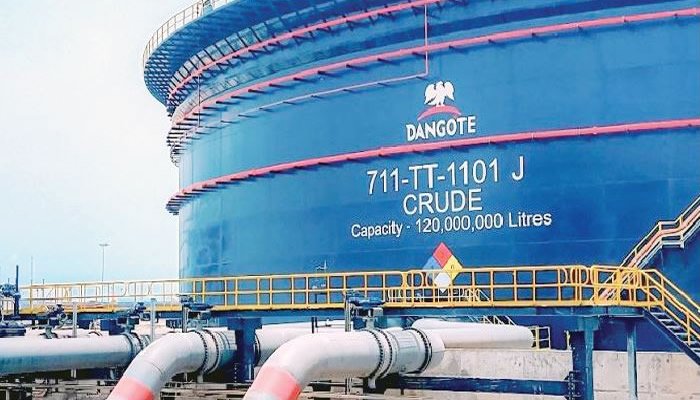
The growing influence of the Dangote Petroleum Refinery on Nigeria’s international trade is becoming increasingly evident, with new figures showing that the United Kingdom has emerged as a major destination for the country’s refined petroleum products, marking a significant shift in a bilateral energy relationship historically dominated by crude oil exports.
The United Kingdom imported £1.02bn worth of refined petroleum products from Nigeria in the 12 months ending June 2026, accounting for 53.5 per cent of its total merchandise imports from the country during the period.
The figures, contained in the latest UK Trade and Investment Factsheet released on November 6, 2026, represent more than a 100 per cent increase in refined petroleum imports compared with the corresponding 12 months ending June 2025.
The development is particularly significant given Nigeria’s long-standing position as a major crude oil producer that depended heavily on imported petrol, diesel and other refined products to meet domestic consumption. The emergence of a large-scale domestic refining operation is now changing that pattern, with Nigeria increasingly participating in the international market as a supplier of finished petroleum products.
An analysis of the report by The PUNCH showed that crude oil imports from Nigeria declined by 56.2 per cent to £550.3m during the period, representing 28.9 per cent of Britain’s merchandise imports from the country.
This means refined petroleum products generated approximately £467m more in export value than crude oil, making them the dominant petroleum category in Nigeria’s merchandise trade with the UK.
Combined, refined petroleum and crude oil accounted for approximately £1.57bn, or 82.4 per cent, of the £1.9bn worth of merchandise the UK imported from Nigeria.
The figures underline the continuing importance of hydrocarbons to Nigeria’s export earnings, but also point to a change in the country’s position within the petroleum value chain. Rather than exporting predominantly unprocessed crude and purchasing finished products from overseas, Nigeria is beginning to capture a larger share of the value created through refining.
The expansion of the Dangote Refinery in the Lekki Free Zone, Lagos, has been central to this development. The facility, which commenced operations in January 2024, has become a major source of domestic petroleum supply and an increasingly important participant in international fuel markets.
The scale of the refinery’s influence is also reflected in the changing direction of petroleum shipments. The United States Energy Information Administration, in an analysis published on August 24, 2026, reported that Nigeria’s seaborne petroleum product exports had increased sevenfold since 2023, with the growth underpinned by the opening and subsequent expansion of the Dangote facility.
According to the agency, Nigeria’s seaborne petroleum product shipments averaged 561,000 barrels per day in the second quarter of 2026, compared with an annual average of 79,000 barrels per day in 2023. Of the shipments recorded in the second quarter, 350,000 barrels per day were exports, against an annual average of 46,000 barrels per day in 2023.
The EIA attributed the increase to improved domestic refining capacity, which has reduced Nigeria’s dependence on imported petroleum products while creating room for exports to international markets.
It said, “With the increased supply of petroleum products in Nigeria from the country’s largest refinery, imports fell, exports increased, and Nigeria became more self-sufficient in refined petroleum products.”
The agency also noted that shipments increased following the commencement of operations at the Dangote Refinery and expanded further after maintenance and capacity improvement works were completed in February 2026.
The works increased the refinery’s crude oil distillation capacity from 650,000 barrels per day to 700,000 barrels per day, strengthening its ability to supply the domestic market and serve export destinations.
Nigeria’s seaborne petroleum product exports to Europe averaged 130,000 barrels per day in the second quarter of 2026, compared with 40,000 barrels per day in 2025 and 15,000 barrels per day in 2023. Exports to other African countries also rose to nearly 120,000 barrels per day from 89,000 barrels per day in 2025.
These figures suggest that the Dangote Refinery is not merely changing the source of petroleum products consumed in Nigeria but is also repositioning the country within the international fuel supply chain.
The impact is particularly visible in the trade figures between Nigeria and Britain, where the value of refined petroleum products moving in both directions has changed considerably.
Britain exported £772.3m worth of refined petroleum products to Nigeria during the 12 months ending June 2026, accounting for 51.5 per cent of its total merchandise exports to the country. Although refined oil remained the largest category of British goods exports to Nigeria, its value declined by 42.7 per cent compared with the corresponding period a year earlier.
The reduction represents approximately £575.5m from the previous period’s estimated £1.35bn.
The decline is significant because Nigeria had historically relied on foreign refineries, including those in Europe, to meet a substantial portion of its domestic demand for petrol, diesel and other petroleum products.
The expansion of domestic refining is gradually reducing that dependence, although the latest figures show that Britain remains an important supplier of refined products to the Nigerian market.
Based on the reported trade values, Nigeria recorded a refined petroleum trade surplus of approximately £245m with Britain during the period. This was calculated by deducting the £772.3m worth of refined products exported by the UK to Nigeria from the approximately £1.017bn imported from Nigeria.
The reversal represents a notable development in a trading relationship in which Nigeria traditionally supplied crude oil while importing a considerable volume of finished petroleum products.
However, the broader trade figures show that petroleum is only one component of the relationship. Britain exported £4.8bn worth of goods and services to Nigeria during the 12 months ending June 2026, while its imports from Nigeria stood at £2.5bn. Total bilateral trade reached £7.3bn, with the UK maintaining an overall trade surplus of £2.2bn.
The UK factsheet also showed that its merchandise exports to Nigeria declined by 25.9 per cent to £1.5bn, while merchandise imports from Nigeria increased by 10.4 per cent to £1.9bn.
This distinction is important because Nigeria’s emerging surplus in refined petroleum trade does not mean it has overturned Britain’s overall trade advantage. The UK continues to earn substantially more from services supplied to Nigeria, contributing to its wider trade surplus.
The shift has also coincided with changes in Britain’s petroleum import regulations. On May 20, 2026, the UK introduced restrictions on petroleum products refined in third countries using Russian crude oil, as part of measures aimed at preventing Russian oil from entering Western markets through indirect supply chains.
The restrictions target products refined from Russian-origin crude in countries outside Russia before being exported to Britain. Under the new rules, importers are generally required to provide evidence that petroleum products were not produced using Russian crude oil.
However, Nigeria was included in the UK government’s list of net crude oil-exporting countries, which benefit from a presumption that petroleum products imported from them were produced using domestic crude. Consequently, importers are not required to provide supply-chain history at the point of entry under the normal procedure, although British authorities retain the right to request additional evidence where there are reasonable grounds for concern.
The arrangement is significant for Nigerian refiners seeking to expand their access to the British market, as it provides a less burdensome compliance process for qualifying petroleum shipments without exempting them from the sanctions themselves.
For the Dangote Refinery, whose output is increasingly reaching international markets, access to Europe presents an opportunity to deepen its export business beyond the traditional African market.
Nevertheless, the latest UK trade figures should not be interpreted as evidence that Nigeria has completely overcome its dependence on imported refined petroleum products. Britain still exported £772.3m worth of refined oil to Nigeria during the period, while domestic fuel supply, distribution costs, foreign exchange exposure and the refinery’s ability to sustain production at high capacity remain important considerations.
There is also the question of how much of the additional value generated by refining will be retained within the Nigerian economy. The benefits extend beyond export earnings to include reduced demand for imported petroleum products, employment, logistics, shipping and opportunities for businesses involved in the country’s downstream petroleum industry.
The UK government’s figures are reported in current prices and are not adjusted for inflation or exchange-rate movements. Consequently, the increase in the value of refined petroleum exports should be considered alongside actual production and export volumes when assessing the full extent of the transformation.
The refinery’s planned expansion could further strengthen Nigeria’s position. The EIA reported that Dangote Group intends to double its refining capacity by adding a second 750,000-barrel-per-day crude distillation unit by 2028.
If realised, the project would substantially increase the country’s potential to supply petroleum products to Europe and other African markets, although its eventual contribution will depend on investment, crude supply, operational efficiency and sustained international demand.
For now, the £1.02bn in refined petroleum products purchased by Britain provides one of the clearest indications yet of how domestic refining is changing Nigeria’s export profile.
While crude oil remains an important source of foreign exchange, the emergence of refined products as the largest category of Nigerian merchandise exports to Britain represents a departure from the traditional pattern of trade.
The Dangote Refinery has not eliminated Britain’s petroleum exports to Nigeria or reversed the overall bilateral trade balance. But it has altered an important part of the relationship, giving Nigeria a stronger presence in a market where it was previously better known as a supplier of crude oil than as an exporter of finished petroleum products.


