



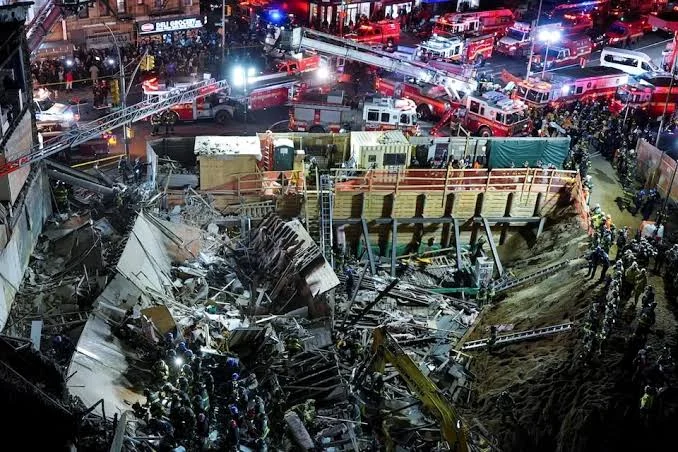
A Nigerian-born landlord in the United States, Olufemi Falade, is facing renewed scrutiny after a three-storey apartment building linked to him collapsed in Brooklyn, New York City, killing eight people, amid revelations that he had appeared on the city’s annual Worst Landlord Watchlist six times in the last decade.
Falade reportedly owes more than $450,000 in fines, unpaid property taxes and water bills, while records show that the collapsed building had accumulated dozens of outstanding housing violations before the tragedy.
The revelations have raised questions about the landlord’s history of property management and whether longstanding maintenance problems at the building were adequately addressed before it collapsed.
According to a statement issued by New York City Public Advocate Jumaane Williams on Saturday, Falade is registered with the city’s Department of Housing Preservation and Development (HPD) as the head officer of 1321 Flatbush Avenue, the Brooklyn apartment building that collapsed on Wednesday, November 11.
Williams said Falade had appeared on the Public Advocate’s annual Worst Landlord Watchlist six times in the last 10 years, most recently in 2024.
PUNCH Online had earlier reported that the three-storey apartment building, located in the Flatbush area of Brooklyn, collapsed at about 4 pm on Wednesday, plunging onto an adjoining construction site where excavation work was underway.
The incident killed eight people, including two children, while 18 others sustained injuries. The victims included construction workers at the neighbouring site, according to reports by Reuters and other US media organisations.
The building, constructed in 1930, housed residential tenants and was part of a neighbourhood where several nearby properties were subsequently evacuated pending safety inspections.
In the statement sighted by PUNCH Online, Williams said Falade first appeared on the Worst Landlord Watchlist in 2017, when he was ranked 93rd. He subsequently appeared in 2019, ranked 66th; 2020, ranked 50th; 2021, ranked 68th; 2022, ranked 100th; and 2024, ranked 95th.
The statement read partly, “The landlord of 1321 Flatbush Avenue, the building which collapsed Wednesday in a tragedy that has killed eight New Yorkers, made several appearances on the annual Worst Landlord Watchlist over the last decade, New York City Public Advocate Jumaane D. Williams announced today.
“Olufemi Falade, registered with the Department of Housing Preservation and Development (HPD) as the head officer for the property, has appeared on the Public Advocate’s annual list six times in the last decade, most recently in 2024.”
The watchlist identifies private landlords whose properties have accumulated significant outstanding housing code violations. According to the Public Advocate’s Office, rankings are determined by the average monthly number of open HPD violations across qualifying buildings owned by the landlords.
Williams said landlords with poor maintenance records routinely put profit ahead of the welfare of tenants, warning that negligence in the management of residential buildings could have fatal consequences.
He, however, stressed that investigations were ongoing to establish what caused the Brooklyn collapse and whether negligence contributed to the tragedy.
“The Worst Landlords in our city routinely put profit over people, and negligence can put lives at risk.
“While we don’t yet know exactly what caused the collapse that claimed the lives of our neighbours and devastated our city, Olufemi Falade has a documented record of failing to maintain properties. It is essential that any negligence which may have contributed be identified, everyone responsible held accountable, and preventative action taken to save lives in the future,” the statement added.
Further details published by the New York Post on Saturday showed that Falade owed more than $450,000 in fines, unpaid taxes and water bills, with most of the liabilities linked to the collapsed property.
According to the newspaper’s review of city records, Falade owed about $170,000 in fines issued by the Department of Buildings in 2019 over improperly displayed signs.
He also owed the city $114,945 in outstanding water bills accumulated over several years and $113,526 in property taxes dating back to 2021.
The report further disclosed that Falade owed the Internal Revenue Service $49,269 in unpaid personal federal income taxes, according to a 2010 lien, while another $4,316 was owed in New York state personal income taxes.
The outstanding amounts, taken together, exceed $450,000, adding to concerns about the landlord’s financial and regulatory obligations.
Investigations by the New York Post also revealed that the 96-year-old building was purchased by Falade in 1999 for an undisclosed amount through an entity known as Femi Realty Corp.
In November 2024, he reportedly transferred ownership of the property to another company under his control, Isolag Realty Corp, signing the deed as both the seller and buyer without any money changing hands.
The newspaper said the building had 98 open violations with the city’s Department of Housing Preservation and Development before its collapse.
The violations included a leaking roof, defective doors, bedbug infestations and exposed electrical wiring, among other maintenance problems.
Some of the complaints concerning the roof dated as far back as 1976, with further violations issued over the years, including earlier this year.
The building’s extensive violation record has become an important part of the investigation into its condition before the collapse, although the existence of outstanding housing violations does not, on its own, establish what caused the structure to fall.
Falade’s record also includes an earlier confrontation with New York authorities over the maintenance of properties under his ownership.
According to the New York Post, he was sentenced to 12 days in jail in 2006 and fined $50,000 for civil contempt after failing to address more than 1,800 violations involving 12 Brooklyn buildings he owned at the time.
The violations reportedly included vermin infestations, exposed electrical wires and leaking pipes.
The latest revelations have revived concerns about the effectiveness of enforcement measures against landlords who repeatedly fail to comply with housing regulations.
The New York Post, citing legal experts, also reported that some landlords use multiple companies or corporate entities to hold properties, a practice that can complicate efforts to establish ownership and recover outstanding liabilities.
However, transferring a property between companies controlled by the same individual does not automatically extinguish existing debts or legal obligations.
Meanwhile, the New York City Department of Buildings is leading an investigation into the collapse, examining the condition of the building and the construction activities taking place on the adjoining property.
The building collapsed onto an excavation site at 2625 Bedford Avenue, where construction work was underway.
According to Reuters, Mayor Zohran Mamdani ordered an expanded investigation involving companies connected to the construction project, while inspectors were also deployed to examine other sites associated with the firms.
Authorities are examining whether construction activities, including excavation and other operations, contributed to the collapse.
The investigation is particularly significant because the adjoining construction work introduces questions beyond the landlord’s maintenance record, including the safety measures adopted by contractors and whether appropriate precautions were taken to protect neighbouring structures.
New York City officials have pledged to establish the circumstances surrounding the tragedy and hold those found responsible accountable.
For Falade, the collapse has brought renewed attention to a property management record that had already attracted repeated scrutiny from the city’s housing authorities.
His six appearances on the Worst Landlord Watchlist, the outstanding financial liabilities and the 98 open violations at the collapsed building have placed his conduct under intense public scrutiny.
However, investigators are yet to establish whether any of these issues directly contributed to the collapse.
The tragedy has also renewed concerns about tenant safety and the enforcement of housing standards in New York City, where landlords are required to maintain residential properties in compliance with building and safety regulations.
For the families of the eight people who died, the immediate concern is accountability and a clear explanation of how a residential building in an established Brooklyn neighbourhood came crashing down.
The findings of the ongoing investigation will determine whether failures in property maintenance, construction practices or other factors contributed to the disaster.


