


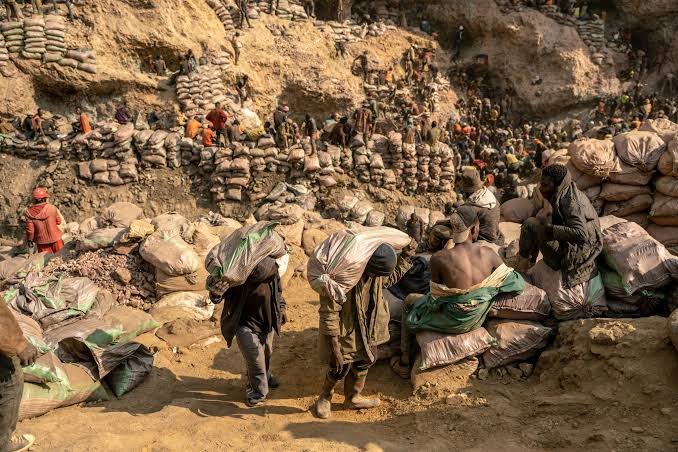
Artisanal miners in eastern Democratic Republic of Congo are continuing to work in gold mines despite the growing threat of Ebola, as economic hardship and displacement leave many with little choice but to earn a living in high-risk environments.
In Iga-Barrière, miners say the need to buy food and pay rent has forced them to keep working even as Ebola cases rise in surrounding communities.
Men and women at the mining site earn as little as a few dollars a day. Many are internally displaced people who fled decades of conflict and now depend on small-scale mining for survival. Others come from nearby towns and villages.
Miner Mechac Ngadjole Katavara said he had lost 13 members of his family but was unable to access medical treatment or vaccination.
“The authorities don’t know what to do about this Ebola virus disease,” Katavara said, adding that he had no access to disinfectants or other protective materials.
“We are displaced by war and life is difficult. That is why we have to work under these conditions,” he said.
Another miner, Daniel Ndjalenga Musingo, who is from Ngatsupka, said he had spent a month working at the Iga-Barrière mine.
Musingo said he was trying to reduce his risk of infection by keeping his distance from other miners and avoiding handshakes, amid reports of widespread infections in villages around the mining area.
He called on the government and humanitarian organisations supporting the Ebola response to establish a treatment centre in Iga-Barrière.
“Patients die on the road while being evacuated to Bunia. If the Ebola treatment centre was nearby, people could receive care quickly and recover,” he said.
The highly mobile nature of artisanal gold mining is complicating efforts to contain the outbreak. Miners frequently move between remote mining sites and population centres where gold is traded, making it more difficult for health workers to identify infected people and trace their contacts.
Response teams have also cited community mistrust and misinformation as major obstacles to containing the disease. However, miners in Iga-Barrière say they are aware of the Ebola threat but remain trapped between the risk of infection and the need to survive.
About two million people are engaged in artisanal and small-scale mining across Congo, according to a 2024 report by the Organisation for Economic Co-operation and Development.
Eastern Congo is rich in minerals including gold, coltan, tin and tungsten. The mining sector has provided livelihoods for millions but has also been linked to decades of conflict in the region.
The latest Ebola outbreak has spread across six provinces, with authorities struggling to contain its rapid expansion. According to the figures provided, the outbreak has recorded 5,375 confirmed cases and 2,557 deaths, while health officials warn that transmission has yet to peak.
An initial shipment of 16,250 vaccine doses arrived at N’djili International Airport in Kinshasa on Friday as part of 70,000 doses expected from the World Health Organisation and its partners. Additional doses are expected in the coming days.
For miners like Esperance Acheni Nyango, however, the immediate struggle is survival.
Nyango, from Ladile village, said people were dying in large numbers there. Although she fears contracting Ebola, she said she could not afford to abandon the mine because her children depend on the income she earns.
“If I can earn even 10,000 francs ($4.36) so the children can eat, it helps. I am struggling to pay rent. This is why I come here to work,” she said.
For eastern Congo’s artisanal miners, the Ebola outbreak has therefore created a painful dilemma: staying away from the mines could mean hunger and homelessness, while continuing to work could expose them and their families to a potentially deadly disease.


