


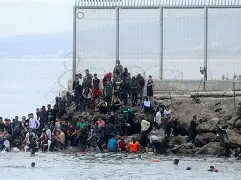
Spain’s North African enclave of Ceuta is experiencing a humanitarian and security emergency, after more than 1,500 migrants reached the city by swimming across from Morocco over the past week, according to the territory’s leader. The Ceuta migrants swim crisis rapidly escalated within days, with authorities later reporting more than 2,000 arrivals by sea and, ultimately, thousands breaching the border entirely.
Ceuta, together with Melilla, another Spanish autonomous city in North Africa, represents the European Union’s only land border with Africa.
Numbers Surge as Crisis Deepens
“In the last few days, more than 1,500 migrants, including adults and minors, have reached Ceuta by sea,” Juan Jesús Vivas, leader of Ceuta’s regional government, told journalists. He said reception centres were collapsed and saturated.
While good weather typically brings a seasonal rise in migrant crossings by sea each summer, Ceuta authorities said the scale of this surge was unusual. Within days, the situation intensified further: a Guardia Civil spokesperson said migrants were massively entering from the sea, with more than 2,000 people crossing over the following days. The crisis peaked on Thursday, July 30, when thousands of migrants breached the border fence, overwhelming police at the city’s breakwater.
Spain Deploys Military After Deaths Reported
Spain announced it would deploy its military to restore order at the Ceuta border after thousands of migrants streamed into the territory, with at least nine people dying in the attempt. The deployment followed repeated requests from Ceuta’s regional government for Madrid to send reinforcements and declare a national emergency.
Vivas said migrants had died attempting the crossing before this latest surge as well, with 60 bodies recovered at sea over the past year. Spain’s Civil Guard, Maritime Rescue Service and the Red Cross have used boats to rescue migrants from the water before bringing them to Ceuta, where hundreds have been left sleeping outside a reception centre that has exceeded its capacity.
What’s Driving the Surge
It remains unclear what prompted so many migrants to attempt the crossing. Vivas pointed to a Spanish Supreme Court ruling issued earlier this month, which found that migrants arriving by sea cannot be immediately returned to Morocco without due process, unlike those who cross by land, such as by scaling the border fence.
However, some activists have questioned that explanation. Omar Naji, president of the Moroccan Association of Human Rights in Eastern Morocco, said most Moroccans would have been unaware of the legal ruling, and suggested other factors, including the timing relative to a recent meeting between Spanish Prime Minister Pedro Sánchez and Algeria’s president, may have played a role.
Spain’s Interior Ministry said it was working closely with Morocco to address the surge in irregular arrivals, blaming people-smuggling networks for exploiting the Supreme Court ruling to encourage undocumented migration. Interior Minister Fernando Grande-Marlaska acknowledged an “extraordinary, exceptional situation” on the ground and pledged to guarantee the safety of citizens and the integrity of the border, though he initially declined to declare a national emergency. Morocco’s Interior Ministry has not publicly responded to the reporting.
Both countries have agreed to work together on the prompt return of everyone who entered Ceuta illegally.
A Familiar Flashpoint
To reach Ceuta, migrants often swim from the Moroccan town of Fnideq, covering roughly 3.1 miles to reach Spanish territory, or attempt a shorter crossing from nearby Belyounech. The scenes recall a similar border crisis in May 2021, when more than 8,000 migrants entered Ceuta in just two days, an episode that followed a diplomatic rift between Madrid and Rabat over Spain’s decision to allow a Polisario Front leader to receive hospital treatment on Spanish soil.


