



The Democratic Republic of Congo (DRC) government has accused former President Joseph Kabila of planning a major offensive against the country after aligning with the Rwanda-backed M23 rebel group in the conflict ravaging the country’s eastern region.
Government spokesman Patrick Muyaya told AFP on Friday that Kabila had decided to formalise his campaign against the state, warning that taking up arms would result in the deaths of Congolese citizens and attempts to seize territory.
Kabila “has decided to formalise his widespread attack against the Republic,” Muyaya said, adding that “the choice to take up arms means killing Congolese in order to try to conquer territories.”
He accused the former president and his allies of attempting to repackage their movement while retaining the same objectives and methods.
“They want to launch a movement to give themselves a new face, but in reality the intentions, the macabre plans, the modus operandi are known,” Muyaya said.
“The players remain the same, the nature of the movement remains the same,” he added.
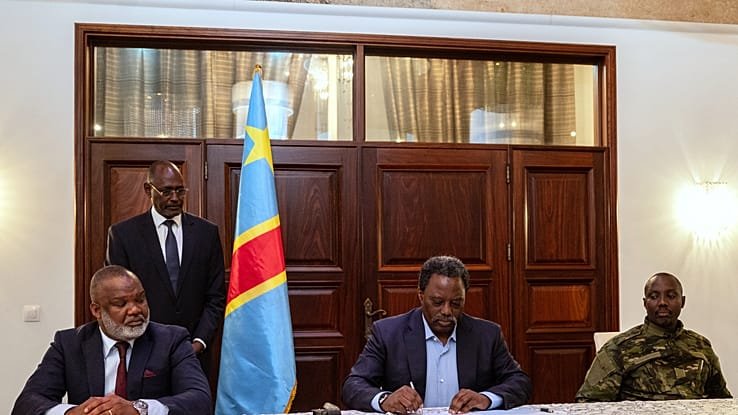
Kabila on Monday joined forces with M23 to lead a new organisation, marking a more direct involvement in the insurgency that has destabilised eastern DRC.
The new group, known as the Front for the Refoundation of the Nation (FRN), was presented as a “politico-military” movement that would combine its members’ strengths, resources and capabilities to end what it described as tyranny, including through the use of force.
The organisation is headed by Kabila, with M23 leaders serving as deputies.
The former president was sentenced to death in absentia about a year ago for alleged complicity with M23.
Kabila, 55, who governed the DRC from 2001 to 2019, has also been accused by Congolese authorities of helping to establish the Congo River Alliance (AFC), the now-dissolved political wing of M23. He has denied the allegations.
After spending several years outside the country, Kabila resurfaced in May 2025 in Goma, a major city in eastern DRC captured by M23. He has since made repeated visits to territories under rebel control.
In early 2025, an offensive involving M23 and the Rwandan army resulted in the capture of Goma and Bukavu, two strategic cities in eastern Congo.
Although the front line has since stabilised, fighting has continued, at times intensifying with drone strikes and artillery exchanges, particularly in South Kivu province.
Kabila’s renewed political activity comes amid growing domestic tensions over the leadership of President Felix Tshisekedi, who succeeded him in office.
Opposition rallies held in June and September protested against a proposed constitutional amendment that critics fear could pave the way for Tshisekedi to seek a third term.
Tshisekedi, 63, is due to complete his second and constitutionally final five-year term in 2028.
The main opposition coalition has so far maintained its distance from Kabila, despite his renewed involvement in the political landscape.
In a speech posted online on Friday, however, the former president expressed support for the opposition and accused the government of being “motivated solely by its own perpetuation in power”.


 government has accused former President Joseph Kabila of planning a major offensive against the)