



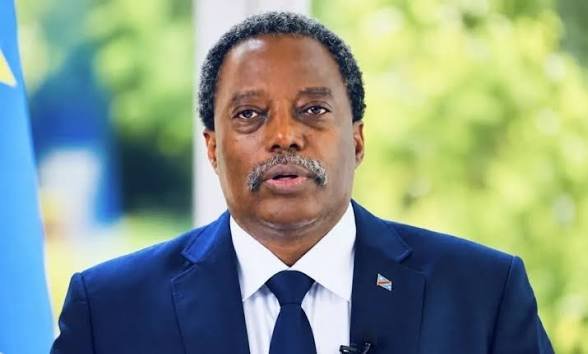
Former Democratic Republic of Congo (DRC) President Joseph Kabila has warned that the country is in danger, accusing the government of worsening governance, undermining democratic institutions and failing to resolve the conflict in the east.
Speaking to Congolese citizens on Friday through his Reconstruct the DRC YouTube channel, Kabila said the country’s situation had “steadily worsened”, criticising what he described as the concentration of power in the hands of the head of state.
Although he did not mention President Félix Tshisekedi by name, Kabila condemned a system in which decisions were guided by the “sole will of the head of state”, whom he accused of treating the country as “private property”.
“This has resulted in a system of governance more concerned with maintaining the status quo than with the welfare of the people,” he said.
Kabila argued that the DRC had ceased to function as a genuine republic or democracy, alleging that governance was characterised by “the institutionalization of tribalism and nepotism”.
He also raised concerns about the alleged discrimination against minority groups, the use of state institutions for political purposes and the management of public assets.
On the security situation in eastern DRC, the former president said continued military confrontation would not resolve the country’s broader political and security challenges.
He accused Tshisekedi of refusing to engage with initiatives seeking a political settlement, insisting that dialogue was essential to ending the crisis and restoring national unity.
“Dialogue is not an option,” Kabila said, describing it as a necessary path towards peace and stronger national cohesion.
He referred to initiatives by regional organisations in eastern, southern and central Africa, alongside efforts by the African Union and some international partners, as potential avenues for resolving the crisis.
Kabila renewed his call for an inclusive national dialogue that would bring together different political and social groups to reconcile the population, restore national cohesion and strengthen democracy and the rule of law.
In May 2025, he presented a 12-point plan that included ending the war, restoring state authority and the rule of law, reconciling communities, neutralising armed groups and withdrawing foreign troops.
His latest intervention comes after Tshisekedi officially launched a process known as the National Dialogue for Peace, Cohesion, and the Refounding of the State in August.
According to the presidency, the process is expected to last no more than three months, beginning at the grassroots level before progressing to national institutions.
However, the proposed format has proved contentious, with Kabila’s political allies challenging the arrangements and demanding assurances that the process will be inclusive.
Meanwhile, fighting continues in eastern DRC between government forces and the AFC/M23 rebel coalition, which is supported by Rwanda, according to the report.
Diplomatic efforts led by the United States and Qatar to resolve the conflict have yet to produce a definitive settlement, as insecurity continues to threaten stability in the region.
The competing positions over national dialogue have further highlighted divisions over how the DRC should address its political disputes and the protracted conflict in its eastern provinces.


 President Joseph Kabila has warned that the country is in danger, accusing the government)