



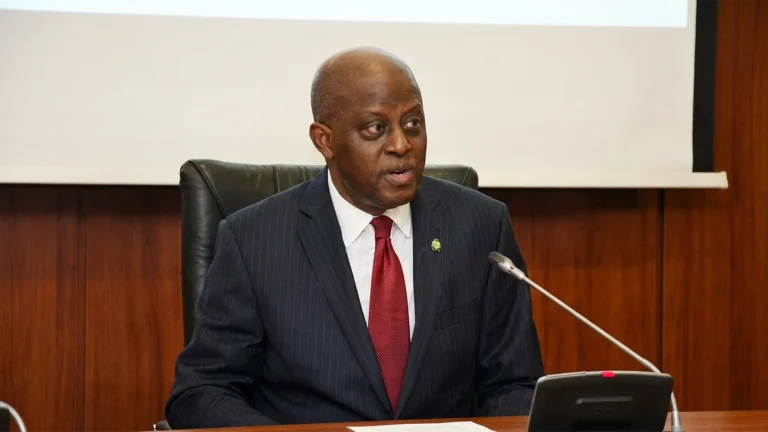
The Central Bank of Nigeria (CBN) has said recent improvements in the foreign exchange market, stronger external reserves and easing inflation indicate that its monetary reforms are beginning to deliver positive results for the Nigerian economy.
CBN Governor Olayemi Cardoso made this known on Tuesday during the CBN Fair held at the International Conference Centre in Gombe. He was represented by the Acting Director of Corporate Communications and Investor Relations, Hakama Sidi-Ali.
The event, themed “Driving Alternative Payment Channels as Tools for Financial Inclusion, Growth and Accelerated Economic Development,” was organised to educate the public on the bank’s policies and strengthen engagement with stakeholders.
According to Cardoso, Nigeria’s headline inflation rate declined slightly from 15.93 percent in May 2026 to 15.91 percent in June 2026, while both core and food inflation also recorded modest reductions.
He attributed the improvement to sustained monetary tightening, reforms in the foreign exchange market and greater transparency in exchange rate management.
The CBN Governor noted that the naira has become more stable in recent months, with the difference between the official exchange rate and Bureau de Change rates narrowing to less than two percent. He said the development has been supported by stronger foreign exchange inflows and renewed investor confidence in Nigeria’s financial markets.
Cardoso also revealed that Nigeria’s foreign reserves had risen above 52.5 billion dollars as of July 17, 2026, describing the figure as the country’s highest reserve level in 17 years and above the Central Bank’s annual target.He explained that over the past 34 months, the apex bank has implemented several reforms designed to strengthen economic stability, stimulate investment, create jobs and reduce poverty.
Among the reforms highlighted were the unification of the foreign exchange market, recapitalisation of commercial banks, the introduction of the Non-Resident Bank Verification Number, the B-Match foreign exchange trading platform and the Nigeria Payments System Vision 2028 initiative.
Cardoso also pointed to the implementation of a 75 percent Cash Reserve Ratio on non-Treasury Single Account public sector deposits, describing it as a measure aimed at improving liquidity management while reducing inflationary pressures.
In addition, he said the CBN partnered with the Financial Markets Dealers Association to introduce the Nigerian Overnight Financing Rate, a benchmark designed to improve transparency in short-term funding transactions and align Nigeria’s money market with global best practices.
Speaking on financial inclusion, Cardoso said expanding alternative payment channels remains a major priority for the Central Bank as it seeks to encourage digital transactions, broaden access to financial services and support economic development.
He explained that the CBN Fair provides an opportunity for the bank to interact directly with businesses, consumers and other stakeholders, explain its policies and receive feedback that can improve policy implementation.
Cardoso encouraged participants to actively engage with officials by asking questions on areas such as consumer protection, payment system innovations, microfinance operations, monetary policy and the management of the naira.
The Central Bank also used the event to renew its warning against the abuse of the national currency. Representing the Governor, Hakama Sidi-Ali urged Nigerians to obtain information on CBN policies only through the bank’s verified communication channels and reminded the public that spraying, mutilating, hawking or counterfeiting the naira remains prohibited by law.
She described the naira as a symbol of Nigeria’s national identity and urged citizens to treat it with dignity and respect. Earlier, the Controller of the CBN Gombe Branch, Yunusa Buba-Mubi, said the outreach programme forms part of the bank’s regular engagement with the public to improve awareness of its policies while providing an avenue for feedback from citizens and stakeholders.
He encouraged participants to pay close attention to the presentations, seek clarification where necessary and contribute suggestions that could help strengthen Nigeria’s banking and financial system.


