



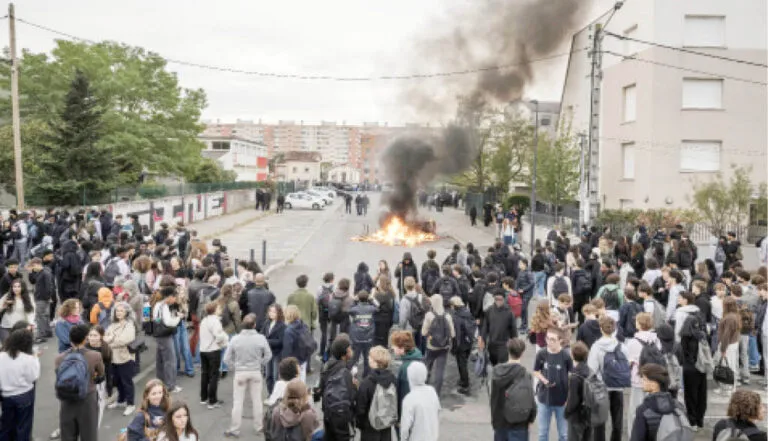
Tens of thousands of people took to the streets across France on Tuesday in solidarity with protesting high school students, strengthening a growing protest movement that poses a challenge to President Emmanuel Macron’s government.
The interior ministry estimated that 161,500 people participated in the nationwide demonstrations, more than twice the 71,500 recorded during the previous protests on Thursday. Organising unions, however, put the turnout at 480,000.
The demonstrations came six months before France is due to elect a successor to Macron, who is serving his final constitutionally permitted term.
Unions and student groups are also preparing for nationwide protests against the rising cost of living on Saturday, with organisers hoping to unite the two movements.
The unrest comes as Macron’s centrist government struggles to secure parliamentary approval for a budget aimed at reducing spending amid mounting national debt and concerns in financial markets.
Although most of Tuesday’s rallies were peaceful, violence broke out during one of two marches in Paris, where the interior ministry recorded 41,500 participants.
AFP journalists reported that some cars were set on fire as masked youths attempted to erect road barricades and threw objects. Police responded with tear gas. Similar incidents were reported during a demonstration in Lyon.
Swedish climate activist Greta Thunberg joined protesters in Saint-Denis, a suburb of Paris, saying she was participating because “our future is being robbed”.
University students, teachers and trade union leaders featured prominently in the demonstrations. The far-left France Unbowed (LFI) party also backed the protests, with its leader and presidential hopeful, Jean-Luc Mélenchon, seen among demonstrators in Paris.
Thousands more marched in Nantes, Lyon, Lens, Strasbourg, Toulouse, Bordeaux and Marseille, according to police and AFP reporters.
“We stand in solidarity with the high schools that are worse off. We need real measures and proper dialogue, not repression,” said Emeline, 16, outside a school in Marseille.
Another student, Nina, 17, said the demonstrations reflected a growing feeling among young people that the government was not listening to their concerns.
The student movement began last month when teenagers at France’s lycées, secondary schools for students aged 15 to 18, started blocking school entrances to demand improved classroom conditions.
Allegations of excessive police force against demonstrators have since fuelled public anger and attracted more participants.
One teenager lost a hand after picking up a police stun grenade during the protests, while another lost an eye. A third lost teeth after an officer fired a tear gas canister into his face.
Police have launched internal investigations into 34 allegations of violence against protesters. The education ministry also reported that 147 teaching staff had been injured during the unrest.
“We’re not giving up the fight, whether it’s for the high school students who were hit with a harsh crackdown, or for denouncing police violence,” said Patricia, a 20-year-old university student in Paris.
The education ministry said 214 schools, most of them high schools, were closed on Tuesday. University student union l’Union Etudiante reported that 90 per cent of universities had shut down nationwide in solidarity with the movement.
Students are demanding action over teacher shortages, deteriorating school buildings, overcrowded timetables and other concerns. They have rejected a government pledge, made after last week’s demonstrations, to deploy 3,000 substitute teachers to 114 of the worst-affected schools.
“We are continuing the blockades. We are not budging,” said Naouel, a high school student in Brest, adding that she hoped the protests would resume after the half-term holidays in late October.
Mariolino, a 16-year-old student in Nantes, said the government should not expect the anger to fade during the break.
“Those who think the anger will disappear with the holidays just don’t get it,” he said.
On Monday, Macron urged demonstrators to exercise restraint, saying the issues required time, consultation, discussion and respect.


