



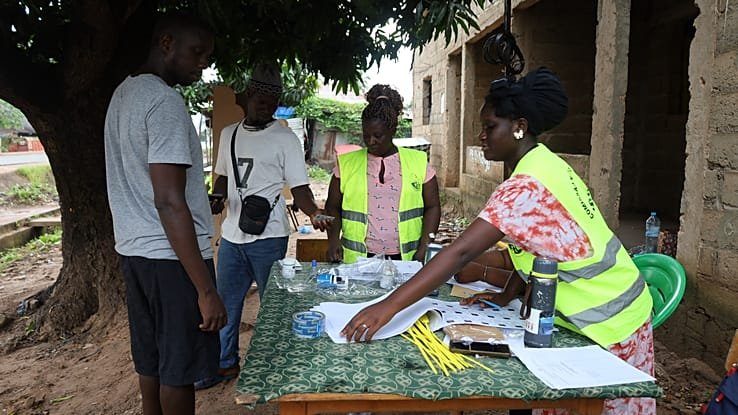
Voters in military-ruled Guinea-Bissau went to the polls on Sunday to decide whether to approve a new constitution that would significantly expand the powers of the president ahead of elections scheduled to return the country to civilian rule later this year.
Polling stations opened at 7:00 a.m. GMT, although voting began slowly in some parts of the capital following heavy early-morning rainfall, according to AFP correspondents.
Security was also heightened across Bissau, with police and national guard personnel deployed at strategic locations.
Voting is scheduled to end at 5:00 p.m. GMT, while the first provisional results are expected from Tuesday.
The referendum comes less than 10 months after the military seized power in a coup in the impoverished Portuguese-speaking West African country.
The junta has presented the proposed constitutional changes as necessary to strengthen political institutions and prevent the recurring power struggles that have plagued Guinea-Bissau.
Under the proposed constitution, the country would move from a parliamentary system to a presidential system. The president would gain the authority to appoint and dismiss the prime minister and members of government, as well as dissolve parliament.
The current system requires the prime minister to emerge from the parliamentary majority, a structure that has frequently resulted in tensions and power-sharing disputes between the president and government.
Voters are being asked to answer “yes” or “no” to the question: “Do you agree with the entry into force of the new constitution approved by the National Transitional Council?”
Shopkeeper Halimatou Traore said she hoped the constitutional reform would help bring stability and improve economic conditions.
“The successive crises the country has gone through have had a very negative impact on my earnings. If everything goes well, Guinea-Bissau will set off on new paths,” she said after arriving to vote.
Braima Seidy, a 76-year-old veteran of Guinea-Bissau’s war of independence against Portugal, also expressed support for the proposed constitution.
“I truly believe that this new Constitution can bring stability to the country,” he said.
However, the referendum has been opposed by sections of the political opposition, which has urged citizens to boycott the vote, citing restrictions on public freedoms and the broader political climate under military rule.
The junta seized power in November and appointed General Horta N’Tam as transitional president. The transitional charter prevents him from contesting elections.
The military takeover came only days after a presidential election, when soldiers overthrew President Umaro Sissoco Embalo and suspended the electoral process.
Embalo had himself dissolved the opposition-dominated parliament following the 2023 legislative elections, saying the move was necessary after what he described as an attempted coup. He subsequently governed by decree until his removal by the military.
The junta says presidential and parliamentary elections will be held on December 6 to restore civilian rule.
Guinea-Bissau has a long history of political instability. Since gaining independence from Portugal in 1974, the country has experienced five coups, alongside several attempted coups.
The referendum is taking place amid broader concerns over constitutional changes across Africa, with several countries in recent years adopting reforms that have extended presidential terms, removed age limits or strengthened executive powers.
The outcome of Sunday’s vote could therefore have significant implications for Guinea-Bissau’s political transition and its efforts to return to democratic civilian rule.


