



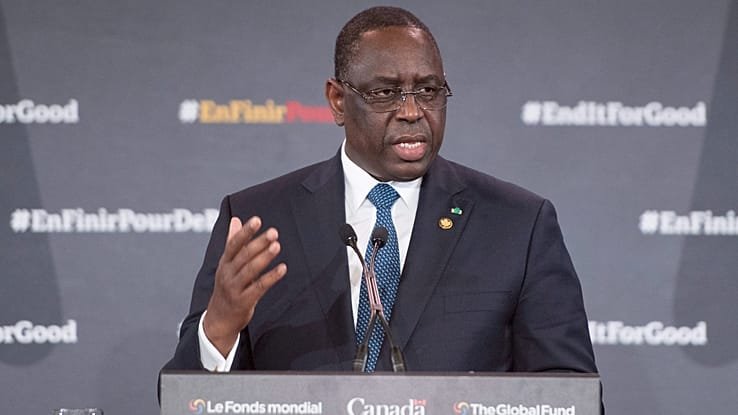
Senegal’s former President, Macky Sall, has withdrawn his candidacy for the position of United Nations Secretary-General following a round of informal voting by UN Security Council members in which all seven contenders faced at least one veto.
Sall announced his decision on Saturday, a day after the latest straw poll, saying he hoped to facilitate the emergence of a consensus candidate for the global organisation’s top job.
In a statement posted on social media, the former Senegalese leader said he “hoped to contribute now to the emergence of a consensus candidate.”
Candidates seeking the position must secure at least nine votes of support from the Security Council’s 15 members. A negative vote from any of the five permanent members — Britain, China, France, Russia and the United States — can effectively block a candidate’s chances.
Sall had struggled to gain sufficient support in earlier voting. In the first straw poll conducted in July, he secured six votes in favour, seven against and two abstentions.
The informal polls are not binding, and further rounds are expected before the final selection process in the autumn.
Following Friday’s voting, Costa Rica’s Rebecca Grynspan emerged as the leading contender, securing seven positive votes. However, she also received five votes against her candidacy, including two from permanent members of the Security Council.
Sall’s bid had initially lacked the backing of his home country, Senegal, and he was nominated by Burundi. However, Senegalese President Bassirou Diomaye Faye endorsed his candidacy in July following a meeting between the two leaders.
His withdrawal leaves Uganda’s Olara Otunnu as the sole African contender in the race.
The contest is also shaped by the longstanding convention that the UN secretary-generalship should rotate among geographical regions. Under this informal arrangement, Latin America is expected to have a strong claim to the position in the next selection, with most of the seven original candidates coming from the region.
Sall’s exit further narrows the field as Security Council members continue consultations to identify a candidate capable of securing the necessary support to lead the United Nations.


