



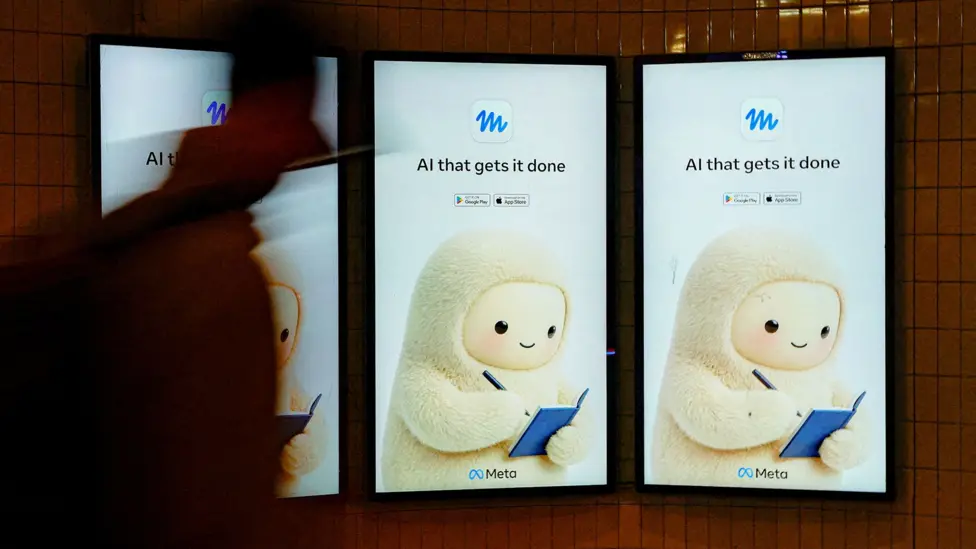
Meta has officially launched its artificial intelligence assistant, Muse, within the United Kingdom.
Initial user reports suggest the tool offers practical assistance for everyday tasks, though some find its interaction style slightly unnatural or awkward.
The service is now accessible to UK users, marking another step in the mainstream adoption of generative AI tools in the European market.
Professionals should note this expansion as part of the broader integration of AI into daily workflows, requiring an assessment of how such tools might alter communication patterns and task management in corporate environments.
Muse has been a hit in the US and is ranked first and second respectively on Google and Apple’s free app stores, having been downloaded millions of times. However, UK regulators have said they are keeping a close eye on the launch over privacy and consumer protection requirements.
Muse can be used as an app or directly within Meta’s WhatsApp messaging platform. Meta invites users to give their assistant a name, a look and a personality, so they can talk to it as well as assign it tasks such as sending an email, booking travel or buying festive presents.
“From doing the Christmas shopping and searching for a cheaper energy deal, to sorting the school calendar … Muse can get it done for you,” Meta said.
The company acknowledged that handing control of your day-to-day digital life to an AI agent was “an act of trust”. Muse cannot make a purchase or send an email without your permission and will only be connected to apps that you let it join.
The app has no visibility into people’s passwords or payment methods, Meta said, and it does not share your conversations with advertisers. It will ask for your approval before making a purchase or sending an email, while a separate “security agent” checks Muse’s actions against the permissions you’ve granted.
“Think of it as a helping hand for the jobs that pile up, like chasing a refund, renewing car insurance or keeping on top of the school calendar,” Meta said. “To get those jobs done, you can connect Muse to the apps you already use, from your email and calendar to the retailer apps you shop on.”
Meta said it had signed deals with an array of British businesses – including Marks & Spencer, Currys, Sainsbury’s and easyJet – allowing Muse to navigate their websites more easily and to access their apps. If a company does not offer a “connector” app that Muse can visit, the agent will access their website instead.
Muse bills itself as a personal AI agent available to anyone aged 18 and over.
“It doesn’t just answer questions, it actually goes out and does work for you,” said David Singleton, Meta’s VP of engineering on AI products.
“So it helps people stay on top of things,” he added. “[It] helps you take tasks and projects off your plate, and also helps you turn your long-term goals into action plans.”
What this means is you can set it up to do something for you, like find some specific holiday options, and it will work away on that even as you move off the app and get on with your day, reporting back once it has finished.
It won’t book the holiday without your permission – but it can then make the purchase, if you let it.
And the permission requests keep on coming. Every time Muse wants to do something, send something or post something, you have to allow it.
It is reassuring to know that an AI agent isn’t running amok in your name, even if it also gets a bit annoying, though you can give it more autonomy (and so get fewer messages) if you adjust the settings.
The Information Commission’s Office and the Competition and Markets Authority said they had been in talks with Meta ahead of the launch about its responsibility to comply with UK laws. The ICO, the UK’s data protection watchdog, said on Tuesday that Meta had committed to a “voluntary monitoring and reporting scheme” with the regulator, while the CMA said talks with Meta had resulted in changes to make the app’s terms and conditions “fairer”.
“We will be closely monitoring this and if we have concerns we will not hesitate to act to protect UK consumers,” said Sarah Cardell, the CMA chief executive.
Reuters reported last week that Meta employees had raised concerns about the app’s performance, including one staff member receiving a reminder to respond to a message from her sister on Signal, an encrypted messaging app. In another example reported by Reuters, Muse delivered a message with random bank account balances in it.
Muse is powered by Muse Spark, Meta’s first model from the company’s “super intelligence” AI lab. In a social media post on Sunday, Meta’s chief AI officer, Alexandr Wang, raised the possibility of humanity losing control over AI systems that are able to improve themselves autonomously.


