


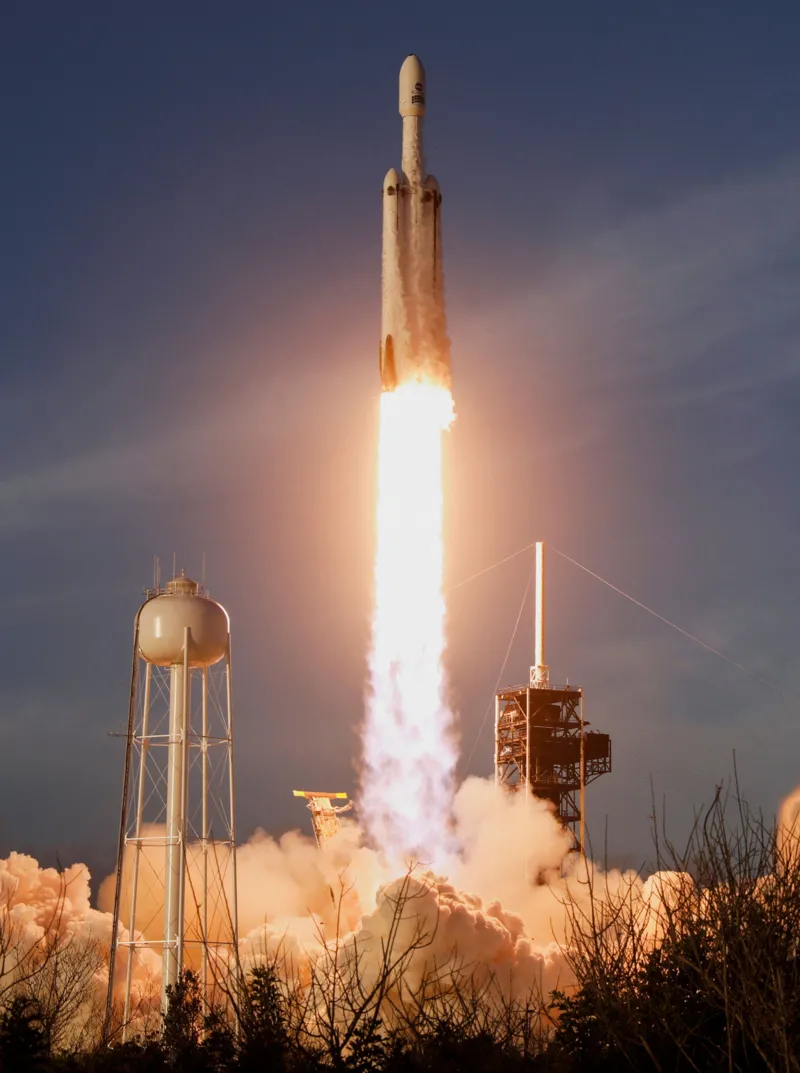
NASA has successfully launched its powerful new space telescope, the Nancy Grace Roman Space Telescope, on a mission to investigate some of the biggest unanswered questions about the Universe.
The telescope lifted off on Sunday from the Kennedy Space Center in Florida aboard a SpaceX Falcon Heavy rocket.
Named after Nancy Grace Roman, NASA’s first chief astronomer and its first female executive, the telescope is expected to provide scientists with an unprecedented view of the cosmos.
Unlike the Hubble Space Telescope, Roman is designed to capture extremely wide views of the sky. Its field of vision is at least 100 times larger than Hubble’s, allowing it to survey huge areas of space more rapidly.
NASA said the telescope will travel for about 100 days to reach its observation point roughly one million miles from Earth. Once operational, it will begin a wide-ranging survey of the Universe, including the search for planets beyond our solar system.
Nicky Fox, a NASA administrator, said the mission would transform scientists’ understanding of the cosmos.
“Roman is going to change the way we look at the universe,” Fox said, adding that the telescope could discover tens of thousands, and potentially up to 100,000, new exoplanets.
The mission will focus on some of astronomy’s most challenging questions, including the nature of dark energy and dark matter. NASA also expects Roman to map billions of galaxies, study black holes and discover and characterise distant exoplanets.
Scientists believe dark matter and dark energy account for about 95 per cent of the Universe, although their true nature remains unknown.
Dark matter cannot be directly seen but is thought to provide gravitational structure that holds galaxies together. Dark energy, meanwhile, is believed to be responsible for accelerating the expansion of the Universe.
About 30 minutes after Sunday’s launch, the Roman telescope separated from the Falcon Heavy rocket and began its journey towards its destination.
Fox said one of the major goals of the mission was to help answer the long-standing question of whether humanity is alone in the Universe.
She explained that Roman’s ability to observe distant worlds could help scientists study their atmospheres and determine whether some may have conditions suitable for life.
The telescope is expected to operate for at least five years, with a potential mission lifespan of up to 10 years.
Roman follows in the footsteps of NASA’s Hubble Space Telescope, which was launched in 1990, and the James Webb Space Telescope, which began its mission in 2021.
While both telescopes have made major discoveries, Roman’s exceptionally wide field of view will allow scientists to conduct much broader surveys of the sky.
The telescope is named in honour of Nancy Grace Roman, who played a key role in the development of Hubble and became known as the “mother of Hubble” for her contribution to getting the landmark telescope approved and developed.
NASA hopes the new mission will provide fresh insights into the origins and evolution of the Universe and bring scientists closer to understanding some of its greatest mysteries.


