



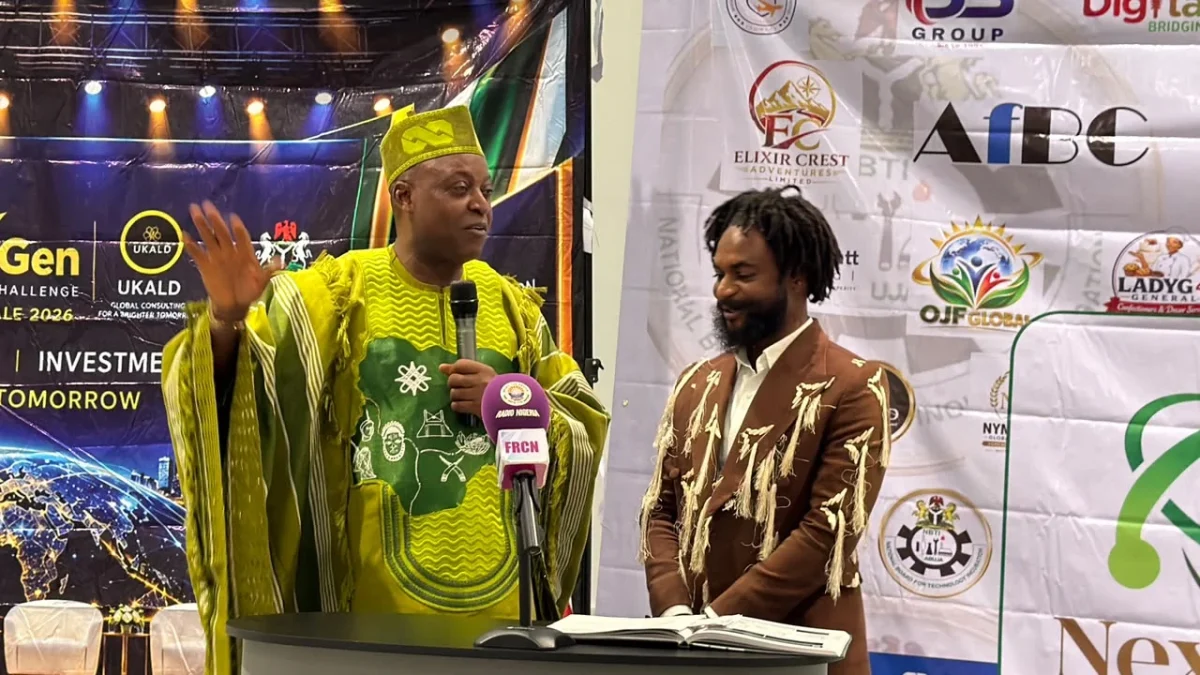
The National Board for Technology Incubation (NBTI) has showcased 298 Nigerian innovators drawn from the 36 states and the Federal Capital Territory to international investors and potential business partners in London, United Kingdom, as part of efforts to commercialise indigenous technologies and attract global investment.
The innovators participated in the 2026 NextGen Innovation Challenge international grand finale, which brought together entrepreneurs, investors, government officials, diplomatic representatives and other stakeholders to explore opportunities for technology development, business partnerships and international collaboration.
According to a statement made available to PUNCH Online on Friday, the initiative is designed to connect Nigerian innovators with global markets and transform locally developed ideas into commercially viable products and businesses.
Speaking at the event, the Director-General of NBTI said innovation, entrepreneurship and technology commercialisation were critical to Nigeria’s ambition of building a $1tn economy.
He maintained that the country’s economic prosperity could not depend solely on government spending or natural resources but required investment in technology, manufacturing, intellectual property and enterprise development.
“A one-trillion-dollar economy cannot be built by government alone. It must be built by Nigerians who innovate, Nigerians who manufacture, Nigerians who invest, Nigerians who create intellectual property, Nigerians who build enterprises, and Nigerians who compete successfully in the global markets,” he said.
The NBTI chief explained that the NextGen Innovation Challenge was established to bridge the gap between ideas and commercial opportunities by connecting innovators with investors, business partners and international markets.
He disclosed that participation had increased from 105 Nigerian innovators in the previous edition to 298 in 2026, describing the expansion as a significant step towards moving indigenous research and innovations from prototypes to marketable products, viable businesses and job creation.
He commended the Federal Ministry of Innovation, Science and Technology, the Ministry of Foreign Affairs, the Nigerian High Commission in the United Kingdom, the British High Commission and strategic partner UKALD for supporting the initiative.
He also acknowledged NBTI staff and managers of technology incubation centres across the country for identifying, mentoring and supporting innovators.
“The ultimate measure of the programme would be the businesses established, technologies commercialised, investments secured, jobs created and lives improved,” he said.
“Today is a celebration, but tomorrow is the real test,” he added, urging participants to focus on developing, commercialising and scaling their innovations through strategic partnerships.
In a keynote address delivered on behalf of Nigeria’s High Commissioner to the United Kingdom, Ambassador Aminu Dalhatu, Ambassador Abu Obey Eche described the showcase as an opportunity to demonstrate Nigeria’s innovation potential to the international community.
He said London’s position as a major centre for finance, technology, research and enterprise made it an appropriate platform for Nigerian innovators seeking investors and international business partners.
“Diplomacy today must go beyond governments speaking to governments. It must also connect businesses to markets, innovators to investors, researchers to institutions, and Nigerian opportunities to global capital,” Eche said.
He reaffirmed the Nigerian High Commission’s commitment to strengthening relationships that would help local innovators access international opportunities.
Eche also encouraged Nigerians in the diaspora to contribute their expertise, financial resources and knowledge of international markets to support emerging entrepreneurs at home.
He commended the Federal Government, NBTI and UKALD for creating a platform that connects grassroots innovators with prospective global partners. He further suggested that the challenge could be extended to other Commonwealth countries to expand opportunities for Nigerian entrepreneurs.
An investor, Erin Grover, expressed enthusiasm about the innovations and business ideas presented at the event, particularly those developed by women.
Grover, who said she had worked with startups and nonprofit organisations across Africa and Asia, disclosed her interest in investing in at least one of the women entrepreneurs she encountered at the showcase.
“I think there are some inspiring women here especially who I’ve been able to speak with today, and I definitely hope to invest in at least one of them coming out of this event,” she said.
Drawing from her entrepreneurial experience, she encouraged participants to remain persistent, believe in their ideas and learn from their mistakes.
“My one piece of unsolicited advice is to just never give up ever, be persistent as hell, keep going,” she said, urging the innovators to maintain strong support networks while pursuing their business goals.
The Chairman of the All Progressives Congress in the United Kingdom and Executive Director of UKALD, Tunde Doherty, described the challenge as an opportunity to expose the commercial potential of Nigerian innovations to international investors.
He said the 298 innovations presented at the event offered investment opportunities in products with commercial potential, urging investors to consider Nigeria as a destination for technology and enterprise investment.
Doherty cited the country’s human resources and creative capacity as important assets and commended NBTI for expanding the programme and facilitating connections between local innovators and international partners.
The Permanent Secretary of the Federal Ministry of Innovation, Science and Technology, Mukhtar Muhammad, also praised NBTI for creating opportunities for young Nigerians to apply their knowledge and creativity to practical challenges.
He argued that innovation was not limited to academic qualifications but also involved identifying societal problems and developing workable solutions.
“If there is a problem in the society and you identify that problem and you try to solve it, you are making more impact to the society than someone who is doing several degrees in university,” Muhammad said.
He pledged increased ministerial support for the initiative in the coming year and proposed that states establish their own processes for identifying promising innovators.
According to him, such an approach could encourage healthy competition, expand opportunities for young people and help discover more technologies capable of addressing local challenges.
The showcase brought together government representatives, investors, diplomats and other stakeholders seeking to strengthen Nigeria’s innovation ecosystem.
Organisers said the programme was intended to establish lasting connections between Nigerian innovators and global markets, attract investment, create jobs, commercialise indigenous technologies and support the growth of sustainable enterprises.


 has showcased 298 Nigerian innovators drawn from the 36 states and the Federal Capital)