


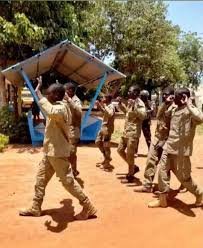
Dozens of soldiers have been arrested, while others were reportedly killed, after an attempted mutiny in Niger’s capital, Niamey, following nearly 24 hours of unrest.
The rebellion was reportedly led by young soldiers angered by the worsening jihadist violence and continued deaths among security forces under the country’s military junta.
Analysts and diplomats said Russia’s Africa Corps provided aerial and ground support to Nigerien forces as they moved to suppress the mutiny.
Niger’s state broadcaster, RTN, aired footage showing dozens of mostly young soldiers being paraded in public after sustained gunfire and explosions were heard overnight around a key military base located within Niamey’s main airport and close to the presidential palace.
The whereabouts of Niger’s military leader, Abdourahamane Tchiani, remained unclear during the unrest.
Russian media quoted Moscow’s Ambassador to Niger, Viktor Voropayev, as saying that senior Nigerien military officers had visited the Africa Corps base at the airport and expressed gratitude to its personnel for helping to suppress the rebellion.
According to analysts and diplomats, the mutinous soldiers remained at the military base until late Saturday, while members of the presidential guard secured the presidential palace and moved to retake control of the base.
Wassim Nasr, a senior research fellow at the Soufan Center, said loyalist forces had regained the “upper hand at least at the airport (and base).”
However, Nasr said some military forces were still moving towards Niamey, making it unclear whether they were heading to support the mutineers or the junta.
Following the restoration of order, hundreds of people gathered in Niamey to demonstrate their support for Tchiani and his military government.
Ibrahim Boubacar, head of a pro-junta association, condemned the attempted rebellion and warned against efforts to destabilise the country.
“We do not accept that ill-intentioned individuals try to destabilize us, or try to undermine this emancipatory process that we have embraced,” Boubacar said.
He added that Niger’s “external enemies” had vowed to take measures to destabilise the country and create divisions among its population.
Tchiani’s junta seized power in a 2023 coup, citing the elected government’s failure to contain jihadist violence as one of the reasons for its intervention.
Since taking power, the military government has cut security ties with several longtime Western partners, including France, and strengthened its relationship with Russia.
Despite the shift in alliances, militant attacks and killings of security personnel have continued, raising concerns over the junta’s ability to restore security and reportedly contributing to growing discontent within the military.
Diplomats and analysts said some of the soldiers involved in the mutiny were from southwestern Niger, one of the areas hardest hit by persistent insecurity.
The attempted uprising comes as Niger’s military authorities face mounting pressure to contain armed groups operating across the country and address growing concerns over the security situation.


