


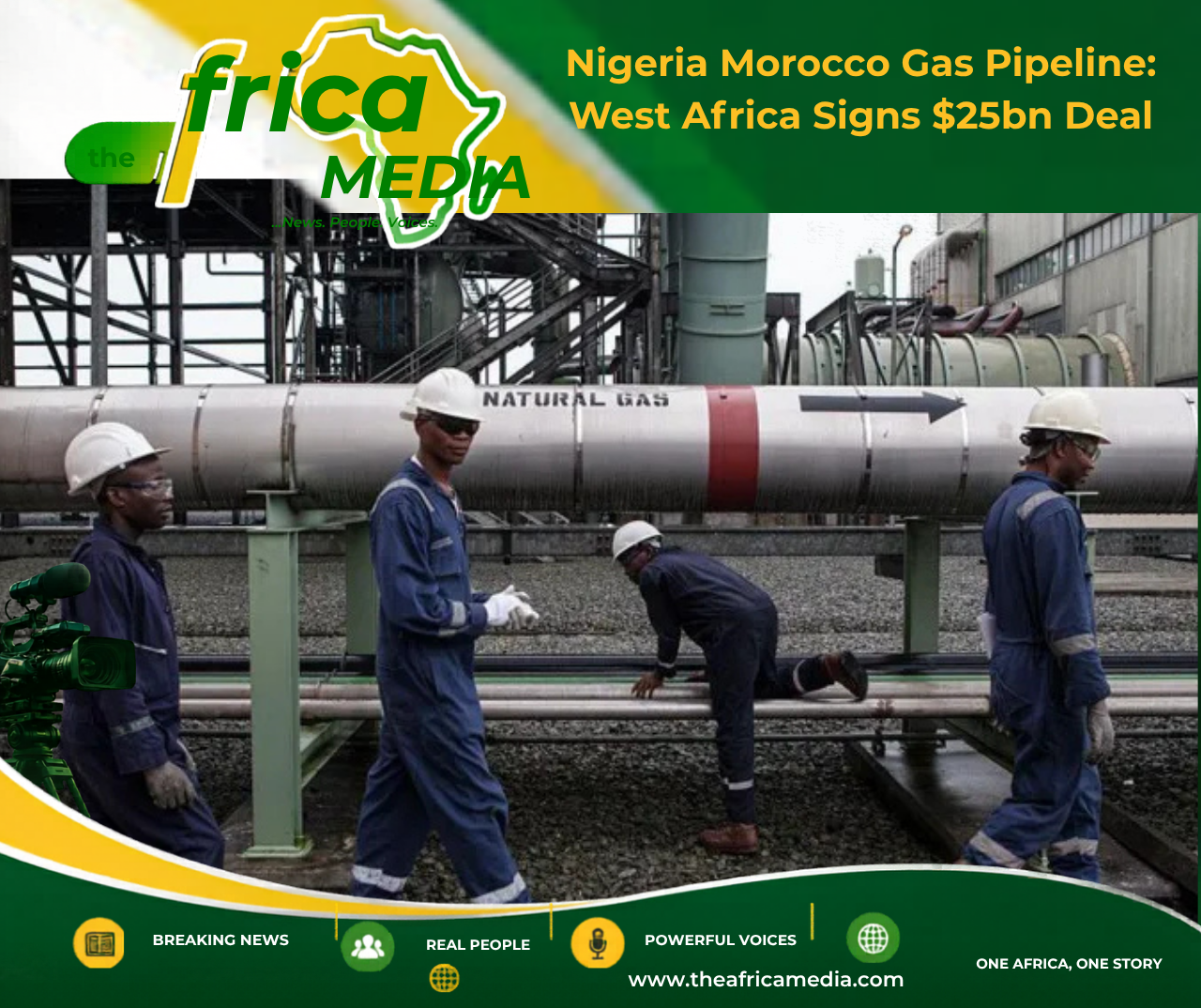
One of Africa’s most ambitious energy infrastructure projects has finally been signed off at the highest level, with West African leaders formally endorsing the long-awaited Nigeria Morocco gas pipeline.
“Don’t be surprised when the gas comes your way,” said Julius Maada Bio, Sierra Leone’s president and current head of the West African regional bloc ECOWAS, following Sunday evening’s ceremony in Freetown.
The vast 6,000km (3,700 mile) pipeline will run along the Atlantic coast of 14 African nations, carrying Nigerian gas to Morocco before linking into Europe’s existing gas network via Spain. Construction is expected to begin in 2028, with a total estimated cost of $25 billion (£19 billion).
Ending a Costly Cycle of Raw Resource Exports
The pipeline signals a shift away from current models, where gas is typically extracted from African nations, refined and processed abroad, then shipped back to African countries at three or four times the price, according to energy expert and former Nigerian government adviser Charles Majomi.
That practice must end, Majomi told BBC Focus on Africa, describing it as a complete devaluation of resources that countries like Nigeria are fortunate to have. He argued that, if leveraged correctly, the pipeline has the potential to stimulate regional industrial growth and boost Africa’s standing on the international stage, giving the continent more weight in negotiations with Europe and Asia.
Professor Ganiyat Adejoke Adesina-Uthman of the National Open University of Nigeria said the project will open up Africa as a corridor to international markets, beyond simply strengthening energy security. She called it a symbol of what Africa can achieve when countries collaborate.
A Decade in the Making
If all goes to plan, some 30 billion cubic metres of gas per year will pass through the Nigeria Morocco gas pipeline, serving 400 million consumers and making it one of the world’s longest offshore gas pipelines. The project would reshape West Africa’s energy landscape.
Sunday’s agreement follows roughly a decade of negotiations involving more than a dozen countries. It establishes the legal and governance framework for the pipeline and is widely seen as the last major political hurdle before financing and construction decisions.
While construction has not yet begun, the project has entered a more advanced political and technical phase than at any point since it was first proposed in 2016. Analysts told the BBC that construction will not begin in Nigeria, since the country was initially flagged as a potential stumbling block. Majomi said financing will instead proceed in segments, starting with the Morocco-Mauritania-Senegal axis, then moving to the Ghana-Côte d’Ivoire axis, before finally connecting to Nigeria, which would then supply the gas.
Unlike the Trans-Saharan Gas Pipeline through Niger and Algeria, this Atlantic route largely avoids the Sahel’s most insecure regions, although offshore construction significantly raises costs. Feasibility studies and front-end engineering design (FEED) studies are said to be complete, and the pipeline route has largely been agreed.
Financing and Security Remain Key Hurdles
Financing may prove more difficult. The projected $25 billion cost could rise due to inflation, and the project’s success depends on all 13 member nations, plus the disputed territory of Western Sahara, playing their part in protecting the infrastructure from attacks.
Majomi said that whether a country defaults on its off-take obligations for the gas moving through its territory will depend on its ability to muster security and integrate host communities into defending the long pipeline routes. He added that drones and aerial monitoring are also likely to play a role in protecting the infrastructure.
Nigeria’s state oil firm and Morocco’s national mining body are jointly leading the pipeline project. Regional institutions supporting the initiative include ECOWAS, the Islamic Development Bank and the OPEC Fund for International Development.
What the Pipeline Could Mean for the Region
Beyond exports to Europe, the pipeline is intended to supply natural gas to countries that currently rely on expensive imported fuels, potentially supporting new power generation, fertiliser plants, petrochemical industries and manufacturing along the Atlantic coast. For Nigeria, it offers an opportunity to monetise its vast gas reserves while strengthening economic ties across West and North Africa.
Despite strong political momentum, significant obstacles remain. Financing the project, securing the pipeline route, and ensuring political stability across participating countries will pose major challenges even before construction can advance. Other challenges include lengthy offshore engineering sections and competition from alternative export routes, including liquefied natural gas (LNG) projects and the Nigeria-Algeria Trans-Saharan Gas Pipeline. There are also open questions about future European gas demand as the continent accelerates its transition to renewable energy.
“Nigeria has the gas and there’s market access from Morocco to Europe,” said Adesina-Uthman. “It’s not just extracting energy, it will lead to access to clean energy for many countries with Morocco as a gateway. It will also create industries, job opportunities and ultimately a global market. It’s not just for regional integration but a global project.”


