


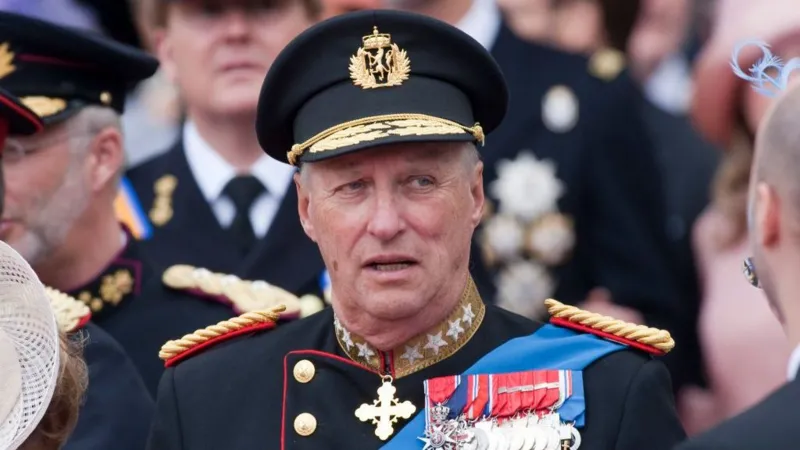
Norway is mourning the death of King Harald V, who passed away at the age of 89 after a long period of declining health. The Norwegian Royal Palace announced that the monarch died peacefully at 6:35 a.m. local time on Friday at the National Hospital in Oslo, where he had been receiving treatment for a rare blood disorder.
Following his death, the royal flag at the palace was lowered to half-mast, while a period of national mourning was declared ahead of his funeral. Mourners also gathered outside the palace to lay flowers and pay their respects. Harald’s death brings an end to a 35-year reign during which he became known as a warm, approachable and reform-minded monarch. He will be succeeded by his 53-year-old son, Crown Prince Haakon. A King Who Modernised the Monarchy Born on February 21, 1937, near Oslo, Harald was the first Norwegian-born king in centuries.
He was only three years old when Nazi Germany invaded Norway during World War II, forcing his mother and siblings to flee first to Sweden and later to the United States. After the war, Harald returned to Norway, completed his education and served in the military. He later studied social sciences, history and economics at Oxford University.His personal life also helped reshape Norway’s royal traditions.Harald fell in love with Sonja Haraldsen, the daughter of a businessman.
Because she was a commoner, the couple had to wait nine years before receiving permission to marry. Harald reportedly told his father that if he could not marry Sonja, he would remain unmarried. His father eventually agreed, and the couple married at Oslo Cathedral on August 29, 1968. Their marriage helped pave the way for future members of the royal family to marry outside traditional aristocratic circles.
A Monarch Close to the PeopleHarald became king in January 1991 following the death of his father, King Olav V.Over the years, he earned a reputation for being down-to-earth and emotionally open. Royal observers often described him as the “People’s King” because of his close relationship with ordinary Norwegians. During his reign, the monarchy became more transparent about its finances and the health of members of the royal family.
One of his most memorable moments came after the devastating 2011 terrorist attacks in Oslo and Utøya, in which 77 people were killed. Harald addressed the nation with an emotional message of unity, urging Norwegians not to allow fear to divide them. His ability to openly express grief and empathy strengthened his image as a national figure who stood with citizens during difficult times.In 2016, he again attracted international attention after delivering a speech celebrating Norway’s diversity, embracing people of different nationalities, religions and sexual orientations.
A Passionate Athlete and Environmentalist Away from royal duties, Harald was an accomplished sportsman and environmentalist. He was particularly passionate about sailing and represented Norway at three Olympic Games. He was also involved in environmental conservation and helped establish the Norwegian branch of the World Wide Fund for Nature, serving as its president for two decades. He regularly supported Norwegian athletes and national teams, becoming a familiar figure at major sporting events. Family Controversies During His Final Years Despite Harald’s personal popularity, his final years were overshadowed by controversies and health problems involving members of his family.
His son, Crown Prince Haakon, married Mette – Marit in 2001. Harald and Queen Sonja welcomed Mette-Marit’s young son from a previous relationship into the family, although he was never considered a member of the royal family. In recent years, Mette-Marit’s past association with convicted sex offender Jeffrey Epstein attracted intense scrutiny. She later apologised and acknowledged that her judgement had been poor.Her son, Marius Borg Høiby, was also convicted of multiple offences, including rape, and received a four-year prison sentence. He has appealed the conviction.
Harald’s daughter, Princess Märtha Louise, also generated controversy after marrying an American self-described shaman in 2024. Her business activities eventually led her to step back from official royal duties. These controversies contributed to a decline in public support for Norway’s monarchy, although critics generally distinguished between the family’s scandals and Harald himself. Declining Health and Final DaysHarald’s health had deteriorated in recent years, forcing him to reduce his public engagements permanently in April 2024.
He was later treated for haemolytic anaemia, a rare condition that can reduce the number of healthy red blood cells in the body. He was admitted to hospital on August 17, with Crown Prince Haakon temporarily taking over his official responsibilities. Harald died days later, surrounded by the final chapter of a reign that had combined tradition with significant social change. International leaders, including King Charles III of the United Kingdom and King Carl XVI Gustaf of Sweden, expressed their condolences.
For many Norwegians, however, the immediate focus is not on the controversies that surrounded the royal family, but on remembering a monarch who spent 35 years representing the nation.
King Harald V leaves behind his wife, Queen Sonja, their daughter Princess Märtha Louise, their son King Haakon, and six grandchildren. As Norway begins a new chapter under King Haakon, the country says goodbye to a monarch remembered by many as its beloved “People’s King.”


