


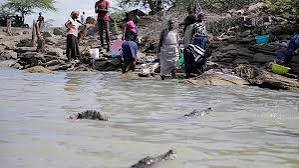
Kenyan wildlife authorities have launched an operation to capture and relocate crocodiles from the shores of Lake Baringo after rising water levels pushed the reptiles dangerously close to homes and fishing communities.
The week-long operation, led by the Kenya Wildlife Service (KWS), aims to reduce growing human-wildlife conflict in the area, where exceptionally high lake levels have displaced thousands of people and brought wildlife closer to populated areas.
Scientists have linked the dramatic rise in water levels across several lakes in Kenya’s Rift Valley to extreme rainfall associated with climate change.
With further heavy rains expected under the El Niño weather pattern, authorities fear that crocodiles could be forced even deeper into nearby villages.
Lake Baringo has expanded significantly in recent years. An analysis of satellite imagery from Copernicus Sentinel and NASA Landsat shows that the lake’s surface area has increased by about 70 per cent since 2010, reaching approximately 234 square kilometres.
KWS veterinary officer Dominic Mijele, who is leading the operation, said capturing the reptiles was both difficult and dangerous.
“Catching them is not easy, they are very shy… it is difficult to lure them… and dangerous,” Mijele said.
Wildlife officers have adopted an unusual method to lure the crocodiles into traps. They play a recording of a distressed dog from a speaker positioned along the lakeshore, while nets baited with dead fish are used to capture the reptiles.
Officers have also had to instruct curious residents to remain quiet and stay out of sight so they do not frighten the crocodiles away from the traps.
At one point, several crocodiles moved around the edges of a net without entering it, with officials saying the reptiles had become more cautious after at least five had previously been captured at the same location.
When a mid-sized crocodile eventually entered one of the traps, a vehicle attached to the net pulled the reptile from the water.
The animal fought fiercely, thrashing and twisting as wildlife officers struggled for nearly 30 minutes to restrain it.
A local fishmonger who witnessed the capture said the crocodile had repeatedly approached her home.
“It is the one that has been disturbing me at my home every day,” she said.
According to Mijele, Lake Baringo is estimated to be home to more than 200 crocodiles, with the current operation focusing on larger animals weighing at least 200 kilogrammes.
So far, about 13 crocodiles have been captured and transferred to a protected park, while authorities hope to relocate at least 30 during the operation.
Residents in fishing communities have largely welcomed the move, saying the crocodiles have posed a longstanding threat to their livelihoods and safety.
Dorcas Kiplagat, a 35-year-old fishmonger, described the operation as a relief.
“It is a great relief, they have terrorised us for a long time… they destroy our fishing nets every day,” she said.
However, not everyone supports the relocation.
Some residents fear that removing the crocodiles could diminish the area’s appeal to tourists, particularly visitors who come to see wildlife around the lake.
One local resident questioned what would remain as a tourist attraction if the crocodiles were removed.
“It is enough now… what are we going to show foreign tourists?” the resident asked.
For wildlife officials, however, the immediate concern is safety, with fears that further rises in Lake Baringo could push more crocodiles into surrounding villages and increase the risk of dangerous encounters between the reptiles and displaced communities.


, aims to reduce growing human-wildlife conflict in the area, where)