


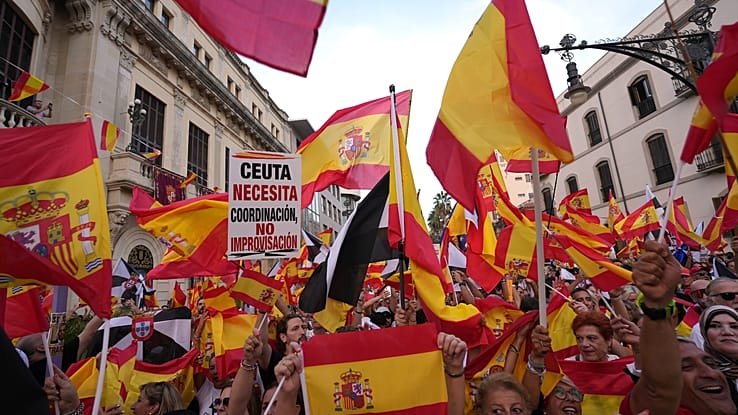
Tens of thousands of people took to the streets across Spain on Wednesday to protest the country’s handling of a major migration crisis in Ceuta, demanding urgent action from the government and accusing Prime Minister Pedro Sánchez of mishandling the situation.
The demonstrations coincided with Ceuta’s annual official holiday, but celebrations in the Spanish enclave were overshadowed by the continuing humanitarian and political fallout from a mass migrant crossing earlier in the year.
In Madrid, authorities estimated that about 50,000 people joined the protest. Large demonstrations were also reported in Barcelona, Valencia and Seville.
Many protesters waved Spanish flags and chanted slogans including “A united Ceuta will never be defeated,” “Sánchez to prison” and “Invaders — go home,” in reference to migrants who remain in the territory.
Following the end of the Madrid demonstration, an Associated Press journalist reported hearing gunshots and explosions. Spanish newspaper El País reported that police used rubber bullets and tear gas to disperse crowds.
Spain’s Minister of Territorial Policy, Ángel Víctor Torres, accused opposition forces of using the crisis for political purposes.
“This is not to show support for the city of Ceuta or its residents; it is to attack the government of Spain,” Torres told Spanish National Radio.
The crisis began in late July when about 72,000 people reportedly attempted to enter Ceuta by swimming, scrambling over barriers or charging through the border area from neighbouring Morocco. At least 90 people died in the attempt, according to reports.
Although most of those who crossed were quickly returned or escorted back to Morocco, Spain’s national government said about 5,000 migrants remained in Ceuta weeks later, including approximately 1,200 minors. Local authorities have cited a higher number.
The sudden arrival of such a large number of migrants overwhelmed the small territory, which has a population of about 84,000, placing considerable pressure on accommodation and other public services.
Local officials have accused Spain’s central government of failing to respond adequately to warnings before the border was breached, while questions have also been raised over whether Moroccan authorities could have done more to prevent the mass crossing.
Sánchez has repeatedly defended Morocco’s response, saying its authorities acted quickly to assist Spain in returning most of the migrants.
The Spanish prime minister has also rejected suggestions that Moroccan officials were involved in facilitating the influx.
“There is no information from any of our intelligence services that points to the participation of Moroccan authorities,” Sánchez told Cadena Ser radio.
He has instead attributed the mass movement to a combination of misinformation on social media and a misunderstanding of a Supreme Court ruling.
Sánchez has further alleged that social media accounts linked to Russia and Israel, as well as right-wing groups, exploited and amplified the crisis after the mass crossing occurred on July 30 and 31.
Both Russia and Israel have rejected the allegations.
With Sánchez facing an election next year, the Ceuta crisis has become a major political issue, deepening public debate over immigration, border security, Morocco’s role and the Spanish government’s handling of the unprecedented influx.


