


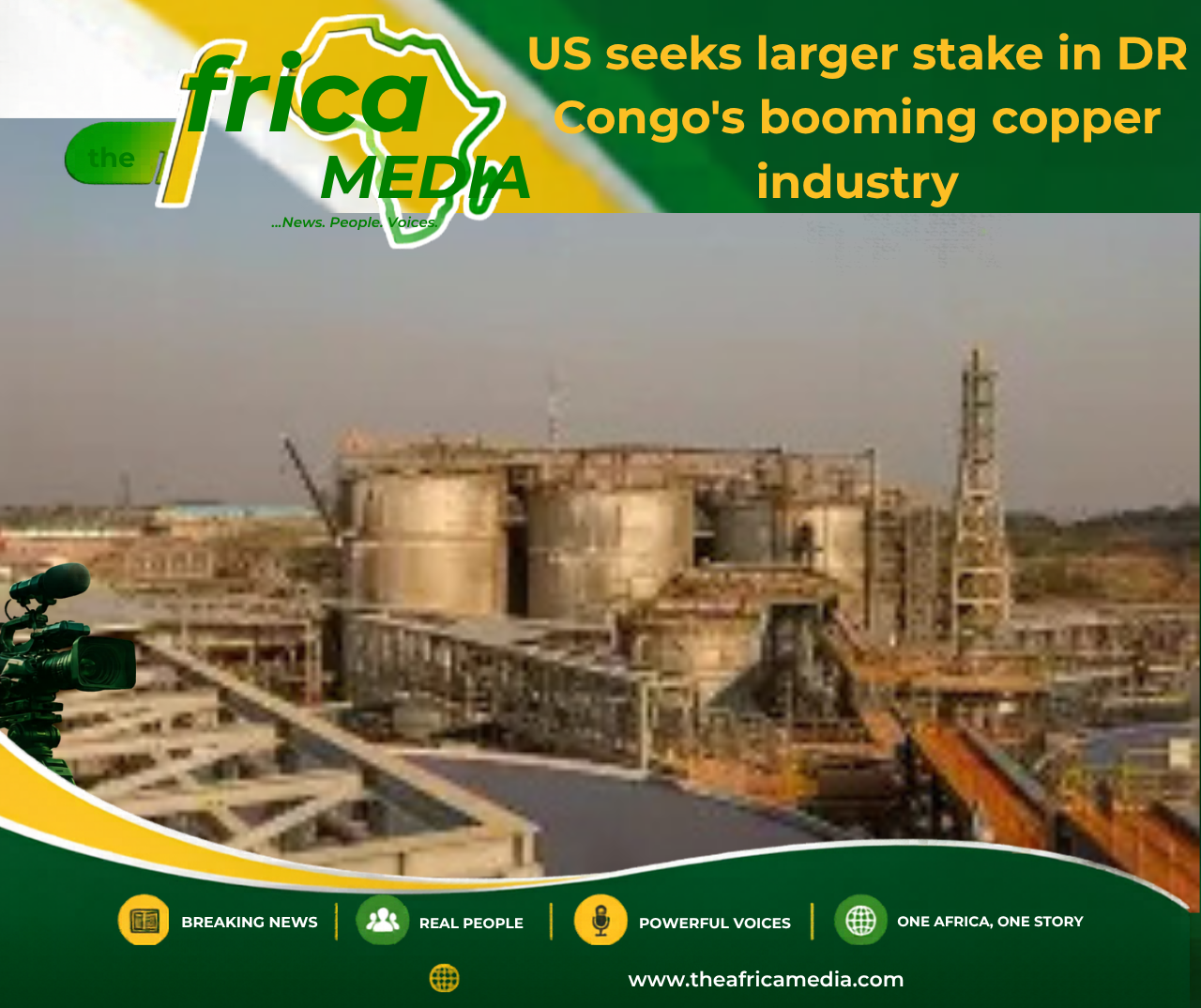
The United States is seeking a greater role in the Democratic Republic of the Congo’s vast copper industry as global competition intensifies over access to critical minerals essential for modern technology and clean energy.
At the heart of the race is the Kamoa-Kakula Copper Complex, one of the world’s richest copper deposits. The mine is expected to produce around 500,000 tonnes of copper annually by 2028, making it one of the largest copper-producing operations globally.
“Kamoa is currently one of the largest copper mines in the world and is growing to become the largest in Africa,” said managing director Annebel Oosthuizen.
The mine’s exceptionally high-grade ore contains copper concentrations about four times the global average, making it highly valuable for industries producing smartphones, computers, electric vehicles, batteries, electrical wiring and renewable energy technologies.
The Democratic Republic of the Congo is also the world’s leading producer of cobalt, supplying more than half of global demand. Both copper and cobalt are regarded as strategic minerals due to their importance in electronics, defence, aerospace and the global transition to clean energy.
According to the United Nations Conference on Trade and Development, global demand for copper is expected to increase by more than 40% by 2040, while demand for cobalt could quadruple by 2030.
The Kamoa project is jointly owned by Ivanhoe Mines and Zijin Mining, with the Congolese government holding a 20% stake.
China has dominated mining investment in the DRC for nearly two decades and is estimated to account for around 70% of the country’s mining activity. However, Washington is now increasing its involvement following a strategic partnership agreement signed with Kinshasa last December as part of a broader peace initiative.
Under the agreement, Congolese authorities have submitted an initial list of 25 mining sites for potential US investment or development.
In February, commodities giant Glencore signed a memorandum of understanding with the US-backed Orion Critical Mineral Consortium, which could acquire up to a 40% stake in Glencore’s mining assets in the DRC.
Glencore DRC president Marie-Chantal Kaninda said the agreement would allow the United States to benefit from mineral production from the country through the partnership.
Meanwhile, Eric Kalala, head of the state-owned General Cobalt Company, said the rivalry between the United States and China was not the DRC’s concern.
“We are working with everyone,” Kalala said, adding that the country welcomes investment from all partners, provided it benefits both the Democratic Republic of the Congo and its investors.
Mining remains the backbone of the Congolese economy, accounting for roughly half of the country’s estimated $10.9 billion gross domestic product.


