



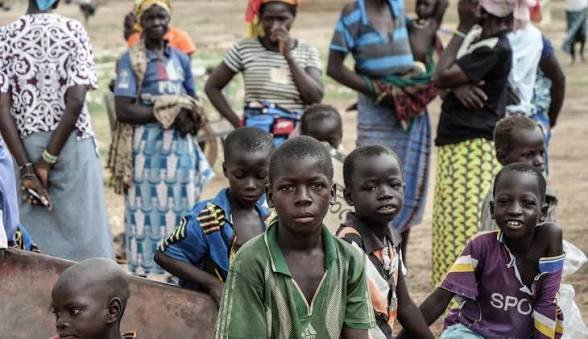
An estimated 260 million children across Africa lived in conflict zones in 2025, accounting for 44 per cent of the 589 million children exposed to armed conflict globally, according to a new report by Save the Children, highlighting the growing humanitarian burden of wars, insurgencies and violence on the continent.
The figure means that nearly two in every five African children live within areas affected by conflict, as prolonged insecurity continues to expose millions to displacement, hunger, injuries, psychological trauma and disrupted education.
Africa accounts for the largest share of children living in conflict zones worldwide, with the situation worsening in several countries where armed violence, political instability and humanitarian crises have forced families from their homes and weakened access to essential services.
The report, which puts the global figure at one in four children living in conflict zones, said the number reached its highest level since the end of the Cold War in 1990, reflecting the increasing spread and intensity of conflicts across several regions.
The consequences are particularly severe for children, who often bear the brunt of violence despite having little or no control over the circumstances that expose them to war.
In Yemen, a young girl diagnosed with severe acute malnutrition is fighting for her life, while a six-year-old boy is recovering from serious injuries and lasting trauma after an unexploded device detonated as he walked home from school.
In Syria, years of conflict have forced children to flee repeatedly, with many living in overcrowded displacement camps and makeshift shelters where access to healthcare, education, clean water and other basic necessities remains limited.
Save the Children warned that the situation could deteriorate further in 2026 as fighting and instability persist across the Middle East, including Iran, Lebanon and Yemen.
Despite a ceasefire, conditions in Gaza remain dire, with continued attacks, displacement and restrictions on humanitarian supplies leaving children vulnerable to hunger, disease and further trauma.
The organisation said millions of children remain trapped in conflict, facing threats not only to their immediate survival but also to their education, development and long-term prospects.
The increase in children living near armed conflict in Africa reflects the spread of violence across several regions, including the Sahel, the Horn of Africa, the Great Lakes region and parts of Central Africa.
In the Democratic Republic of Congo, renewed fighting and attacks by armed groups have continued to displace families, leaving children exposed to violence, exploitation and the loss of basic services. In Sudan, the war between the Sudanese Armed Forces and the Rapid Support Forces has triggered one of the world’s largest displacement and humanitarian crises, with children facing acute food shortages, disease and disrupted schooling.
Nigeria also remains affected by insecurity in parts of the North-East, North-West and North-Central, where insurgency, banditry, communal violence and kidnappings have disrupted communities and forced families to flee.
The report’s findings place Nigeria among countries where grave violations against children continue to be documented. Across conflict settings, children face risks of recruitment by armed groups, abduction, sexual violence, killing and maiming, as well as attacks on schools and healthcare facilities.
These violations have consequences that can last into adulthood. Children who lose parents or caregivers may be forced into work or early marriage, while those who experience violence or prolonged displacement can suffer lasting emotional and psychological distress.
The loss of schooling is another major concern. When schools are destroyed, occupied, closed because of insecurity or inaccessible to displaced families, children lose not only education but also protection, routine and opportunities for social development.
In communities where conflict persists for years, the disruption can leave children with little prospect of returning to normal life, even when violence temporarily subsides.
The report’s African figures show the scale of the challenge. The number of children living in conflict zones increased from approximately 218 million in 2024 to 260 million in 2025, a rise of nearly 20 per cent.
The proportion of African children living in conflict zones has also more than tripled since 2010, when about one in eight children were affected. By 2025, the figure had risen to approximately two in five.
Save the Children said the increase reflects the widening geographical reach of armed conflict and the growing number of children whose homes and communities are within areas experiencing violence.
Nigeria is among the countries where the United Nations documented high numbers of grave violations against children in 2025, alongside the Palestinian territories, the Democratic Republic of Congo, Myanmar and Somalia.
The report’s findings are particularly relevant to the country’s prolonged security challenges, with children in conflict-affected communities facing abductions, recruitment, killings, sexual violence and the destruction or disruption of schools.
The UN-verified data recorded 38,967 grave violations against children globally in 2025, the second-highest annual figure since monitoring began in 2005. More than half of the violations occurred in the Palestinian territories, the Democratic Republic of Congo and Nigeria.
The violations include killing and maiming, recruitment and use of children by armed forces and groups, abduction, sexual violence, attacks on schools and hospitals, and denial of humanitarian access.
The report documented 14,224 children killed or maimed, 5,128 abductions and 1,787 cases of sexual violence in 2025. Attacks on schools and hospitals increased for the fifth consecutive year to 2,930 incidents.
In Africa, sexual violence against children remains particularly alarming. About 86 per cent of verified cases globally occurred in conflict settings on the continent, with the Democratic Republic of Congo and Sudan recording significant increases.
In the DRC, verified cases rose from 358 in 2024 to 592 in 2025, while Sudan recorded an increase from 74 to 193.
The figures, however, do not capture the full scale of abuse. Save the Children said many incidents remain undocumented, particularly in areas where insecurity prevents humanitarian workers and investigators from reaching victims.
The report also raises concerns over the growing restrictions on humanitarian assistance, with verified incidents of aid denial increasing from 509 in 2015 to 8,322 in 2025, more than 16 times the figure recorded a decade earlier.
The restrictions have left children without food, medicines, clean water and emergency protection in some of the world’s most dangerous conflict settings. More than 70 per cent of the verified incidents of aid denial in 2025 involved Palestinian children.
Save the Children called on governments and parties to conflicts to respect international humanitarian law, protect children and civilian infrastructure, and allow humanitarian organisations safe and unhindered access to affected populations.
The report’s estimates of children living in conflict zones were compiled by the Peace Research Institute Oslo using conflict-event data and population estimates. It defines a conflict zone as an area within 50 kilometres of at least one recorded conflict incident in a given year.
The methodology measures children’s proximity to violence rather than suggesting that every child within the radius experiences the same level of danger.
Nevertheless, the rising numbers point to a deepening crisis across Africa, where millions of children are growing up amid insecurity, displacement and uncertainty.
With 260 million children living in conflict zones, the report warns that the consequences of today’s wars could extend well beyond the battlefield, threatening education, health, development and the future of an entire generation.


