


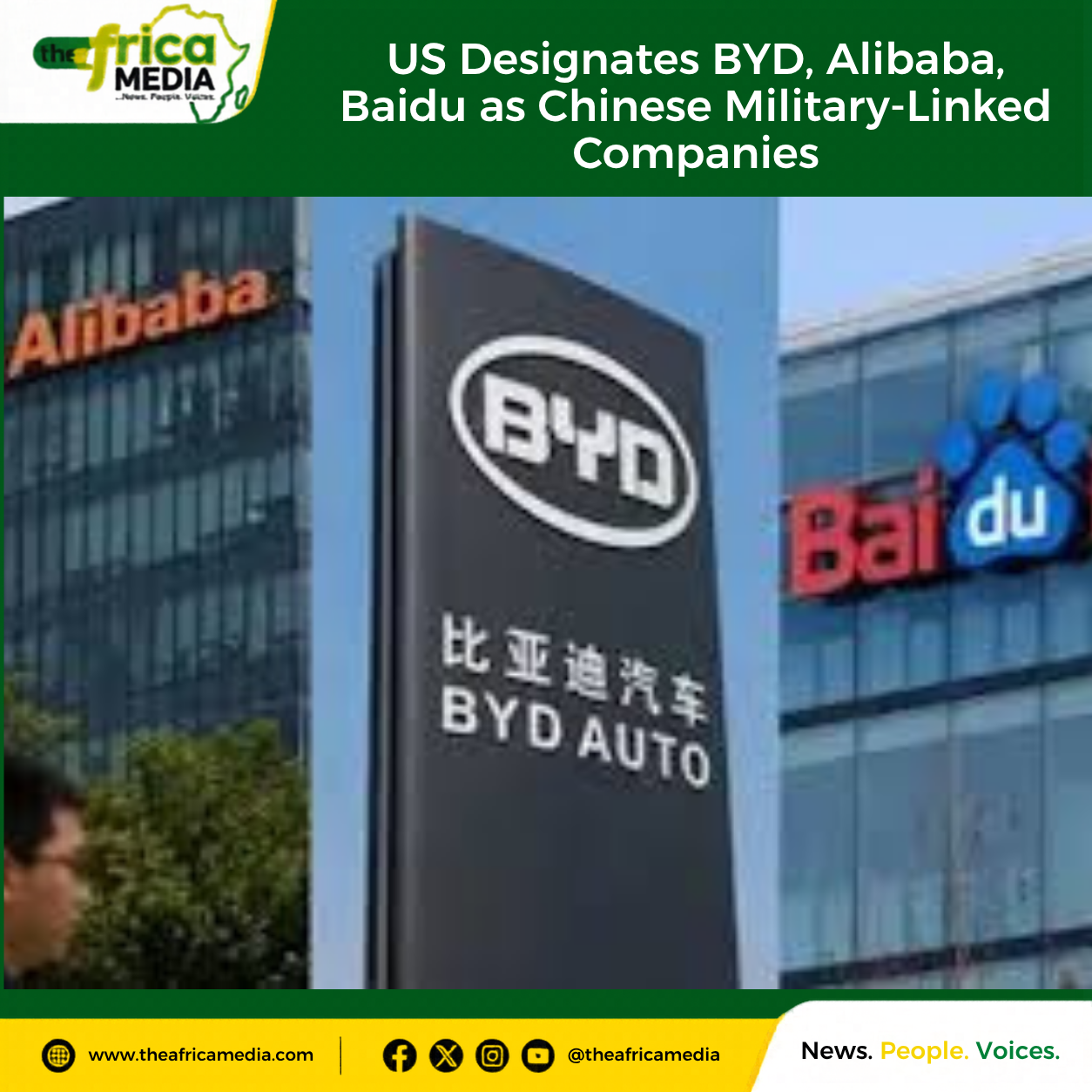
The United States Department of Defense has added major Chinese corporations Alibaba, BYD, and Baidu to its list of companies identified as supporting China’s military, expanding a blacklist that now includes some of the country’s most prominent commercial brands.
The designation, announced in an updated Pentagon report on Monday, is expected to add new strain to relations between Washington and Beijing despite recent diplomatic efforts aimed at easing tensions between the two countries.
Reacting to the development, the Chinese Embassy in Washington described the move as discriminatory and accused the United States of expanding the definition of national security beyond reasonable limits.
According to the embassy, Chinese companies operating internationally comply with the laws and regulations of their host countries and should not be subjected to unfair treatment.
Alibaba rejected the designation, insisting that it is neither a military company nor part of any military-civil fusion programme. The company stated that it would pursue all available legal avenues to challenge what it described as a misrepresentation of its business activities.
The Pentagon’s annual list of Chinese military-linked companies now contains 188 firms, up from 134 in 2025. Companies included on the list, along with entities under their control, will be excluded from consideration for U.S. defence contracts under regulations taking effect later this month.
The U.S. Department of Defense defines such companies as entities owned, controlled, or significantly linked to China’s military establishment, or those contributing to Beijing’s military-civil fusion strategy, which integrates civilian research and technology development with military objectives.
In its latest update, the Pentagon said Alibaba, BYD, and Baidu were included due to alleged links with Chinese state institutions, including the State-owned Assets Supervision and Administration Commission and the Ministry of Industry and Information Technology.
The move received support from some U.S. lawmakers, who argued that American businesses should reduce their reliance on companies viewed as potential national security risks.
The blacklist expansion comes shortly after high-level talks between U.S. President Donald Trump and Chinese President Xi Jinping aimed at improving bilateral relations following years of trade and technology disputes.
Alibaba, Baidu, and BYD are among China’s most influential companies, dominating the country’s e-commerce, internet search, and electric vehicle sectors respectively. Other firms added to the list include robotics and artificial intelligence companies RoboSense Technology and Unitree Robotics.
Analysts, however, have questioned the practical impact of such a broad designation, noting that many American companies maintain extensive commercial relationships with Chinese firms and may be reluctant to sever those ties without stronger legal restrictions.
The latest action highlights the continuing competition between the world’s two largest economies, particularly in technology, artificial intelligence, advanced manufacturing, and national security-related industries.


