


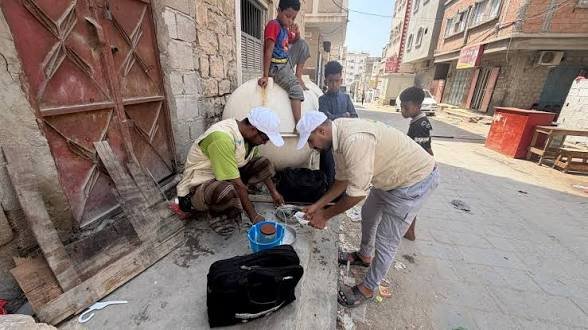
Under the scorching sun and through heavy humidity, Salem bin Shabz and his team of health workers move slowly through the narrow alleyways of Al-Koud, a densely populated slum in Yemen’s port city of Mukalla.
The Yemen dengue fever outbreak has made this area one of the country’s hardest hit, and every time the team spots a pool of stagnant water, they stop to inspect it. Armed with dippers and sample containers, the team is hunting for mosquito breeding grounds amid an outbreak of the deadly viral infection, which spreads through mosquito bites and can cause fevers, headaches, body aches, nausea and, in severe cases, death.
Tracking Mosquito Breeding Sites in Mukalla’s SlumsBin Shabz kneels beside an open drainage chamber where a puddle of stagnant water, discharged from a household air conditioner, has turned green after standing for weeks. He dips a ladle into the water and pours the contents into a shallow metal tray.
Within seconds, tiny larvae begin wriggling across the surface. “These are mosquito larvae,” bin Shabz, an insect surveillance officer at the provincial office of the National Malaria Control Programme (NMCP), told Al Jazeera. “This type is Anopheles, which transmits malaria, while the other is Aedes, the mosquito that spreads dengue fever. We collect the larvae, place them in containers and identify them before taking the necessary control measures.
“The discovery confirms the team’s fears: Al-Koud has once again become a breeding ground for both dengue and malaria mosquitoes, despite repeated campaigns to control the insects. “We carried out mosquito control campaigns in this area two months ago, combining public awareness, insecticide spraying and efforts to eliminate breeding sites,” bin Shabz said. “Now we’ve returned and found many of the same breeding sites still exist.
“After draining the chamber, the team presses deeper into the neighbourhood. Minutes later, they stop outside another house where an uncovered water storage tank sits beside the entrance. Bin Shabz lowers a long-handled dipper into the tank and transfers another sample into a metal tray. “The tank is infested with both malaria and dengue larvae,” he confirms.
Residents Not Always Cooperating With Health TeamsBin Shabz asks a group of curious children to fetch the homeowner so he can explain the dangers of leaving the water tank exposed and encourage him to cover the container. “A simple step like covering the tank would help protect his family and their neighbours from dengue fever,” he said. To his disappointment, the homeowner is not home, so bin Shabz leaves a message with neighbours, though the breeding site will remain untouched until the owner can be reached.
“People are not cooperating with us,” he said. “In urban areas, many residents are still asleep when we carry out our morning inspections, while others are away from their homes. Whenever we identify a breeding site, we speak to the homeowner, explain the risks and advise them how to eliminate it.”Part of a Nationwide Response Effort
The vector control team in Mukalla forms part of a nationwide campaign across government-controlled areas of Yemen to curb the dengue fever outbreak. The campaign combines surveillance of mosquito breeding sites with public awareness efforts, insecticide spraying, larval control, and training for health workers to diagnose and treat dengue cases in hospitals and local health centres.
According to the Aden-based Electronic Integrated Disease Early Warning System (eIDEWS), which monitors disease outbreaks across government-controlled areas of Yemen, authorities recorded 7,815 suspected dengue cases and 33 deaths between January 4 and July 18, 2026. Hadramout was the hardest-hit governorate, reporting 2,204 cases, followed by Aden with 1,639, Abyan with 962, Shabwa with 951, and Taiz with 770. Outbreak Strains an Already Fragile Health SystemThe dengue fever outbreak has placed further strain on Yemen’s already fragile healthcare system, pushed to the brink of collapse by years of war, chronic underfunding and repeated disease outbreaks.
Thousands of suspected dengue patients have sought treatment at hospitals across Aden, Taiz, Abyan and Hadramout, forcing overstretched health workers to cope with the surge despite limited resources.
Mohammed Omer, head of the laboratory at the government-run Ibn Sina Hospital in Mukalla, recalled that at the height of the outbreak in May, the hospital received more than 60 suspected dengue cases in a single day, placing an enormous burden on its emergency department, which serves patients from Hadramout, Shabwa and Al Mahra governorates.


