



Nigeria’s push for equitable representation in the proposed ECOWAS Monetary Union goes beyond the question of who occupies key positions in the regional institution, touching on the country’s financial commitments, economic influence and ability to protect its interests in a common currency arrangement that could reshape trade, investment and monetary relations across West Africa.
As preparations for the proposed ECO single currency gather momentum, the Central Bank of Nigeria (CBN) is seeking a governance framework that balances the sovereign equality of member states with the financial contributions, economic weight and systemic responsibilities of individual countries.
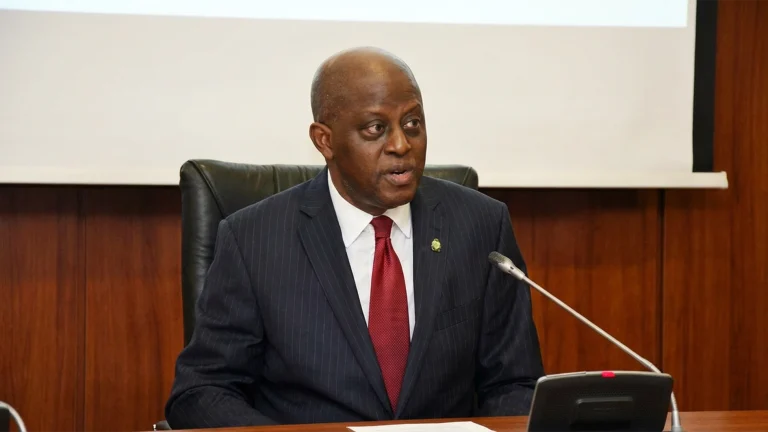
Governor of the CBN, Mr Olayemi Cardoso, made the position clear at the Ministerial Session of the Sixth Presidential Task Force Meeting on the ECOWAS Single Currency Programme in Abidjan, Côte d’Ivoire, where he represented Nigeria over the weekend.
Cardoso said the success of the proposed monetary union would depend not only on the willingness of member states to adopt a common currency but also on the fairness, credibility and transparency of the institutions that would administer it.
The discussions, he said, were focused on critical aspects of the Union’s institutional architecture, including the location of its institutions, leadership appointments and the distribution of authority and responsibilities among participating countries.
For Nigeria, which remains West Africa’s largest economy and a major financial contributor to regional integration initiatives, the outcome of these negotiations could determine how much influence it would have over decisions affecting monetary policy, financial stability, reserve management and the future direction of the regional economy.
Cardoso described the meeting as a defining milestone in the region’s monetary integration efforts, warning that decisions being taken at this stage would have consequences extending well beyond the immediate preparations for the currency.
“The decisions we take today will shape the future of the Union for decades to come. They will influence its credibility in the eyes of investors and development partners, its legitimacy in the eyes of our citizens, and the confidence of Member States that their commitments are being matched by a meaningful voice within the institutions they are helping to build,” he said.
The CBN governor reaffirmed Nigeria’s longstanding commitment to the ECOWAS Monetary Cooperation Programme and the establishment of the proposed ECO, citing the country’s substantial financial contributions, technical support and willingness to make compromises in the interest of regional consensus.
However, he maintained that regional solidarity must not be interpreted as an arrangement in which countries with significantly different economic capacities and financial responsibilities are expected to assume similar obligations without appropriate consideration in the governance structure.
The argument reflects a central question facing monetary unions: how to distribute decision-making authority among countries with different economic sizes, financial capacities and levels of exposure to risks arising from a shared currency.
While the principle of sovereign equality gives every member state a place in regional decision-making, Nigeria’s position is that the governance framework must also recognise the financial and economic responsibilities that countries assume in establishing and sustaining the Union.
Cardoso said countries making larger financial commitments should be given significant consideration in the governance arrangements, particularly where their contributions and economic exposure could have implications for the stability of the entire monetary bloc.
“While bigger economies continue to take up the burden, they should also be considered to play a significant role because of the risk and systemic importance they have in the sub-region,” he said.
The CBN governor argued that governments committing substantial resources to the Union must be able to explain such obligations to their parliaments, citizens and civil society, particularly where public resources and national financial institutions are involved.
He warned that a system in which member states share responsibilities and financial obligations without corresponding influence in the institutions managing the Union could weaken confidence in the project and undermine its long-term sustainability.
Nigeria’s position, he stressed, was not a demand for dominance or entitlement, but recognition of the responsibilities associated with its economic standing and contributions to regional integration.
The country would be expected to commit substantial financial resources, reserves and institutional capital to the success of the Monetary Union. Cardoso therefore insisted that its participation in governance, accountability and decision-making should appropriately reflect the scale of those commitments.
The stakes for Nigeria are considerable. A monetary union would require member states to coordinate economic policies, establish common institutions and work within agreed frameworks governing monetary stability, financial regulation and the management of the currency.
For Nigeria, fair representation could provide an avenue to protect its interests in decisions concerning the management of regional financial institutions, the formulation of monetary policies, the allocation of responsibilities and the handling of financial risks that could arise within the bloc.
It could also help ensure that the country’s contribution to regional economic stability is recognised in the institutional arrangements, while giving it a meaningful voice in decisions that could affect its economy, financial system and trade relationships with other member states.
The proposed currency is also expected to deepen economic integration by reducing barriers associated with multiple currencies, facilitating cross-border transactions and potentially lowering the costs of trade among participating countries.
Businesses operating across West African borders could benefit from simplified payments, reduced currency conversion costs and greater certainty in transactions, provided the monetary framework is supported by credible institutions and sound economic policies.
For Nigeria, whose businesses and traders maintain commercial relationships across the region, a functioning monetary union could offer opportunities to expand trade, improve payment systems and strengthen the country’s position within the regional market.
But the benefits would depend on the design and management of the Union, particularly its ability to maintain monetary stability, address economic disparities among member states and ensure that participating countries meet agreed convergence requirements.
The CBN governor’s emphasis on fairness therefore goes beyond institutional appointments. It reflects Nigeria’s concern that the rules governing the proposed currency should be sufficiently balanced to encourage sustained commitment from countries expected to provide substantial financial and institutional support.
A credible governance structure, Cardoso argued, must ensure that all member states have a meaningful stake in the arrangement and that no country is left carrying significant obligations without adequate participation in the institutions responsible for managing the Union.
He urged delegates to approach the deliberations with openness, mutual respect and a willingness to compromise, expressing confidence that member states could reach a balanced agreement capable of securing a strong, stable and prosperous monetary union.
The challenge for ECOWAS is to reconcile Nigeria’s demand for proportional consideration with the concerns of smaller member states that may fear an arrangement in which the region’s largest economies wield disproportionate influence over collective decisions.
Achieving that balance would be critical to building trust among member states and preventing disagreements over governance from becoming obstacles to the broader monetary integration project.
The meeting forms part of ongoing efforts to accelerate preparations for the phased introduction of the proposed ECO single currency from 2027, with member states expected to resolve outstanding institutional, governance and operational questions ahead of implementation.
While the proposed timeline remains dependent on progress in meeting the necessary conditions and securing agreement on key institutional arrangements, the Abidjan deliberations highlight the growing importance of governance negotiations in determining whether the monetary integration ambition can translate into a workable regional framework.
Nigeria’s position is that the success of the ECO will require more than political commitment to a common currency. It must also be built on an institutional arrangement that recognises contributions, distributes responsibilities fairly, protects the interests of member states and commands confidence across the region.
For Cardoso, the task is to ensure that the emerging Union is founded on both solidarity and fairness, with every participating country having a meaningful voice in shaping an institution whose decisions could influence West Africa’s economic future for decades.


