



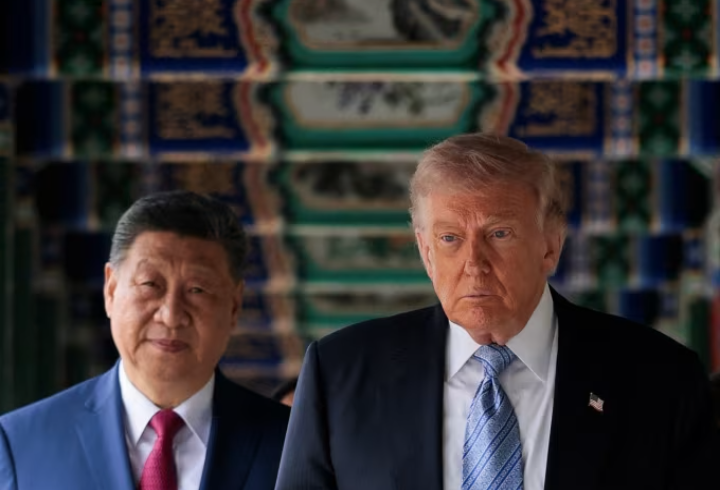
China has announced a series of retaliatory measures against the United States, including sanctions on several American companies and tighter export controls on drones, as tensions between the world’s two largest economies continue to rise ahead of an expected summit between Chinese President Xi Jinping and US President Donald Trump next month.
The measures were announced on Wednesday by China’s Ministry of Commerce, which said they were a response to recent US actions targeting Chinese companies. Among the new actions, China imposed sanctions on several American firms, including companies involved in biotechnology and resource analysis. Chinese individuals and organisations are now prohibited from conducting business or cooperating with the listed companies.
Beijing said six of the firms were sanctioned in response to Washington’s recent decision to ban imports from 43 Chinese companies over allegations of forced labour involving Uyghurs and other minority groups. A seventh company was added after the US Federal Communications Commission (FCC) prohibited imports of new humanoid robots, quadruped robots and certain power converters, products largely manufactured in China.
China also introduced stricter export controls on drones, drone components and related technologies destined for the United States. As the world’s largest producer of drones, China has gradually tightened export restrictions on the sector in recent years. In addition, Chinese authorities announced a national security investigation into imported office equipment using foreign operating systems and suspended some cooperation with the United States on factory inspection and product tracking.
A spokesperson for China’s Ministry of Commerce said Beijing had “no choice” but to adopt countermeasures in response to US restrictions, urging Washington to reverse its recent actions and work toward maintaining a stable bilateral relationship.
The spokesperson also warned that China would take additional measures if the United States introduced further restrictions against Chinese companies.
The latest dispute follows several recent actions by the Trump administration, including sanctions on Chinese shipping companies accused of transporting Iranian fuel, blacklisting additional Chinese institutions including two leading civilian universities and imposing tariffs of 10 to 12.5 percent on imports from several countries, including China, over alleged forced labour concerns.
US officials have also recently warned that Chinese artificial intelligence companies could face future sanctions. Despite the escalating trade and technology dispute, diplomatic engagement between the two countries continues. Senior US and Chinese economic officials held virtual trade discussions last week, while a senior Chinese foreign ministry official visited the United States in July, a trip widely viewed as preparation for the expected summit between Presidents Xi and Trump.
The latest exchange highlights the continuing strategic competition between Washington and Beijing, particularly in advanced technologies, trade, and national security, even as both governments publicly express a desire to maintain stable bilateral relations.


