



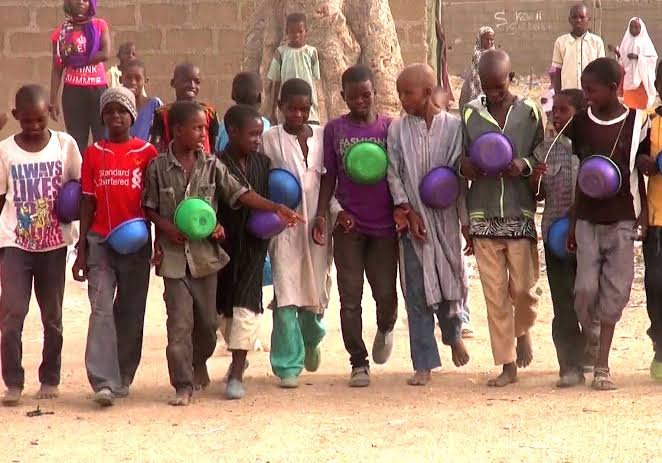
The revelation that Kano State has 875,593 children out of school has renewed concerns over Nigeria’s education crisis and its wider implications for Africa, as millions of children remain excluded from formal education across the continent.
The Kano State Ministry of Education disclosed the figure in its 2026 Out-of-School Children (OOSC) Survey Report presented in the state, describing the data as a more comprehensive assessment of the scale of the problem.
The state’s Commissioner for Education, Dr Ali Haruna-Makoda, said the figure represented a reduction of 113,641 children, or 11.5 per cent, from the 989,234 out-of-school children recorded in Kano in 2023 based on UNICEF data.
While describing the reduction as encouraging, Haruna-Makoda said the number of children still outside the formal education system demonstrated that the state could not afford to slow down its interventions.
“Previous figures were largely estimates derived from national samples and other sources. The 2026 OOSC figure is based on a rigorous state-wide survey,” he said.
He added that the survey provided verified and disaggregated data by Local Government Area, age and gender, which would enable government and development partners to better understand the scale and distribution of the problem.
The commissioner said the findings would serve as a baseline for evidence-based educational planning, policy formulation, resource allocation and targeted interventions designed to enrol, retain and support children who are currently outside the formal school system.
The situation in Kano is significant beyond the borders of the state because Nigeria accounts for a substantial share of Africa’s out-of-school population.
With more than 875,000 children out of school in just one state, the scale of the challenge illustrates the enormous education deficit confronting Africa’s most populous country.
The consequences extend beyond lost classroom opportunities. Large numbers of children excluded from education can translate into a future workforce with inadequate skills, reduced productivity and limited economic opportunities.
For Africa, where governments are seeking to harness a growing youthful population as an engine of economic transformation, persistent exclusion from education poses a serious development challenge.
Education is central to developing the skilled workforce required to drive technology, manufacturing, healthcare, agriculture and other sectors of modern economies.
When millions of children fail to receive basic education, countries risk widening inequalities and weakening their human-capital base.
The challenge can also deepen poverty, as children without access to quality education are more likely to face limited employment opportunities later in life. In communities already affected by poverty, insecurity and inadequate infrastructure, the cycle can become self-perpetuating.
The Kano government attributed the reduction in the state’s OOSC figure to increased investment in education, enrolment campaigns, improved education data and information management systems, as well as collaboration with UNICEF and other development partners.
The commissioner said the progress showed that sustained intervention could produce measurable results.However, the remaining figure of 875,593 children underscores the magnitude of the work ahead.Haruna-Makoda urged stakeholders to use the survey findings to develop practical and sustainable solutions tailored to individual communities and local government areas.
He also called on parents, traditional and religious leaders, communities, development partners and civil society organisations to intensify their support for efforts to enrol children and ensure they remain in school.Kano’s experience also points to a broader lesson for African countries: tackling the out-of-school crisis requires more than increasing school enrolment.
Governments must address the factors that keep children away from classrooms, including poverty, insecurity, inadequate school infrastructure, child labour, displacement and social and cultural barriers.Reliable data is equally important.
The Kano survey’s emphasis on verified information broken down by location, age and gender could help policymakers identify communities and groups requiring the greatest intervention.For Nigeria and Africa, the stakes are high.
The continent has one of the world’s youngest populations, presenting a potentially powerful demographic advantage. But that advantage can only translate into economic growth and social development if young people receive the education and skills needed to participate productively in society.
The reduction recorded in Kano therefore represents a positive step, but the nearly 900,000 children still out of school serve as a reminder that the education crisis remains far from resolved. How Nigeria responds to the challenge will have implications not only for the affected children and their communities, but also for Africa’s broader efforts to build an educated, skilled and economically productive population.


