


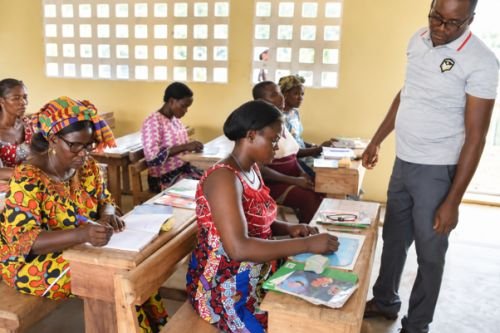
Sub-Saharan Africa accounted for about 30 per cent of the world’s illiterate adult population in 2025, with an estimated 225 million adults unable to read or write, according to data from the UNESCO Institute for Statistics (UIS).
The figures came into focus as African countries joined the global observance of International Literacy Day on September 8, an event marked annually since 1967. This year’s theme was “Literacy for People, Planet and Prosperity.”
Although the region has recorded progress in adult literacy, population growth continues to widen the scale of the challenge.
Between 2015 and 2024, the adult literacy rate in sub-Saharan Africa rose from 65 per cent to 69 per cent. However, the increase was accompanied by rapid population growth, resulting in a larger absolute number of adults without basic literacy skills.
The situation has significant implications for employment and economic participation. UNESCO notes that people without adequate reading, writing and numeracy skills face limited opportunities to obtain professional qualifications and participate fully in the formal economy.
The challenge is particularly significant as millions of young Africans enter the labour market every year.
According to the World Bank, between 10 million and 12 million young Africans join the workforce annually, while only about three million formal jobs are created. The mismatch means that many new workers are likely to depend on an informal economy already under considerable pressure.
Countries Adopt Targeted Literacy Strategies
Several African countries have responded with programmes tailored to their specific educational and socioeconomic circumstances.
In Benin, authorities have placed greater emphasis on literacy programmes delivered in national languages, seeking to make learning more accessible by reflecting local linguistic and cultural realities.
Mauritania is also preparing to update its national literacy strategy under the National Education Sector Development Programme, known as PNDSE III, covering 2023 to 2030. The objective is to align literacy efforts more closely with broader education and social policies.
Niger has similarly expanded its literacy initiatives. More than 60 per cent of the country’s population cannot read or write, while enrolment in literacy centres increased by 58 per cent between 2025 and 2026. The government has linked the programmes to the development of income-generating activities.
The approaches point to an increasingly broader understanding of literacy across the continent, with governments viewing basic education not only as an educational objective but also as an instrument for economic and social inclusion.
Literacy and the Informal Economy
The economic implications are particularly significant in sub-Saharan Africa, where informal employment accounts for the overwhelming majority of jobs.
The International Labour Organisation estimates that more than 85 per cent of workers in the region operate in the informal economy, including family farming, street trading and small-scale service businesses.
Such employment is often characterised by low incomes, limited job security and little or no access to formal contracts or social protection.
The World Bank estimates that about one-third of workers in the region live below its extreme-poverty threshold of $3 a day.
Gender disparities also remain significant. Data from the World Bank show that 38 per cent of women aged 15 and above in sub-Saharan Africa cannot read or write, compared with 25 per cent of men.
The education deficit therefore intersects with existing employment, income and gender inequalities.
Education Investment Faces Fiscal Pressure
The potential economic gains from improving basic education are substantial. In its October 2024 Africa’s Pulse report, the World Bank estimated that achieving universal basic education could double GDP per capita and increase annual economic growth by 1.4 percentage points over the next 50 years.
However, governments across the region face significant fiscal constraints that could make sustained investment in education more difficult.
Debt-service obligations absorbed 34 per cent of government revenue in sub-Saharan Africa in 2024, limiting the resources available for public services, including education.
The United Nations Conference on Trade and Development (UNCTAD) has also highlighted the pressure on African public finances. It estimates that about 769 million Africans live in countries where governments spend more on public debt interest payments than on either education or health.
The literacy challenge in sub-Saharan Africa consequently extends beyond the classroom. It is closely linked to productivity, employability, household incomes and broader economic development.
As the region’s population continues to grow, the ability of governments to expand access to basic literacy and education will remain a critical factor in determining whether demographic growth translates into broader economic opportunities.


