


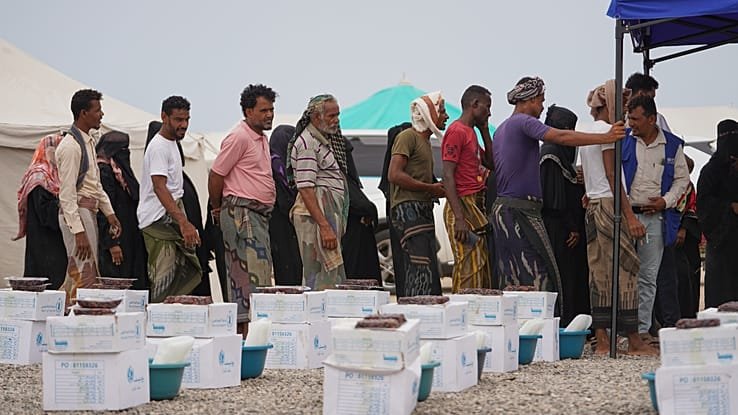
Yemenis fleeing intensified fighting in their country have recounted terrifying journeys across the Red Sea to Djibouti, seeking safety from the escalating conflict.
At least 100,000 people have reportedly fled Yemen since fighting intensified this month between government forces and Iran-backed Houthi rebels, who have expanded their control along the country’s coastline.
More than 2,000 Yemenis have crossed into Djibouti, according to the Djiboutian government, undertaking a short but hazardous sea journey that is normally travelled in the opposite direction by migrants seeking employment in the Gulf.
Alexandre Coissac, head of mission in Djibouti for the United Nations’ International Organisation for Migration (IOM), said some displaced Yemenis arrived carrying household items, livestock and equipment because they expected the conflict to continue.
“Some arrived with goats, refrigerators, or even solar panels, because they think the situation will drag on,” Coissac told AFP.
Waheda Muhammad Ali, 40, who fled the coastal town of Dhubab, described the conditions that forced her family to leave.
“Gunfire was everywhere, we were completely helpless, with no food or water,” she said. “The children were crying, terrified by the fighting and explosions… We prayed constantly to arrive safely.”
The Houthis had previously controlled large parts of northern Yemen, including the capital, Sanaa, and the western port city of Hodeida. They have, however, made a rapid advance along the coast this month, capturing the port city of Mocha last Thursday.
The group now controls the strategic Bab el-Mandeb Strait, a key maritime passage between Asia and Europe whose importance has increased amid the reported blockade of the Strait of Hormuz by Iran.
Hundreds of people have reportedly been killed in the latest fighting.
“Planes were flying over us. Everything was devastated. We had no choice but to flee,” Ali said, recalling a boat journey that lasted almost an entire day.
The IOM praised Djibouti for its “generosity” in receiving the displaced Yemenis, many of whom are young children.
However, Djibouti’s Minister of Economy, Ilyas Moussa Dawaleh, said the growing influx was putting increasing pressure on the country.
He said the situation was becoming “increasingly difficult” for Djibouti, a country covering about 23,000 square kilometres with a population of roughly one million.
Qasim Ibn Qasim, a 40-year-old fisherman who fled with his children and extended family aboard a large dhow, said they left almost everything behind.
“We took nothing. We left everything at home. Everything. We just took a few blankets and clothes for the children… Everything else is back there,” he said.
“The hardest part is living in constant fear of war,” he added.
Djibouti hosts several foreign military bases, including those operated by the United States and China, and is also a major transit point for migrants, particularly Ethiopians travelling towards the Middle East in search of employment.
Coissac said migration flows towards the Gulf had declined as a result of the fighting.
However, he warned that the movement could soon return to high levels, with migrants potentially taking even more dangerous routes in their attempts to reach Gulf countries.


