



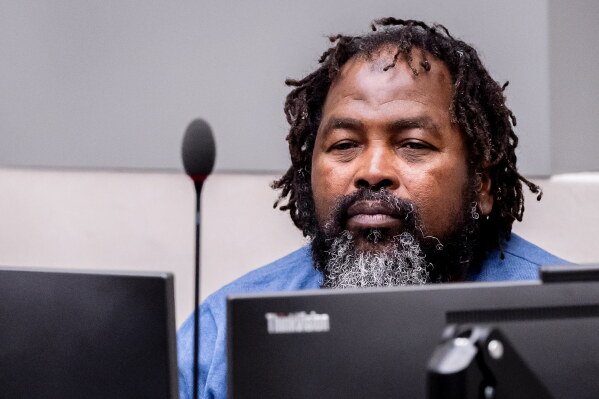
Judges at the International Criminal Court (ICC) on Wednesday convicted former Central African Republic rebel commander Mahamat Said Abdel Kani of crimes against humanity over the torture and mistreatment of detainees during the country’s conflict more than a decade ago.
Said was found responsible for abuses committed at a detention facility in the capital, Bangui, where prisoners were subjected to inhumane conditions.
During the hour-long hearing in The Hague, presiding Judge Miatta Maria Samba described evidence presented by witnesses about the treatment of detainees at the facility.
Witnesses testified that prisoners were held in cramped cells with walls bearing “bullet holes and blood” and were whipped until they soiled themselves. Others said they were detained in a windowless room beneath the floorboards of Said’s office.
Said, dressed in blue jeans and a sweater, remained largely expressionless as the verdict was read.
The charges relate to fighting between predominantly Muslim Seleka rebels, who seized power from then-President François Bozizé, and the mainly Christian anti-Balaka militia.
In Bangui, Marius Olivier Trésor Poussinga, a former detainee who said he was tortured at the detention centre, welcomed the verdict.
“Today, I can sleep easier because the court has acknowledged my suffering,” Poussinga told The Associated Press, describing the judgment as an “international recognition” of Said’s crimes.
Central African Republic Justice Minister Arnaud Djoubaye Abazène also welcomed the conviction.
“Justice cannot be reversed in the Central African Republic,” he said. “No victim will be left behind, and justice will be delivered at every level.”
Lewis Mudge, Central Africa director at Human Rights Watch, described the conviction as a significant step in efforts to hold perpetrators accountable, but said the country still faced major challenges in addressing ongoing abuses.
He also called for greater support for international and domestic justice mechanisms to address what he described as an accountability gap contributing to recurring violence.
The conviction comes amid uncertainty over the ICC’s future involvement in investigating crimes committed in the Central African Republic.
In 2022, then-ICC Prosecutor Karim Khan announced the closure of the court’s 15-year investigation into crimes in the country, citing limited resources. Khan left his position in July following allegations of sexual misconduct, which he has denied.
The ICC has previously prosecuted other figures linked to the Central African Republic conflict. Two senior anti-Balaka leaders were convicted in July 2025 of multiple war crimes and crimes against humanity.
Former Congolese vice president Jean-Pierre Bemba was acquitted on appeal in 2018, while charges against a former Central African government minister were dropped in 2023.
Meanwhile, the Central African Republic’s Special Criminal Court, established with international support to prosecute war crimes and other serious abuses committed since 2003, continues to handle cases.
The court began proceedings earlier this year against former President François Bozizé on crimes against humanity charges. The trial is being conducted in absentia because Bozizé is living in exile in Guinea-Bissau.
The court has indicted more than 30 people, most of whom are in custody, and delivered its first verdict in 2022.
Among those facing trial is Edmond Beina, who was also wanted by the ICC over alleged war crimes and crimes against humanity. His case is continuing before the Special Criminal Court after it rejected an attempt by the ICC to extradite him to The Hague.
However, the Special Criminal Court faces funding difficulties following the withdrawal of US financial support last year.
Marceau Sivieude, Amnesty International’s regional director for West and Central Africa, warned that shutting down the court would undermine efforts to secure justice for victims.
“Despite the authorities’ efforts, national courts still lack the resources and capacity to assume the mandate the ICC has been carrying out,” he said.
Supporters of the court have called on the United Nations and European Union to provide additional funding and help extend its mandate.
Said, who pleaded not guilty when his trial began in 2021, faces a possible life sentence. The ICC will determine his sentence at a later date.


 on Wednesday convicted former Central African Republic rebel commander Mahamat Said)