



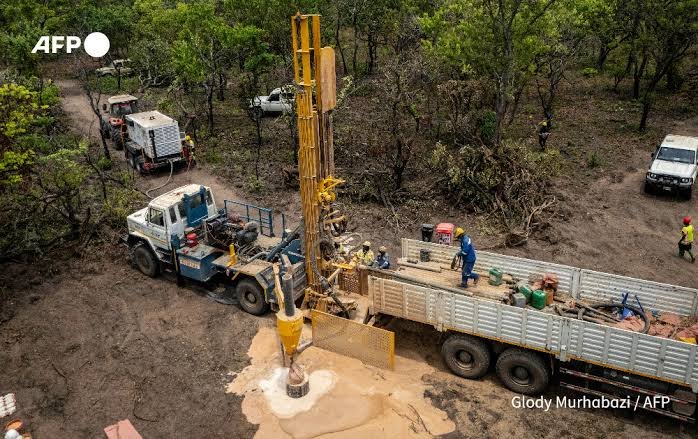
US mining company KoBold Metals is using artificial intelligence and advanced geological technology to search for critical minerals in the Democratic Republic of Congo (DRC), as Washington seeks to strengthen access to strategic resources and reduce China’s dominance of the sector.
Geologists working for the company have ventured deep into the Congolese bush equipped with high-precision GPS devices and tablets linked to an AI system that processes data in real time on servers at KoBold’s headquarters in California.
Founded in 2018 with backing from investors including Bill Gates and Jeff Bezos, KoBold is among the latest US companies seeking opportunities in the DRC’s mineral-rich mining sector.
China has invested heavily in the DRC since the 2000s and controls an estimated 70 to 80 per cent of the country’s copper and cobalt market.
The DRC is the world’s second-largest copper producer and the leading producer of cobalt, minerals that are increasingly important in the production of batteries and other clean-energy technologies.
Despite its vast mineral wealth, much of the DRC’s more than 2.3 million square kilometres remains relatively unexplored.
KoBold is particularly interested in lithium, a key component in electric vehicle batteries. The International Energy Agency projects that global lithium demand will more than double by 2030.
“We have very encouraging results,” Benjamin Katabuka, KoBold’s managing director in the DRC, said without providing details.
The company remains at the exploration stage and hopes to begin production in the coming years.
KoBold has established its base in Manono, a remote town in southeastern DRC known for its deposits of critical minerals.
Since 2025, the company has secured 14 exploration permits covering more than 3,000 square kilometres, ahead of a strategic partnership agreement signed between Washington and Kinshasa in December.
The agreement forms part of wider US efforts to strengthen economic ties with the DRC alongside diplomatic and security initiatives aimed at addressing the conflict in eastern Congo.
KoBold plans to invest more than $50 million in the DRC by early 2027.
Katabuka said American investment in the country remained limited despite the strategic partnership.
“Almost a year since the agreement was signed, but American investment hasn’t poured in,” he said.
Mining and diplomatic sources said discussions were expected on measures to attract more US investment into a sector that has faced allegations of corruption as well as financial and environmental controversies.
KoBold’s exploration teams have been collecting an average of 2,000 soil samples every week since April.
The samples are analysed for geochemical indicators associated with pegmatite, the rock from which lithium can be extracted.
The company’s AI system combines the findings with historical geological maps, old drilling records, some dating back to the colonial period, and satellite imagery to develop predictive models identifying areas that could contain mineral deposits.
“Once we’ve determined the presence of lithium at very specific points, that allows us to target the drilling,” Kevin Tambwe, the company’s laboratory manager, said.
KoBold hopes the technology will give it an advantage over major mining companies, including China’s Zijin, which began shipping its first concentrate in June from a large mine near KoBold’s exploration areas.
The arrival of the American company has generated optimism in Manono, but residents remain cautious after decades of mining activity that have brought limited economic benefits to the local population.
Vicar General Wilson Katende said greater competition among mining companies could improve working conditions.
“Right now, you don’t feel like people here have been fairly paid,” he said, referring to miners who often earn less than $200 a month at existing operations.
The region has an estimated poverty rate of 88 per cent, according to official statistics.
The Lukushi River, which runs through the territory, has also been diverted to support mining operations. Local elders recall when the river was abundant with fish and served as an important resource for the community.
Security concerns also remain, with Congolese soldiers visible in the area and reports of Mai-Mai militias operating in nearby villages.
Manono was established in the early 20th century under Belgian colonial rule, initially around tin mining. Years of declining commodity prices and instability following independence in 1960 contributed to the town’s economic decline.
“Manono lacks drinking water. Manono is not electrified,” territory administrator Cyprien Kitanga told AFP.
He said mining companies had historically extracted resources without leaving sufficient benefits for the local population.
“In the past, mining companies came, took the ore, and left holes behind for the children of Manono,” he said.
The discovery of lithium has revived hopes of renewed economic activity, although local workers continue to raise concerns about working conditions.
“We want to go and work for the Americans,” one miner said, declining to give his name.
Earlier that day, miners reportedly burned tyres at the entrance to a Zijin-operated mine in protest against low wages and long working hours.
Zijin said it had engaged with employee representatives and agreed on measures to address their concerns.
For KoBold, the challenge will be to convert its AI-assisted exploration into commercially viable discoveries while navigating the DRC’s complex mining environment and meeting expectations from communities seeking greater economic benefits from their mineral wealth.
Available next action: Create a downloadable DOCX file here in this chat containing the editable prose above


