



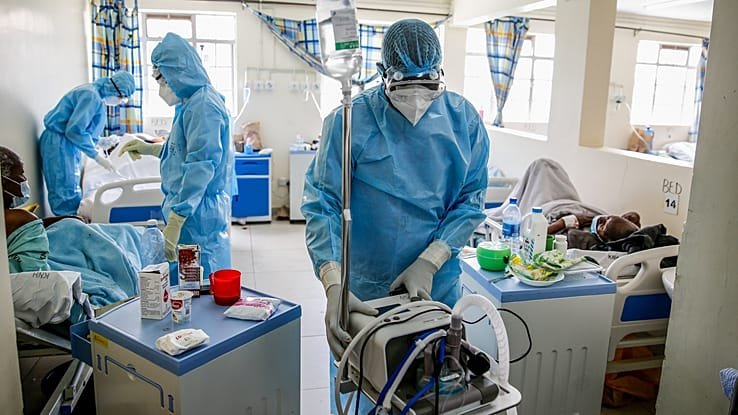
Kenya has confirmed its first recorded Ebola death after a Kenyan man who had been living in the Democratic Republic of Congo (DRC) died following his return to the country.
Health Minister Aden Duale announced the development on Tuesday, saying the man, whose identity was not disclosed, had fallen ill about a month ago and received treatment in the DRC.
According to Duale, the man travelled overland from the DRC to Kampala, Uganda, before flying to Nairobi on October 3.
He was screened after arriving in Kenya and subsequently tested positive for Ebola. The minister said the patient died at about 11:30 p.m. on Monday.
Health authorities have identified 28 people who had contact with the deceased, including family members and healthcare workers.
Duale said initial testing had identified one positive case among those contacts, adding that health authorities were continuing surveillance and testing.
“I wish to assure the public not to panic, as all systems are in place to mitigate the spread of the disease,” the minister said.
The confirmation marks the first known Ebola case and death recorded in Kenya, raising concerns about the possibility of further transmission following the patient’s movements across the region.
Kenya had previously faced public concerns over plans to establish an Ebola treatment facility at Laikipia Air Base, about 200 kilometres from Nairobi.
The DRC declared its 17th Ebola outbreak in May, prompting renewed public health measures and regional monitoring.
Ebola is a severe viral disease that can cause fever, weakness, vomiting, diarrhoea and, in severe cases, internal and external bleeding. It can spread through direct contact with the blood or bodily fluids of an infected person.
The outbreak has renewed attention on cross-border surveillance and rapid contact tracing as health authorities work to contain possible transmission.
According to figures cited from the World Health Organization, as of October 2, 4,082 deaths had been recorded among 8,463 cases since the emergence of the Bundibugyo strain of Ebola.
There is currently no vaccine or specific treatment for the Bundibugyo strain, making early detection, isolation, contact tracing and supportive medical care particularly important in containing its spread.


 died)