



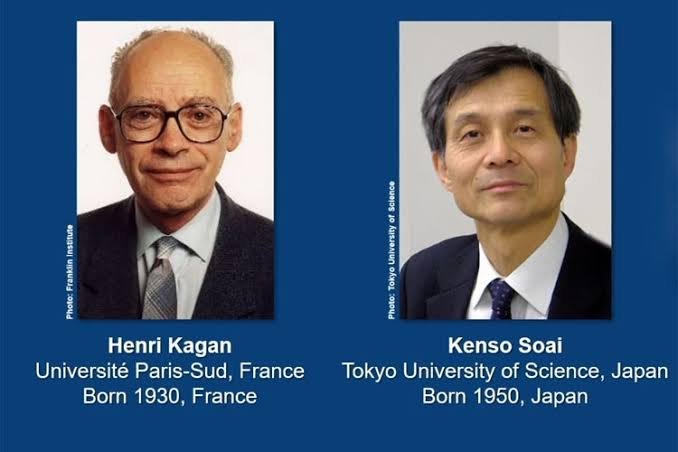
French scientist Henri Kagan and Japanese chemist Kenso Soai have won the 2026 Nobel Prize in Chemistry for research that helped solve a long-standing mystery surrounding “mirror image” molecules.
Their work, announced on Wednesday, is considered particularly important to pharmaceutical manufacturing, where producing the correct molecular form of a drug can determine how it affects the human body.
Kagan, 95, and Soai, 76, built on research that dates back to 19th-century French chemist Louis Pasteur, who discovered that some substances exist in two forms that are mirror images of each other.
Speaking by phone to the Nobel Prize press conference, Soai said he was “very glad” to share the award with Kagan and described the announcement as the most exciting day of his life. He said he had been out grocery shopping when he received the news.
Kagan, the third-oldest person to receive a Nobel Prize, could not immediately be reached. His daughter, Veronique Le Deunff, said she was “very happy”, adding that his work had opened new avenues for research through its creativity and originality.
French President Emmanuel Macron congratulated Kagan on the award, describing it as an immense honour for France and recognition of a lifetime of research.
Japanese Prime Minister Sanae Takaichi also congratulated Soai during a phone call, telling him: “As a Japanese, I’m very proud of you.”
Many molecules essential to life occur in two forms that are mirror images of each other, similar to the relationship between the left and right hands. Living organisms, however, generally use only one of these forms, a phenomenon known as homochirality.
The mystery of why and how one molecular form can be favoured has challenged scientists for more than a century.
According to the Nobel Committee for Chemistry, this year’s laureates developed methods that enabled chemical reactions to favour one molecular mirror image over the other, providing important tools for chemists designing reactions for pharmaceutical production.
Peter Somfai, a member of the Nobel Committee for Chemistry, explained that the two versions of a molecule can have different effects when used in medicine.
“The left-handed version of the drug can have one effect, and the right-handed version can have another effect, and then we need methods for selectively preparing them,” he said.
The origins of the research can be traced to Pasteur’s experiments with tartaric acid, a compound associated with wine production. Pasteur observed that bacteria fermented only one of two forms of the acid — the form naturally found in grapes — demonstrating that substances could exist in mirror-image forms with different properties.
Kagan and Soai later advanced the field by developing asymmetric reactions capable of producing an excess of one molecular form.
Somfai described the achievement as a landmark experiment in organic chemistry.
The significance of controlling molecular handedness was underscored by the thalidomide tragedy of the early 1960s, when thousands of children were born with severe birth defects after their mothers took the drug during pregnancy. Subsequent research highlighted the importance of the different properties of molecular forms in understanding the drug’s effects.
The chemistry award is the third Nobel Prize announced during this year’s Nobel week, following the prizes for medicine and physics.
The Nobel Prizes were established through the will of Swedish inventor and businessman Alfred Nobel and have been awarded since 1901, with interruptions mainly during the two world wars.
The chemistry prize has recognised numerous influential scientific advances over the years, including discoveries related to nuclear fission and genetic sequencing.
Last year’s chemistry prize was awarded to Susumu Kitagawa, Richard Robson and Omar Yaghi for developing metal-organic frameworks, molecular structures with potential applications in areas including climate change mitigation and access to fresh water.
Kagan and Soai will receive their Nobel medals from Sweden’s King Carl XVI Gustaf at a ceremony in Stockholm on December 10, the anniversary of Alfred Nobel’s death.
The laureates will also share prize money of 12 million Swedish crowns, equivalent to about $1.2 million.


