



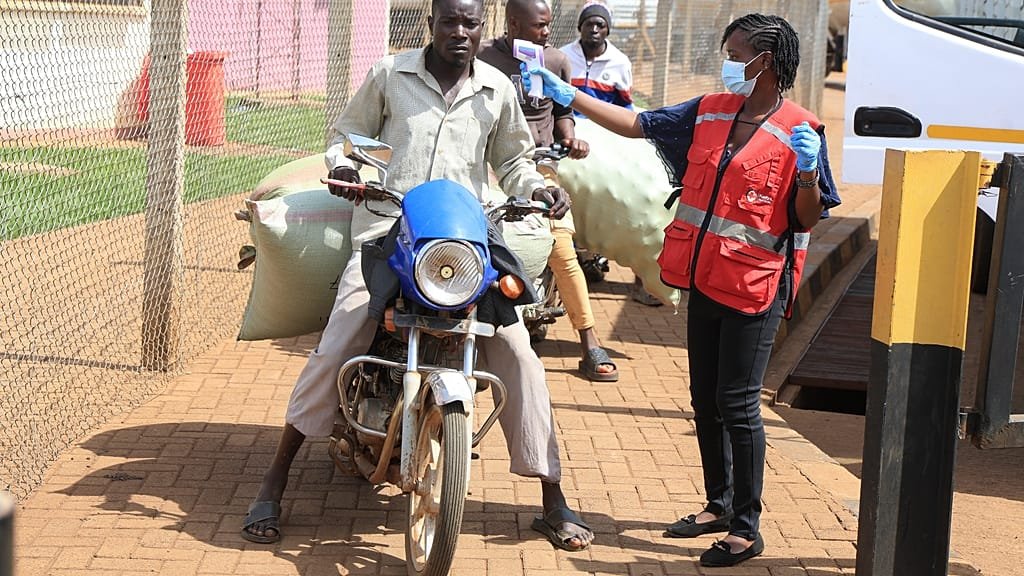
Kenya has heightened health screening at its borders and airports following the confirmation of a second Ebola case linked to an outbreak in the Democratic Republic of the Congo (DR Congo), raising concerns about further transmission across East Africa.
Travellers crossing into Kenya from Uganda underwent temperature checks and handwashing procedures on Thursday as residents called for stricter surveillance to prevent infected people from entering the country undetected.
At the busy Busia border crossing, where traders and truck drivers move between the two countries, motorcycle taxi operator David Makhoha urged authorities to ensure that travellers were properly screened.
“The government needs to be keen so that those people are screened adequately when getting into the country,” he said.
Trader Richard Onyango, however, questioned whether checks at official entry points would be sufficient, given the numerous informal routes connecting Uganda and Kenya.
“I’m asking the government to find other ways to screen because there are too many illegal routes to get into Kenya from Uganda,” he said.
Kenya’s Ministry of Health announced on Wednesday that a 39-year-old man had tested positive for Ebola after developing symptoms while in quarantine. The patient is a close relative of the country’s first confirmed case.
The ministry said the two infections were linked, adding that there was “no evidence of spread in the community.”
Kenya’s first patient was a 40-year-old national who had been living in DR Congo. He reportedly fell ill in the country before travelling by road to Uganda and subsequently flying to Nairobi, where he tested positive for Ebola. He died on October 5.
Following the first case, Kenyan authorities identified approximately 128 contacts associated with the patient and placed 108 of them in quarantine, according to the health ministry.
The patient’s journey through three countries before his infection was confirmed has raised questions about the effectiveness of disease surveillance at international entry points.
Africa Centres for Disease Control and Prevention Director-General Jean Kaseya stressed the need for stronger monitoring at borders.
“We need to ensure that at point of entry, we have a strong surveillance system in place,” Kaseya told The Associated Press last week.
Uganda had earlier declared its Ebola outbreak over after recording 20 cases linked to infections originating in DR Congo. Authorities said identified contacts had completed quarantine without evidence of further transmission.
During the outbreak, Uganda ordered the closure of its border with DR Congo, although exceptions were made for certain movements, including humanitarian assistance and cargo transport.
The World Health Organisation opposed border closures, warning that such measures could push travellers and goods towards informal, unmonitored routes, potentially increasing the risk of transmission.
Meanwhile, the outbreak in DR Congo continues to pose a significant public health challenge. Figures released by the country’s Health Ministry on Tuesday showed 9,066 confirmed cases and 4,381 deaths.
The disease has spread across seven provinces, with containment efforts complicated by armed conflict, population displacement, shortages of medical supplies and inadequate treatment facilities.
Contact tracing has also proved difficult. Kaseya told the Associated Press last week that more than 70 per cent of new cases in DR Congo involved people who had not previously been identified as contacts of infected patients, making it harder for health officials to locate and isolate infections.
The outbreak involves the Bundibugyo virus, a rare type of Ebola for which there is no approved vaccine or specific treatment.
Ebola spreads through direct contact with the bodily fluids of infected people or contaminated materials, including bedding and clothing. Health authorities have emphasised the importance of early detection, isolation and strict infection-prevention measures to contain the disease.


