



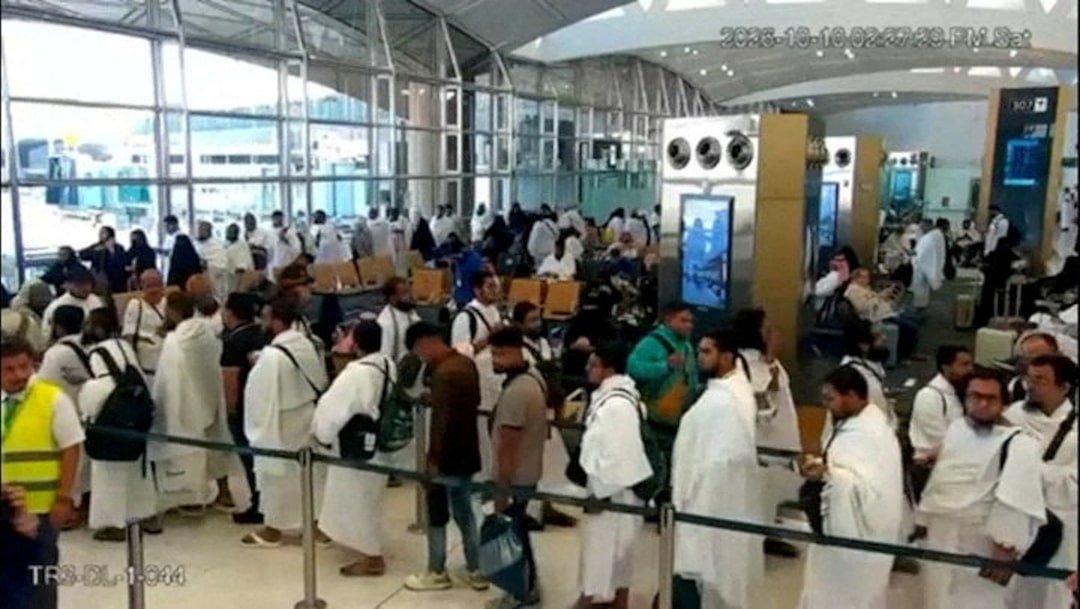
Saudi Arabia has partially resumed flight operations at Riyadh’s King Khalid International Airport despite renewed Houthi attacks and warnings that the facility remains a military target, underscoring the security challenges confronting the kingdom amid escalating regional hostilities.
The airport’s website listed several domestic and international flights scheduled for Sunday, including services arriving from Dubai, Paris and Cairo, after a two-week closure linked to deadly attacks.
However, flight-tracking platform Flightradar24 showed that only a limited number of flights had departed, while most scheduled services remained cancelled. Saudi authorities did not immediately provide details on the scale of the resumption.
The reopening coincided with fresh explosions in Riyadh early Sunday, prompting authorities to send text alerts warning residents of a hostile aerial threat and urging them to seek safety.
The Saudi-led military coalition fighting Yemen’s Houthi rebels said its air defences intercepted a ballistic missile launched towards the capital, as well as two drones in the Riyadh area. The coalition later reported intercepting a cruise missile targeting the southern city of Khamis Mushait.
The Houthis have claimed attacks on three Saudi airports, energy installations, a pipeline and an air base within a 24-hour period, raising concerns over the security of critical infrastructure in the oil-producing kingdom.
Houthi military spokesman Yahya Saree warned international and domestic airlines against operating at King Khalid International Airport, describing it as unsafe and a military target.
“The Yemeni Armed Forces warn all international, regional and local airlines – as well as staff and travellers – against using King Khalid Airport in Riyadh, as it is unsafe and serves as a military target for our forces,” Saree said.
He added that the Saudi government would bear the consequences of any attacks on the airport.
The renewed hostilities have disrupted aviation and other activities in Saudi Arabia, with the closure of the airport affecting travel arrangements and contributing to the postponement of the kingdom’s flagship investment conference until 2027.
The Dakar Rally, a major international motorsport event, has also joined a growing list of events cancelled, postponed or relocated amid the wider conflict.
The violence has extended beyond the capital, with Saudi Arabia’s civil defence agency reporting two injuries in the south from falling debris, alongside damage to buildings and vehicles.
Residents in Khamis Mushait described intense bombardments, while alerts were also issued for Abha and other areas, including Taif, Namas and Jazan.
The escalation has also intensified military exchanges across the Saudi-Yemen border. Saree claimed that Saudi warplanes carried out 56 airstrikes and missile attacks on areas in Yemen over the preceding 24 hours, including Hajjah, Lahj, Amran, Saada, Al-Jawf, Taiz and Ibb. The claim could not be independently verified.
The latest fighting follows the collapse of a years-long truce between the Houthis and Yemen’s internationally recognised government, which is backed by Riyadh.
Amid the deteriorating security situation, Saudi Arabia is also seeking to reinforce its air defences and maintain the security of its strategic infrastructure.
Greek Prime Minister Kyriakos Mitsotakis visited Riyadh on Sunday for talks with Saudi Crown Prince Mohammed bin Salman, during which Athens agreed favourably to a Saudi request to keep its Patriot air-defence system in the kingdom.
Greece has deployed a battery of the US-made system in Yanbu, a major oil export hub on the Red Sea coast.
According to Saudi state news agency SPA, the two leaders emphasised the importance of protecting international maritime corridors and ensuring the uninterrupted flow of energy supplies to global markets.
The developments highlight the growing risks to aviation, energy infrastructure and international trade as the conflict intensifies. Although flights have resumed at Riyadh airport, continued missile and drone threats leave the scale and sustainability of normal operations uncertain.


