



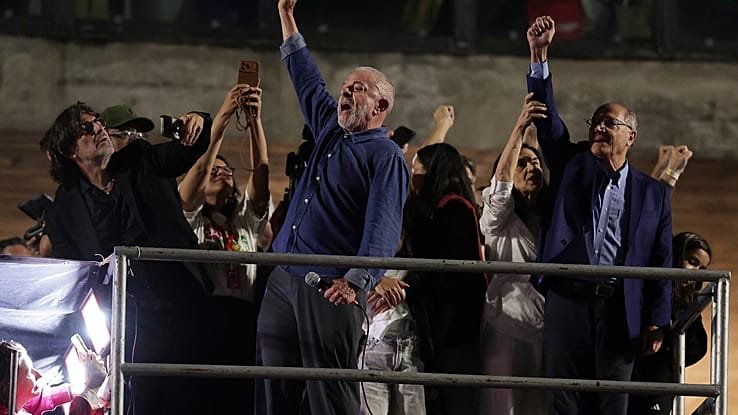
Brazilian President Luiz Inacio Lula da Silva has secured an unprecedented fourth presidential term, defeating conservative challenger Flavio Bolsonaro in a closely contested runoff election, as the opposition vowed to challenge the outcome.
Official results showed Lula winning 51.8 per cent of the votes against Bolsonaro’s 48.2 per cent, giving the incumbent a margin of approximately 4.4 million votes in Sunday’s election.
However, Bolsonaro, a senator and son of former far-right president Jair Bolsonaro, rejected the outcome and announced plans to seek the annulment of the election, raising fresh concerns over political tensions in Latin America’s largest democracy.
“It is impossible to recognise the results. I am going to request the annulment of these elections,” he said in a brief address in Brasilia.
The dispute followed a controversial Supreme Court decision extending voting by two hours after concerns were raised that transport disruptions in some cities had prevented eligible voters from reaching polling stations.
Lula had requested the extension, alleging that buses had been withdrawn from circulation in several cities. Bolsonaro also sought additional voting time in some areas because of heavy rainfall but subsequently condemned the decision as an “unacceptable” move and a “dirty trick”.
The outcome marks a significant political setback for Brazil’s conservative movement and interrupts a broader rightward shift in several Latin American countries, including Argentina, Chile, Colombia and Peru.
Lula, who turns 81 on Tuesday, defied projections to win another term, becoming the first Brazilian president to secure four terms in office. His victory also makes him one of the oldest serving national leaders, with his new mandate extending until 2030, when he will be 85.
In his initial reaction, Lula credited voter mobilisation and described participation in the election as essential to safeguarding democratic institutions.
“People went to vote because we managed to convince them that voting was very important for ensuring democracy in the country,” he said.
Celebrations erupted in Rio de Janeiro and Sao Paulo following the announcement, with supporters of Lula’s Workers’ Party taking to the streets in red clothing, setting off fireworks and sounding vuvuzelas.
The incumbent’s campaign gained momentum after his first-round performance, with the left organising large rallies and intensifying its online outreach under the slogan “Never Again Bolsonaro”.
Voter abstention also declined from 21 per cent in the first round to 19 per cent in the runoff, indicating increased participation in the decisive contest.
The campaign was nevertheless marked by bitter exchanges, scandals and accusations of online manipulation. Lula’s team accused Meta, the parent company of Facebook, Instagram and WhatsApp, of favouring Bolsonaro through its algorithms. The company denied the allegation but acknowledged that technical errors had led to the mistaken deactivation of some Lula campaign advertisements.
Following his victory, Lula renewed calls for greater regulation of social media companies.
The election also exposed persistent divisions over the country’s economic direction, public security and the cost of living.
Although Lula’s third administration recorded declines in inflation and unemployment and made progress in reducing hunger, some voters remained frustrated by rising living costs and crime. Bolsonaro capitalised on these concerns, presenting himself as a more moderate alternative to his father while appealing to conservative voters and those seeking political change.
Lula’s return to office in 2022 followed the annulment on procedural grounds of corruption convictions that had resulted in his imprisonment for more than 18 months. He previously served as president from 2003 to 2010.
His new term is expected to face significant political challenges, including a right-dominated Congress and an electorate divided almost evenly between the two candidates.
Foreign policy and national sovereignty also featured prominently in Lula’s campaign, particularly amid commercial and diplomatic pressure from the United States under President Donald Trump.
“This country will not accept being anyone’s backyard,” Lula said on Sunday.
The election result drew reactions across the region, including congratulations from Chilean President Jose Antonio Kast and Ecuadorian President Daniel Noboa, both conservative leaders aligned with Trump. Mexico’s left-wing President Claudia Sheinbaum also welcomed the outcome, writing on X: “Long live democracy, the people of Brazil won.”
Despite Lula’s victory, Bolsonaro’s rejection of the result threatens to prolong the political confrontation, leaving the country facing the challenge of reconciling a decisive electoral outcome with deep ideological divisions.


